How to Multiply and Factor Polynomials Easily
Algebra often feels like learning a brand-new language, and algebraic expressions can look intimidating at first glance. Among the most common expressions you will encounter are polynomials. Whether you are prepping for a college entrance exam or working through a high school algebra course, learning how to multiply and factor polynomials is an essential skill that unlocks higher-level mathematics.

At its core, a polynomial is an expression consisting of variables and coefficients, involving only the operations of addition, subtraction, multiplication, and non-negative integer exponentiation. While multiplying polynomials builds on basic distribution rules, factoring requires you to work backward, looking for hidden patterns and common divisors. This guide breaks down both processes into manageable, actionable steps.
Understanding Polynomials Basics
Before jumping into operations, it helps to know the terminology. A polynomial can be a single term (a monomial), two terms (a binomial), or three terms (a trinomial). The degree of a polynomial is determined by the highest exponent in the expression.
Mastering polynomial operations relies heavily on two foundational algebraic rules:
- The Product Rule for Exponents: When multiplying exponential terms with the same base, add their exponents ($x^m \cdot x^n = x^{m+n}$).
- The Distributive Property: Every term inside a set of parentheses must be multiplied by the term or expression outside of it ($a(b + c) = ab + ac$).
How to Multiply Polynomials
Multiplying polynomials is essentially an extension of the distributive property. Depending on the size of your expressions, you will use either direct distribution or a systematic grid method.
Monomial by Polynomial
To multiply a monomial by a polynomial, distribute the single term to every term inside the polynomial parentheses. Use the product rule for exponents.
Example: Multiply $3x(2x^2 - 4x + 5)$
- Multiply $3x$ by $2x^2$ to get $6x^3$.
- Multiply $3x$ by $-4x$ to get $-12x^2$.
- Multiply $3x$ by $5$ to get $15x$.
- Combine the results: $6x^3 - 12x^2 + 15x$.
Binomial by Binomial (FOIL Method)
When multiplying two binomials, the standard approach is the FOIL method, which stands for First, Outer, Inner, Last.
Example: Multiply $(x + 3)(x + 5)$
- First: Multiply the first terms of each binomial: $x \cdot x = x^2$.
- Outer: Multiply the outer terms: $x \cdot 5 = 5x$.
- Inner: Multiply the inner terms: $3 \cdot x = 3x$.
- Last: Multiply the last terms: $3 \cdot 5 = 15$.
Combine your products and simplify by adding like terms: $x^2 + 5x + 3x + 15 = x^2 + 8x + 15$.
Polynomials with More Terms

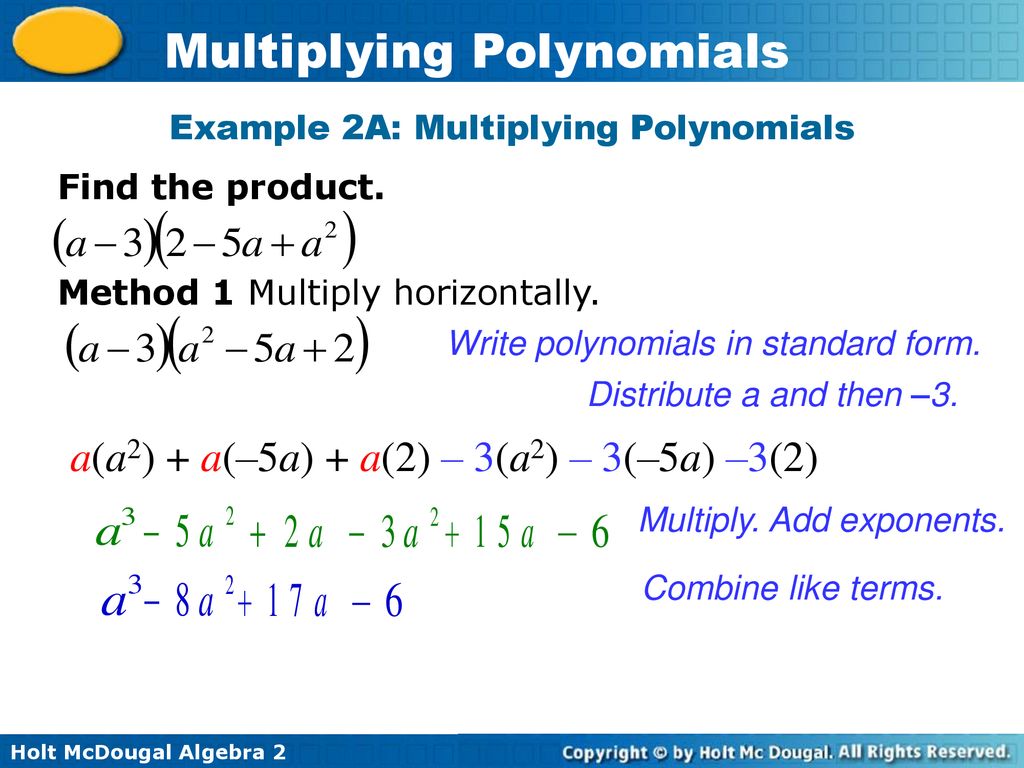
For larger polynomials—such as multiplying a binomial by a trinomial—FOIL no longer applies. Instead, take each term of the first polynomial and distribute it across the entire second polynomial, then combine all like terms.
How to Factor Polynomials
Factoring is the reverse process of multiplication. Instead of expanding an expression, your goal is to break a polynomial down into a product of simpler polynomials. Think of it like finding the prime factorization of a number, but with variables.
Step 1: Always Factor Out the Greatest Common Factor (GCF)
Before trying any advanced factoring techniques, look at all the terms in the polynomial to see if they share a common numerical coefficient or variable. Factor this GCF out first to simplify the rest of the problem.
Example: Factor $4x^3 - 8x^2 + 12x$
- The largest number that divides evenly into 4, 8, and 12 is 4.
- Each term contains at least one $x$, so the GCF is $4x$.
- Divide each term by $4x$: $4x(x^2 - 2x + 3)$.
Step 2: Factoring Quadratic Trinomials ($ax^2 + bx + c$)
When $a = 1$, factoring a quadratic trinomial requires finding two numbers that multiply to give you the constant term ($c$) and add up to give you the middle coefficient ($b$).
Example: Factor $x^2 + 7x + 10$
- We need two numbers that multiply to $10$ and add up to $7$.
- Those numbers are $2$ and $5$ (since $2 \times 5 = 10$ and $2 + 5 = 7$).
- Write the factored form: $(x + 2)(x + 5)$.
Step 3: Recognizing Special Products
Memorizing common algebraic patterns can save you a tremendous amount of time. Keep an eye out for these special product forms:
- Difference of Squares: $a^2 - b^2 = (a - b)(a + b)$
- Perfect Square Trinomials: $a^2 + 2ab + b^2 = (a + b)^2$
- Difference of Cubes: $a^3 - b^3 = (a - b)(a^2 + ab + b^2)$
Checking Your Work
One of the best parts about algebra is that you can almost always verify your answers. If you are given a factoring problem and arrive at a solution, multiply your factors back together. If your product matches the original polynomial, your work is correct. Conversely, if you just finished multiplying polynomials, try factoring the result to see if you can cycle back to the starting expression.
Conclusion
Gaining fluency in algebraic manipulations takes practice. By understanding the core mechanics of distribution and reversing those steps to find common factors and roots, you will build the confidence needed to tackle complex equations. Keep practicing with different types of binomials and trinomials, and these steps will soon become second nature.