How to Write 8 as a Fraction (Step-by-Step Guide)
When studying mathematics, you frequently encounter whole numbers that need to be converted into fractions for algebraic equations, multiplication, or division. If you are wondering how to write 8 as a fraction, the process is surprisingly straightforward and forms the foundation of more advanced arithmetic.
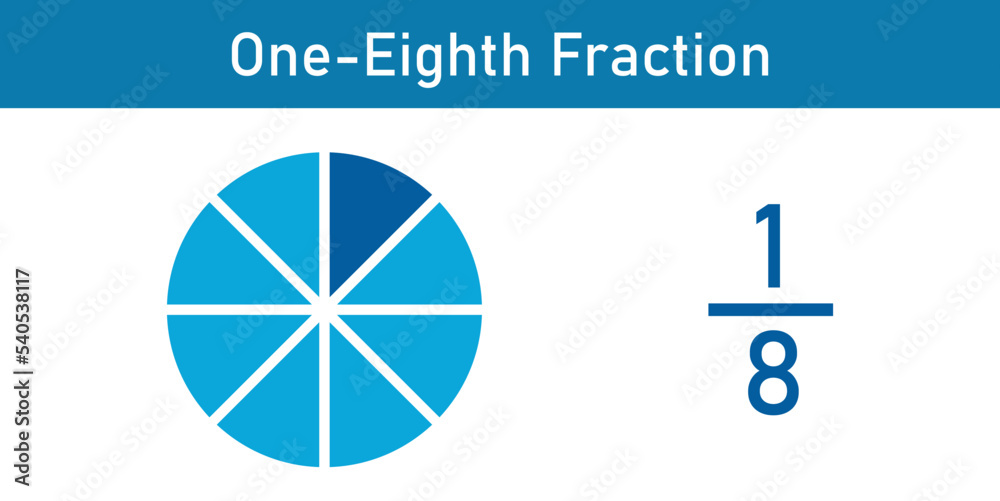
Whether you are helping a student with homework, programming a calculator, or brushing up on basic math skills, understanding the relationship between whole numbers and fractions is essential. Let's break down the different ways to represent the number eight as a fractional value.
Understanding 8 as a Fraction
Every whole number can be expressed as a fraction by placing that number over a denominator of 1. Because the denominator represents the number of equal parts that make up a whole, a denominator of 1 means you have 8 whole items that are undivided.
Therefore, the simplest and most direct way to write 8 as a fraction is:
8 / 1
In this expression, 8 is the numerator (the top number), and 1 is the denominator (the bottom number). Because any number divided by 1 remains unchanged, 8 ÷ 1 equals 8. This makes 8/1 mathematically identical to the whole number 8.
Other Ways to Express 8 as a Fraction
While 8/1 is the most fundamental representation, you can create an infinite number of equivalent fractions by multiplying or dividing both the numerator and the denominator by the same non-zero number. This is a crucial skill when you need to find a common denominator for adding or subtracting fractions.
Here are several common equivalent fractions for the number 8:
- 16 / 2 (multiplied by 2)
- 24 / 3 (multiplied by 3)
- 32 / 4 (multiplied by 4)
- 40 / 5 (multiplied by 5)
- 80 / 10 (multiplied by 10)
- 160 / 20 (multiplied by 20)
To verify that any of these fractions equal 8, simply divide the numerator by the denominator. For example, 32 ÷ 4 = 8, and 80 ÷ 10 = 8.
Converting 8 into Improper Fractions
In algebra and advanced arithmetic, you often need to convert whole numbers into improper fractions with specific denominators. An improper fraction is a fraction where the numerator is greater than or equal to the denominator.

To convert 8 into an improper fraction with any desired denominator, multiply that desired denominator by 8, and place the result over that same denominator.
Formula: (8 × Denominator) / Denominator
Let's look at a few examples:
- Denominator of 3: (8 × 3) = 24. The fraction is 24/3.
- Denominator of 7: (8 × 7) = 56. The fraction is 56/7.
- Denominator of 12: (8 × 12) = 96. The fraction is 96/12.
This technique is especially useful when you are adding a whole number like 8 to a proper fraction, such as 3/4. By converting 8 into a fraction with a denominator of 4 (which is 32/4), you can easily add 32/4 + 3/4 to get 35/4.
Using 8 in Mixed Numbers
Sometimes, 8 appears as the whole number component in a mixed number, which combines a whole number and a fraction (for example, 8 ½). While mixed numbers are common in daily life—such as measuring inches or ingredients in a recipe—they are often converted into improper fractions for mathematical calculations.
To convert a mixed number like 8 ½ into a single improper fraction, use this simple formula:
(Whole Number × Denominator) + Numerator
Let's convert 8 ½ step-by-step:
- Multiply the whole number (8) by the denominator (2): 8 × 2 = 16.
- Add the numerator (1) to that product: 16 + 1 = 17.
- Place that result over the original denominator (2).
The resulting improper fraction is 17/2. Using this same method, 8 ¾ becomes 35/4, and 8 ⅓ becomes 25/3.
Practical Applications of Fractions
Knowing how to manipulate whole numbers into fractional forms is vital for several real-world scenarios:
- Cooking and Baking: Scaling recipes up or down often requires multiplying whole ingredients (like 8 cups of flour) by fractional multipliers.
- Construction and Carpentry: Measuring lumber or hardware frequently involves combining whole units of measurement with fractional inches.
- Algebraic Equations: Solving equations with variables often requires clearing denominators, making whole-number fraction conversions a daily necessity.
By keeping the simple rule in mind—that any whole number can be put over 1—you can easily solve math problems involving the number 8 and any other integer.