Hull Pottery Value Guide: Identification & Prices
Founded in 1905 in Crooksville, Ohio, the A.E. Hull Pottery Company produced some of the most recognized and beloved decorative ceramics of the twentieth century. From delicate pastel floral vases to the iconic Little Red Riding Hood line, Hull pieces remain a staple of American art pottery collecting. Whether you inherited a family heirloom or spotted a pastel ewer at an estate sale, this hull pottery value guide will walk you through identification marks, the most sought-after patterns, condition factors, and realistic market values.

The History Behind Hull Pottery
Addis Emlin Hull established the company initially to produce utilitarian stoneware, tiles, and garden pottery. By the 1920s, Hull expanded into decorative art pottery to meet growing consumer demand. The company reached peak popularity during the 1940s with its soft matte-finish floral lines, characterized by pastel gradients and embossed blossoms.
In 1950, disaster struck when a catastrophic flood and subsequent fire destroyed the Crooksville plant. The factory was rebuilt and reopened in 1952 with updated equipment, marking a noticeable shift from the company's early matte glazes to high-gloss, mid-century finishes and durable dinnerware. Hull eventually ceased operations in 1986 due to increasing competition from foreign imports, making authentic pieces limited and collectible today.
How to Identify and Date Hull Pottery
Accurate identification is the first step in assessing value. Hull changed its manufacturing marks multiple times across its 81-year history, making it relatively straightforward to determine production eras.
Pre-1950 Matte Era Marks
Between the late 1930s and 1950, Hull produced its most celebrated floral art pottery. Most pieces from this era feature an incised mark pressed directly into the clay base:
- Hull Art U.S.A.: Usually incised along with a pattern letter code and a size indicator. For example, a mark reading
Hull Art U.S.A. W-1-5 ½"denotes the Water Lily line ("W"), shape number 1, standing 5.5 inches tall. - H inside a circle: Occasionally found on earlier utility wares and early art pottery from the 1920s and 1930s.
Post-1950 Marks
Following the 1952 factory rebuild, marking conventions shifted alongside production styles:
- Script Mark: The word "hull" written in lowercase cursive script, often accompanied by "U.S.A." or "oven proof."
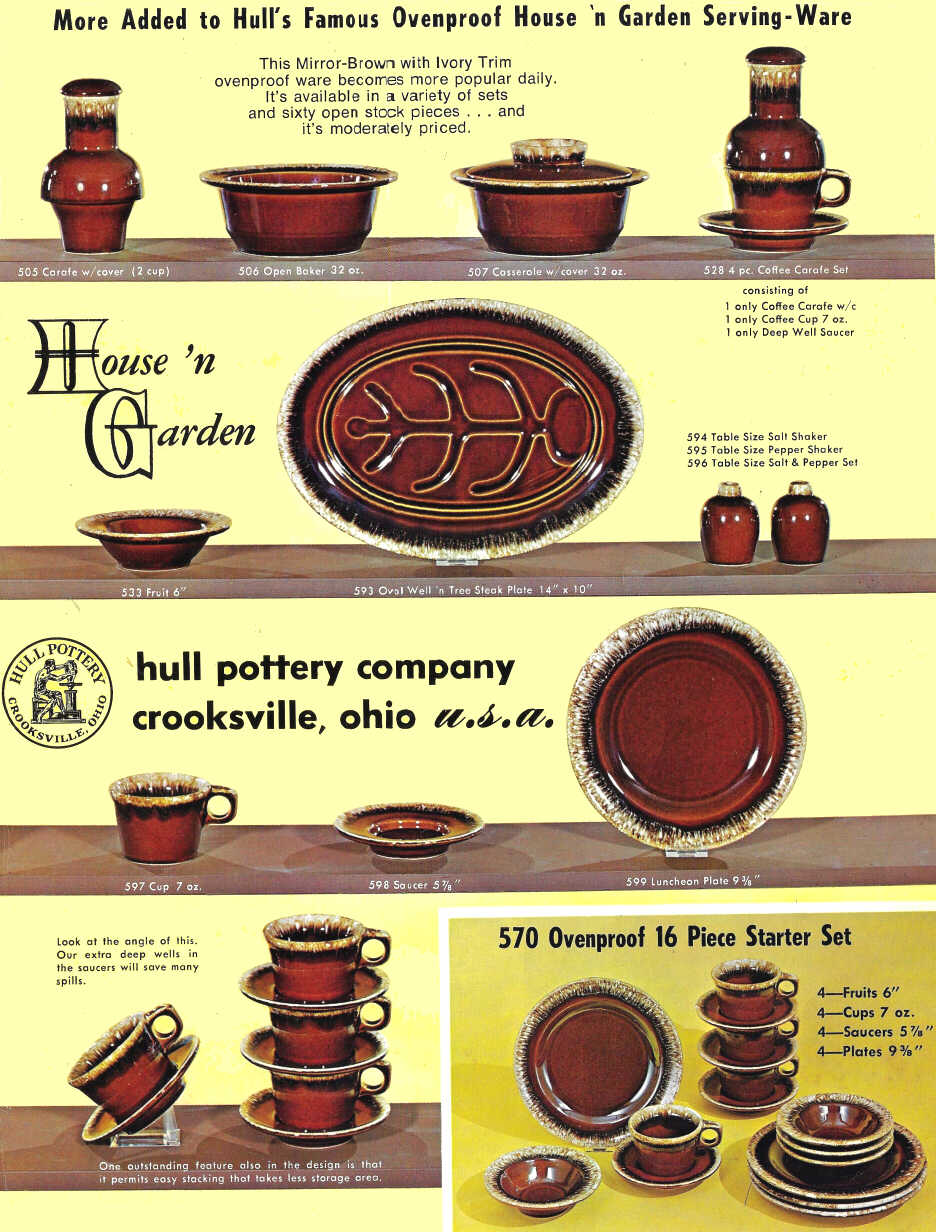
- Block Letters: Raised or incised capital letters reading "HULL" or "HULL U.S.A." commonly seen on later lines like House 'n Garden and Brown Drip.
Watch Out for Reproductions
Because Hull remains popular, foreign reproductions flooded the secondary market starting in the 1990s. Fake pieces often have blurry mold details, muddy paint transitions, and incorrect bottom marks. On genuine Hull, bottom marks are cleanly stamped or incised. If the lettering appears sloppy, uneven, or reads "Hull Art U.S.A." on a glossy, poorly molded piece, proceed with caution.
Most Valuable Hull Pottery Lines
Not all Hull pottery commands high prices. Value is heavily dictated by pattern rarity, aesthetics, and collector demand. Here are the primary lines that drive the collector market.
1. Little Red Riding Hood (Patented 1943)
Hull's Little Red Riding Hood novelty line is arguably its most famous creation. While Hull created the blanks, many blanks were decorated and distributed by the Regal China Company. Figurals, cookie jars, bank jars, and salt-and-pepper shakers featuring the character are intensely collected.

- Common Pieces: Standard cookie jars ($150–$300)
- Rare Variants: Pieces featuring open-basket designs, gold luster trim, or unusual apron decals like the pointsettia or Dutch motif ($400–$900+)
2. Bow Knot (1949)
Introduced shortly before the 1950 fire, Bow Knot features embossed ribbons tied in graceful loops amidst soft floral sprays. Because production was cut short by the factory blaze, authentic Bow Knot pieces are harder to find and represent some of the highest-value floral art pottery Hull produced.
- Ewers and Large Vases: $150–$450 depending on height
- Teapots and Baskets: $120–$275
3. Magnolia (1946–1947)
Magnolia is one of Hull's most recognized pastel floral lines, displaying large, raised pink and white magnolia blossoms set against background gradients of muted pink, blue, or yellow. Its timeless look keeps it in steady demand.
- Wall Pockets and Vases: $60–$180
- Large Centerpiece Jardinières: $175–$350
4. Water Lily (1948)
Water Lily stands out for its dramatic mold details, showing wide blossoms resting above aquatic lily pads. Produced in soft pink, blue, and rich yellow-brown colorways, it offers high display appeal for collectors.
- Planters and Small Urns: $40–$85
- Twin-Handled Ewers and Double Vases: $120–$250
5. Ebb Tide and Woodland (Mid-1950s)
These post-fire lines departed from pastels, incorporating organic mid-century modern aesthetics. Ebb Tide features ocean motifs like seashells, sea horses, and fish finished in high-gloss gradients. Woodland combined matte bodies with glossy accents.
- Ebb Tide Planters: $40–$95
- Woodland Console Bowls and Figural Vases: $50–$140
6. Brown Drip / House 'n Garden (1960s–1980s)
Brown Drip dinnerware features a deep brown glossy glaze crowned with foamy white drip accents. While extremely durable and charming for rustic kitchen setups, it was produced in massive quantities. As a result, individual plates, mugs, and bowls generally sell for $8–$20 each, with complete sets or specialized covered casseroles fetching $75–$150.
Hull Pottery Value Guide: Current Price Ranges
Use the following pricing table as a baseline for genuine pieces in excellent to mint condition.
| Pattern Line | Era | Finish | Typical Price Range |
|---|---|---|---|
| Little Red Riding Hood (Cookie Jars/Banks) | 1943–1950s | Gloss / Hand-Painted Decals | $150 – $800+ |
| Bow Knot (B-Series) | 1949 | Matte Pastel | $100 – $450 |
| Magnolia (H-Series) | 1946–1947 | Matte Pastel | $50 – $350 |
| Water Lily (L-Series) | 1948 | Matte Pastel | $40 – $250 |
| Wildflower (W-Series) | 1942–1946 | Matte Pastel | $40 – $200 |
| Ebb Tide (E-Series) | 1953–1955 | High Gloss | $45 – $175 |
| Brown Drip / Casual Ware | 1960s–1986 | Gloss Kitchenware | $10 – $75 |
Factors That Influence Market Value
Pricing antique pottery requires assessing several variables. Two pieces of the exact same shape and pattern can have wildly different values based on the following criteria:
- Condition: Even minor damage heavily impacts art pottery. Fleabites, hairline fractures, and handle repairs can reduce a piece's value by 50% to 80%. Check rim edges, base rings, and raised flower petals for tiny chips.
- Crazing: Fine hairline crackling in the glaze (crazing) occurs naturally as ceramics age. Light, uniform crazing is acceptable to most collectors, but heavy crazing with dark discoloration underneath the glaze significantly lowers market interest.
- Color Saturation and Mold Crispness: Because Hull pieces were hand-airbrushed and hand-finished, paint jobs vary. Vessels showing vibrant contrast, clean color fades, and crisp mold lines sell at premium prices over pieces with washed-out coloring or muddy detail.
- Form and Utility: Complex shapes—such as cornucopias, multi-handled ewers, and wall pockets—routinely outperform simple round planters and small jardinieres.
- Original Paper Labels: Pieces that still retain original foil or paper manufacturer stickers often command a 20% to 30% premium among dedicated collectors.
Tips for Caring for Hull Art Pottery
Matte-finish Hull pottery is porous compared to modern glazed dinnerware. To protect your collection and maintain its appraisal value:
- Never place art pottery in an automatic dishwasher.
- Avoid submerging pieces in water for extended periods; moisture can seep into crazing lines and cause permanent internal staining.
- Clean using a soft microfiber cloth dipped in lukewarm water and mild dish soap. Avoid bleach, abrasive powders, or chemical solvents.
- Display items out of direct sunlight and away from high-traffic household areas where accidental knocks are likely.