Inside Navy SEALs Submarine Training in the Pacific
Introduction to Undersea Warfare

The vast, deep expanse of the Pacific Ocean presents unique operational challenges for the United States military. When national security demands covert insertion behind enemy lines, the U.S. Navy relies on an elite combination of submariners and maritime commandos. Navy SEALs submarine training in the Pacific represents one of the most demanding pipelines in the armed forces, bridging the gap between undersea platforms and special operations forces.
Operating in the Indo-Pacific theater requires absolute mastery of stealth, endurance, and technical precision. SEALs do not merely jump out of airplanes or storm beaches; a significant portion of their strategic capability relies on launching from submerged submarines thousands of miles from friendly shores.
The Strategic Importance of the Pacific Theater
The geography of the Pacific dictates a heavy emphasis on maritime and amphibious capabilities. With vast archipelagos, contested littoral zones, and immense distances between landmasses, surface ships can easily be detected by modern radar and satellite constellations. Submarines offer the ultimate invisible transport, and pairing them with Naval Special Warfare operators creates a formidable asymmetric advantage.
Training in this region prepares operators for real-world scenarios involving strategic reconnaissance, direct action, and unconventional warfare. The unpredictable Pacific weather, deep thermoclines, and complex ocean currents make local training environments indispensable for building muscle memory.
Core Components of Navy SEALs Submarine Training in the Pacific
Integrating special operations forces with nuclear-powered fast-attack or guided-missile submarines requires intense coordination. Operators must learn how to live, work, and exit from cramped undersea vessels while maintaining combat readiness.
Dry Deck Shelter (DDS) Operations
One of the most critical elements of modern undersea insertion is the Dry Deck Shelter. The DDS is a modular, detachable hyperbaric airlock system affixed to the top of a modified submarine hull. It allows SEALs to exit and re-enter the submarine while it remains submerged.
- DDS Preparation: Operators stage their gear, rebreathers, and navigation boards inside the cramped confines of the shelter before flooding it.
- Lock-Out Procedures: Divers equalize pressure, open the outer hangar doors, and exit into the murky depths of the Pacific.
- Equipment Management: Teams manage heavy gear, underwater propulsion vehicles, and communication arrays in total darkness.
Advanced SEAL Delivery System (ASDS) and UUVs
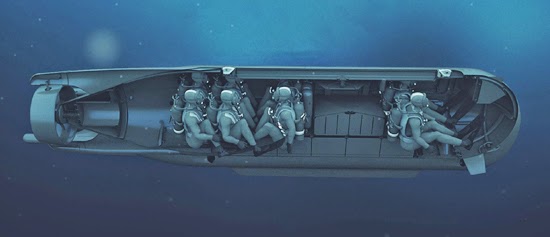
To travel further once outside the submarine, SEALs utilize specialized submersible technology. While older systems like the ASDS have evolved, modern operators continue to test and deploy cutting-edge undersea mobility tools.
Video: US Navy SEALs Mini Submarine in Action

Unmanned Underwater Vehicles (UUVs) are also frequently deployed during Pacific training exercises. These autonomous or remote-controlled drones map enemy harbors, clear naval mines, and gather critical intelligence without risking human lives during the initial reconnaissance phase.
The Training Pipeline: From Classroom to Open Ocean
Before ever stepping foot inside a submarine for a tactical deployment, candidates must pass rigorous preparatory phases. The journey begins long before the submarine submerges off the coast of Hawaii or Washington state.
- Basic Underwater Demolition/SEAL (BUD/S): The legendary selection course where candidates build foundational physical and mental toughness.
- SEAL Qualification Training (SQT): Advanced tactical training covering weapons handling, demolition, and maritime operations.
- Platoon-Level Integration: Once assigned to a team, operators begin joint training cycles with submarine crews, focusing specifically on lock-out procedures and submerged equipment staging.
During live-fire and tactical exercises in the Pacific, platoons practice continuous 24-hour operations. They must transition instantly from the freezing, high-pressure environment of a submarine lock-out to high-speed combat rubber raiding craft (CRRC) operations on the surface.
Overcoming Environmental and Psychological Challenges
Operating inside a submarine for weeks at a time tests human psychology. Add the element of diving into open, shark-infested, or contested Pacific waters at depths exceeding 100 feet, and the margin for error shrinks to zero.
SEALs train extensively in mixed-gas diving, utilizing closed-circuit rebreathers that emit no bubbles. This ensures total stealth. However, breathing pure oxygen or mixed gases at depth introduces risks like oxygen toxicity and nitrogen narcosis. Rigorous medical screening and constant cross-monitoring among team members keep these operational hazards in check.
The Future of Undersea Special Operations
As geopolitical dynamics shift toward the Indo-Pacific, the demand for stealthy maritime insertion capabilities continues to grow. The U.S. Navy regularly updates its submarine fleet and special operations interfaces to counter emerging anti-access/area-denial (A2/AD) networks.
Future training exercises increasingly incorporate joint-domain operations, linking submerged SEAL platoons with cyber warfare units, stealth aviation, and surface fleets. This holistic approach ensures that America's maritime commandos remain ready to deter conflict and execute high-risk missions anywhere in the world's largest ocean.
Conclusion
Navy SEALs submarine training in the Pacific is a masterclass in military coordination, technical engineering, and human endurance. By turning the deep ocean into a covert highway, these elite operators maintain a strategic edge that keeps the nation secure. Through relentless drills in Dry Deck Shelters, cold-water diving, and advanced submersible tech, the SEAL teams prove that mastery of the deep is essential to modern warfare.