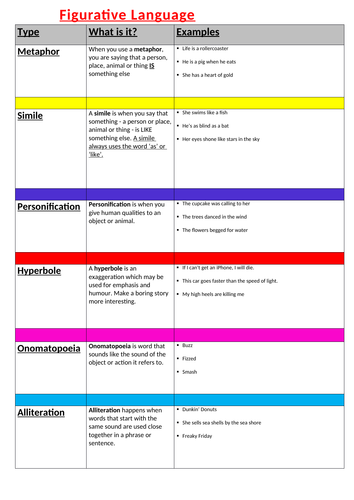
Instantly Download A4 Figurative Language Guides
When students struggle to elevate their descriptive writing, having visual anchor charts within arm’s reach makes all the difference. Whether you are an educator setting up an English classroom, a homeschooling parent, or a writer looking to sharpen your craft, the ability to instantly download A4 figurative language reference sheets provides an immediate, practical boost to daily learning.

Figurative language transforms flat, literal prose into evocative imagery. However, memorizing the subtle distinctions between terms like metaphor, metonymy, and synecdoche takes regular reinforcement. A well-organized A4 printable serves as a reliable desk-side companion that builds student confidence during drafting and editing sessions.
Core Figurative Devices Every Reference Sheet Must Include
A high-quality educational resource should balance clarity with memorable examples. When reviewing or creating an A4 reference sheet, ensure it covers these fundamental categories:
1. Comparisons: Simile, Metaphor, and Analogy
Comparison devices allow writers to explain unfamiliar concepts by linking them to recognizable imagery:
- Simile: An explicit comparison between two distinct things using connective words such as "like" or "as" (e.g., His voice cut through the quiet room like a dull razor.).
- Metaphor: A direct statement asserting that one thing is another, transferring qualities without comparative markers (e.g., The city at dawn was an unspooled ribbon of grey fog.).
- Analogy: An extended comparison designed to demonstrate a logical principle or relationship across multiple points of similarity.
2. Humanization: Personification and Anthropomorphism
Giving non-human entities living qualities enlivens inanimate settings and abstract emotions:
- Personification: Attributing human emotions, actions, or characteristics to animals, objects, or ideas in a figurative sense (e.g., The floorboards groaned under the weight of the trunk.).
- Anthropomorphism: A literal device where animals or objects behave as actual humans, common in fables and character design.
3. Emphasis: Hyperbole and Understatement
Scale and contrast generate emotional weight and humor:
- Hyperbole: Purposeful, dramatic exaggeration not meant to be taken literally (e.g., She had explained the punctuation rule ten thousand times before lunch.).
- Understatement (Meiosis/Litotes): Downplaying the significance or size of an event to create irony or emphasize reality through restraint (e.g., Calling the sudden flash flood "a bit damp" was typical of his humor.).
4. Sound and Phonics: Alliteration, Onomatopoeia, and Assonance
Auditory devices give rhythm and musical texture to written poetry and prose:
- Onomatopoeia: Words that phonetically imitate the sound they describe (e.g., hiss, clatter, thud, sizzle).
- Alliteration: The repetition of identical consonant sounds at the beginning of adjacent or closely connected words (e.g., The bitter breeze blustered across the bay.).
- Assonance: The repetition of internal vowel sounds within nearby words to establish subtle internal cadence.
Why Instantly Download A4 Figurative Language Sheets for Classrooms?

The standard A4 page size (210 × 297 mm) is the international standard for school binders, student exercise books, and standard desktop printers. Choosing to instantly download A4 figurative language materials offers several practical advantages over large wall charts alone:
- Immediate Accessibility: Wall posters located across the room can be difficult for students with vision impairments or those sitting in rear desks to read. Having a personal copy slipped into a binder sleeve eliminates visual barriers.
- Interactive Notebook Integration: An A4 page can be trimmed down or folded into an interactive lapbook, notebook insert, or glued directly into writing journals for ongoing reference.
- Focused Small-Group Tasks: Laminated A4 sheets work well during guided reading and peer-review stations, allowing learners to audit their partner’s work against specific stylistic targets.
- Cost-Effective Printing: Unlike specialized poster sizes that require commercial printing services, A4 documents print seamlessly on school photocopiers in full color or grayscale.
Actionable Strategies for Using A4 Reference Sheets in Writing Workshops
Distributing a reference sheet is only the first step. To ensure students actively apply figurative devices rather than ignoring the handout, integrate it into structured writing exercises:
The "Spot and Swap" Revision Exercise
Have students highlight three weak, generic verbs or adjectives in their rough draft. Using the A4 guide, they must swap one weak phrase for a concise simile, transform another into personification, and rewrite the third using strong sensory onomatopoeia. This turns passive knowledge into direct editorial revision.
Device Scavenger Hunts
During novel studies or close reading of mentor texts, direct students to keep their A4 chart flat on the desk. Challenge them to find authentic examples in the published text that match each device on their page. This cements the understanding that figurative language is not just a worksheet exercise, but an authentic tool used by professional authors.
The "Show, Don't Tell" Challenge
Give learners a bland statement, such as "He was very angry." Using their A4 prompt sheet, ask them to write two sentences that communicate that emotional state without using the words "angry," "mad," or "furious." Suggesting personification (e.g., Rage burned behind his eyes) or hyperbole immediately elevates the sophistication of their work.
What to Look for Before Downloading Your Printables
Not all educational printables are created equal. Before downloading and printing in bulk, evaluate the layout using these criteria:
- Visual Balance: The page should not be overcrowded. High-density text discourages reluctant readers. Look for white space, clear category borders, and distinct color-coding.
- Font Legibility: Sans-serif, dyslexia-friendly, or clean editorial fonts ensure definitions remain legible even when printed in smaller point sizes.
- Modern, Relatable Examples: Outdated or archaic idioms confuse modern students. Quality resources use fresh examples that resonate with contemporary readers while retaining classic definitions.
- High Resolution: Ensure the download file is a vector-based PDF or 300 DPI image so text does not blur when printed on high-speed laser equipment.
Final Thoughts
Equipping students with explicit figurative tools removes the guesswork from creative writing. When you select clean, well-structured A4 printable guides, you provide your learners with a tangible scaffold that improves vocabulary, enhances analytical reading skills, and inspires richer, more expressive writing across every grade level.