IRS SS-8 Guide: Employee vs Contractor Status
Worker classification is one of the most contentious issues in federal tax law. When an individual is treated as an independent contractor (Form 1099) rather than an employee (Form W-2), significant tax and legal consequences follow. If you are a business owner unsure how to categorize a role, or a worker who believes you have been improperly classified, filing an IRS SS-8 form provides an official mechanism to settle the issue directly with the federal government.

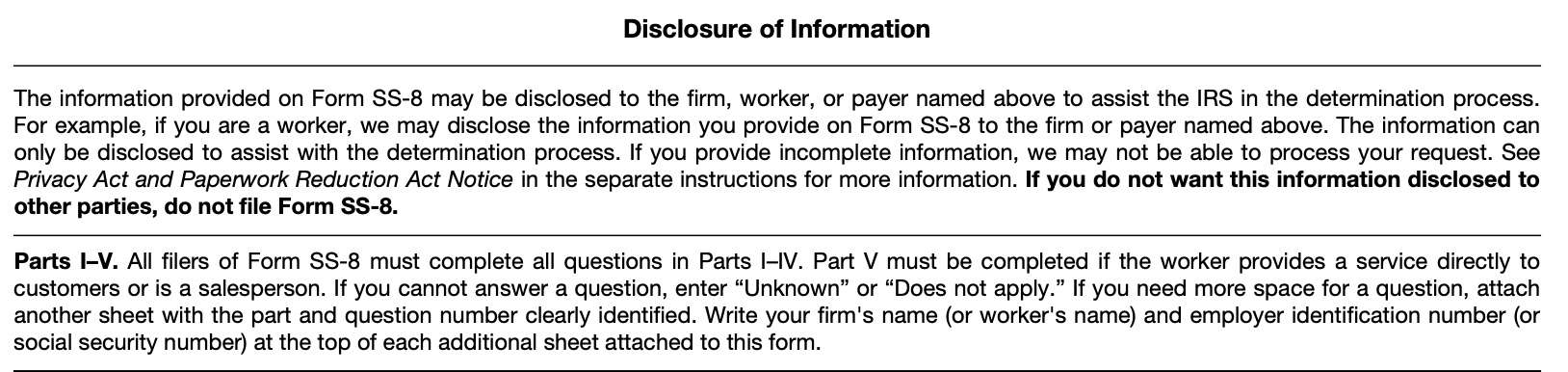
IRS Form SS-8, formally titled Determination of Worker Status for Purposes of Federal Employment Taxes and Income Tax Withholding, requests that the Internal Revenue Service review the facts of a working relationship and issue a formal ruling. Below is an exhaustive look at how the SS-8 process works, when you should file, and the potential risks involved.
What Is IRS Form SS-8?
Form SS-8 is a multi-page questionnaire used by the IRS to establish whether a worker should be treated as an employee or an independent contractor for federal employment tax purposes. The IRS does not base this determination on job titles, internal policies, or private agreements between parties; instead, it relies on common-law rules established over decades of tax jurisprudence.
These common-law rules evaluate three primary categories of evidence:
- Behavioral Control: Does the business have the right to direct and control how the worker does the task? This includes instructions on when, where, and how to work, what tools or equipment to use, and whether detailed training is provided.
- Financial Control: Does the business have the right to direct or control the financial aspects of the worker's activities? Factors include unreimbursed business expenses, investment in facilities or equipment, the opportunity for profit or loss, and how the worker is paid (hourly/salary vs. a flat fee).
- Relationship of the Parties: How do the business and the worker perceive their relationship? Factors include written contracts, provision of employee benefits (insurance, pension, paid leave), the permanency of the relationship, and whether the services provided are a key aspect of regular business operations.
Who Should File an IRS SS-8 Form?
Both businesses and workers can file Form SS-8, though their motivations usually differ significantly.
1. Workers Seeking Classification Relief
Workers file the vast majority of SS-8 forms. Typically, a worker files after realizing that being classified as a 1099 contractor requires them to pay Self-Employment Tax (SECA)—which covers both the employer and employee portions of Social Security and Medicare (totaling 15.3%)—in addition to ordinary income tax.
A worker might consider filing Form SS-8 if:
- They are required to work set hours at a specific location dictated by the business.
- They receive direct daily supervision and cannot hire substitutes.
- They were given a Form 1099-NEC but performed duties identical to W-2 colleagues.
- They were denied benefits or overtime due to their contractor label.
2. Employers Seeking Regulatory Certainty
Firms occasionally submit an SS-8 when introducing a novel role or restructuring their workforce. Proactively obtaining an IRS ruling eliminates the risk of future audits, penalties, and back taxes. However, businesses rarely file an SS-8 for an ongoing dispute with an active worker because submitting the form invites direct IRS scrutiny into company payroll records.
Key Sections of Form SS-8
Form SS-8 is detailed and requires precise documentation. It is divided into five parts:
- Part I: General Information: Basic identifying data for both the firm and the worker, the reason for filing, and whether the worker has received payments reported on Form W-2 or 1099.
- Part II: Behavioral Control: Inquiries into who assigns work, how performance is evaluated, whether training is provided, and what procedures must be followed.
- Part III: Financial Control: Questions about who provides tools and supplies, whether expenses are reimbursed, how the worker advertises their services, and whether the worker can realize a financial loss.
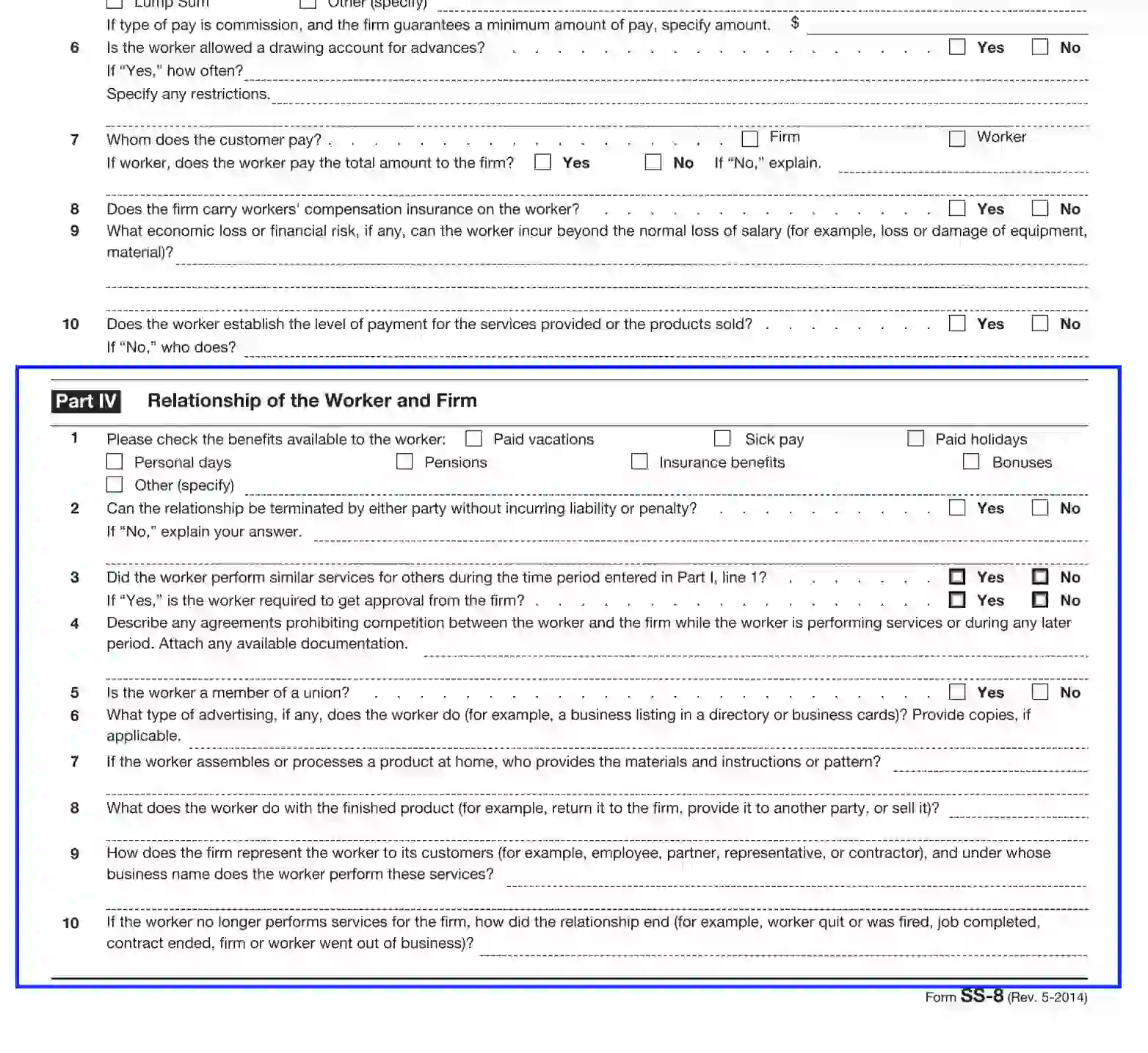
- Part IV: Relationship of the Parties: Information regarding written contracts, termination terms, non-compete clauses, and benefits.
- Part V: Service Providers: Specific questions applicable to leasing companies, sales representatives, and delivery drivers.
The SS-8 Process: What Happens After You File?
Filing an SS-8 initiates a structured administrative process with the IRS, but it is not a quick fix.

Notification and Investigation
When the IRS receives a Form SS-8 from a worker, it assigns the case to an SS-8 technician. The agency will send a copy of the blank form and a formal notice to the employer, requesting their side of the story. The employer is given a strict deadline (usually 30 days) to complete the questionnaire and submit supporting documentation.
The IRS technician then compares the statements from both parties. If there are conflicting statements, the IRS may request additional evidence, such as copies of emails, contracts, time logs, and invoices.
The Determination Letter
Once the review is complete, the IRS issues a formal Determination Letter to both the worker and the firm. This letter states whether the worker is considered an employee or an independent contractor for federal employment tax purposes. The ruling is binding on the IRS for that specific worker and business, provided the facts submitted were accurate.
Timeline Realities
Patience is essential. Because of staffing constraints and the thorough nature of the review, the IRS SS-8 determination process typically takes at least six months, and often up to a year or more. Filing the form does not grant immediate tax relief while the decision is pending.
Strategic Considerations and Risks
Before submitting Form SS-8, both parties must evaluate the secondary effects of an IRS review.
Risks for Workers
- Workplace Retaliation: While federal laws protect employees from retaliation for asserting wage and tax rights, practical friction is common. Employers often terminate contractor relationships once an SS-8 notice arrives. Workers often choose to file only after leaving the company.
- Tax Filing Complications: If your tax return is due while an SS-8 is pending, you cannot simply wait. Workers must file Form 8919 (Uncollected Social Security and Medicare Tax on Wages) alongside Form 1040 to pay only their share of FICA taxes while referencing the pending SS-8 request.
Risks for Employers
- Audit Triggers: If the IRS rules that one worker was misclassified, it frequently opens an inquiry into the classification of all other workers performing similar roles across the entire enterprise.
- Financial Liability: If the worker is determined to be an employee, the employer may be liable for back taxes (FICA, FUTA), failure-to-withhold penalties, and state unemployment insurance contributions.
Alternatives to Filing Form SS-8
Because the SS-8 process is slow and can damage professional relationships, consider alternative avenues when addressing worker classification:
- Direct Negotiation: In some instances, an employer may be unaware of misclassification risks. Presenting IRS guidelines directly to human resources can sometimes result in an immediate transition to W-2 status without IRS involvement.
- Voluntary Classification Settlement Program (VCSP): For employers who recognize they have misclassified a class of workers, the IRS offers the VCSP. This program allows eligible employers to voluntarily reclassify workers as employees for future tax periods while receiving partial relief from past federal employment taxes.
- State Department of Labor Complaints: Many state agencies process misclassification claims significantly faster than the IRS, particularly in states like California, New Jersey, and New York, which enforce strict ABC tests for contractor status.
Final Thoughts
IRS Form SS-8 is an authoritative tool for resolving ambiguous or unfair employment relationships. While the process is slow and adversarial, it provides a definitive, legally supported determination that protects workers from unfair tax burdens and establishes clear ground rules for tax compliance.