Is Mark Cuban a Billionaire? The Truth Behind His Wealth
When people think of modern American entrepreneurship, Mark Cuban is rarely far from the conversation. Known for his energetic presence on ABC’s Shark Tank, his former ownership of the NBA’s Dallas Mavericks, and his outspoken business philosophies, Cuban is a fixture of pop culture and high finance. Yet, casual observers often wonder: is Mark Cuban a billionaire? The unbelievable math behind his wealth reveals a fascinating journey of calculated risks, dot-com timing, and diversified modern investments that keep his net worth comfortably in the multi-billion-dollar tier.

The Short Answer: Yes, Mark Cuban is a Billionaire
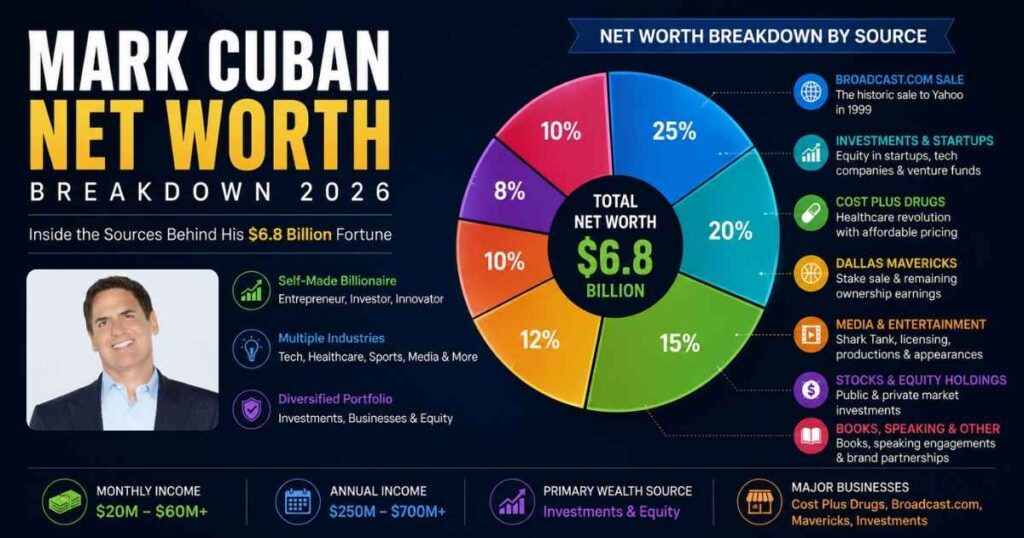
Yes, Mark Cuban is definitively a billionaire. As of recent financial estimates, his net worth hovers around $5.5 billion to $6 billion. But unlike legacy wealth built over generations, Cuban’s fortune was largely self-made, famously accelerating from a working-class upbringing in Pittsburgh, Pennsylvania, to the upper echelons of global wealth in a remarkably short span.
To understand how someone accumulates—and maintains—this level of wealth, you have to look past the superficial headlines and examine the actual math of his biggest liquidity events and ongoing business ventures.
The Unbelievable Math Behind His Wealth
Cuban’s wealth is not tied up in a single product. Instead, it is the result of a compounding chain of tech ventures, media investments, real estate, and venture capital. However, almost every billionaire origin story has a defining moment. For Cuban, that moment came at the height of the late-1990s dot-com boom.
1. The Broadcast.com Jackpot
The foundation of Cuban’s billionaire status was forged in 1999 when Yahoo! acquired Broadcast.com—an internet radio company Cuban co-founded with Todd Wagner—for a staggering $5.7 billion in stock. Cuban’s personal share of the payout amounted to roughly $1 billion before taxes.
What makes this sale legendary in financial lore is not just the price tag, but the timing. Cuban recognized that the dot-com market was an unsustainable bubble. Immediately after receiving his Yahoo! stock, he famously hedged his position by purchasing a "collar" (a combination of put and call options) to protect himself against a market crash. When the dot-com bubble burst shortly thereafter, Cuban locked in his gains, walking away with nearly $1.4 billion in liquid cash and protected securities. Without that single masterclass in risk management, he might have been just another footnote in tech history.
2. The Dallas Mavericks Masterclass

In 2000, shortly after cashing out of Broadcast.com, Cuban purchased the Dallas Mavericks for $285 million. At the time, the team was a perennial loser with a lackluster fan base. Cuban injected energy, money, and modern management into the franchise, transforming it into a first-class organization that won an NBA Championship in 2011.
In late 2023, Cuban sold a majority stake in the Mavericks to the Adelson family at a valuation of approximately $3.5 billion. By retaining a minority stake and operational control over basketball operations, Cuban turned a $285 million investment into a multi-billion-dollar payday, further cementing his billionaire status.
Shark Tank and Modern Venture Capital
While his early tech and sports exits provided the bulk of his capital, Cuban actively grows his wealth through venture capital. Since joining Shark Tank in 2011, he has invested millions of dollars into hundreds of small businesses.
While television entertainment often highlights flashy products, Cuban’s portfolio includes several breakout successes that yielded massive returns:
- Ring: Although famously passed on by most sharks, Cuban invested in other high-growth home and consumer goods that scaled rapidly.
- Tipsy Elves: The novelty apparel company became a multi-million-dollar seasonal giant.
- Plated and BeatBox Beverages: Food and beverage startups that secured major distribution and subsequent acquisitions.
Beyond the TV screen, Cuban launched Mark Cuban Cost Plus Drug Company, an online pharmacy designed to bypass middlemen and provide generic medications at transparent, low prices. While built partly with a social mission in mind, the disruptive business model captures significant market share in the massive healthcare sector.
How Does He Manage His Money Today?
Maintaining a multi-billion-dollar fortune requires a disciplined approach to asset allocation. Cuban’s wealth is spread across several distinct buckets:
- Cash and Liquid Securities: Following his Yahoo! windfall, Cuban has always maintained a healthy buffer of liquid assets, allowing him to pounce on market opportunities or real estate without liquidating core holdings.
- Real Estate: He owns substantial residential and commercial properties, including estates in Dallas and Laguna Beach, California.
- Venture Investments: Through his fund and private portfolio, he holds equity in dozens of software, artificial intelligence, and green-energy startups.
Conclusion
So, is Mark Cuban a billionaire? Absolutely. The math behind his wealth demonstrates that he is not just a lucky entrepreneur who hit the jackpot in the dot-com era, but a savvy strategist who protected his capital and multiplied it through sports ownership, shrewd media investments, and continuous venture capitalism. By combining bold risk-taking with sharp defensive financial planning, Cuban has ensured his place on the billionaire list for the long haul.