Is Valve Corporation Hitting Record Revenue?
Few companies in tech command as much influence with as little public transparency as Valve Corporation. As a private entity steered by co-founder Gabe Newell, the company does not release quarterly earnings calls, annual shareholder reports, or audited balance sheets. Yet across the industry, an undeniable question keeps surfacing: Is Valve Corporation Hitting Record Revenue? Here’s What You Need to Know!
By piecing together recent unsealed antitrust court filings, SteamDB platform data, and third-party market intelligence, industry analysts have reached a clear consensus. Valve is not just growing; it is likely experiencing the most lucrative period in its 28-year history. Here is a deep dive into the financial numbers, key revenue drivers, and unprecedented operational efficiency behind Valve’s business empire.
The Financial Black Box: How We Know Valve’s Performance
Because Valve is not publicly traded, evaluating its performance requires examining triangulated data sources rather than standard SEC filings. Historically, observers relied on estimates from Steam Spy or high-level publisher commentary. However, two recent developments have provided unprecedented clarity into Valve's balance sheet:
- Unsealed Court Filings: The ongoing antitrust litigation filed by Wolfire Games forced Valve to submit previously confidential internal metrics. Released documents from 2024 revealed internal staffing structures, operational expenses, and gross margins spanning recent operational years.
- Advanced Web Scraping and Telemetry: Modern analytics firms like VG Insights and Gamalytic track public Steam API calls, player reviews, achievement data, and wishlist metrics to model digital game sales with remarkable accuracy.
When these data points are combined with Valve's own public milestone announcements, they reveal a platform processing tens of billions in commerce every year.
Is Valve Corporation Hitting Record Revenue? Here’s What You Need to Know
The short answer is yes. According to data gathered across digital storefront trackers, Steam generated an estimated $9 billion to $10.5 billion in gross game sales in 2023, with projections for 2024 and 2025 pointing even higher.
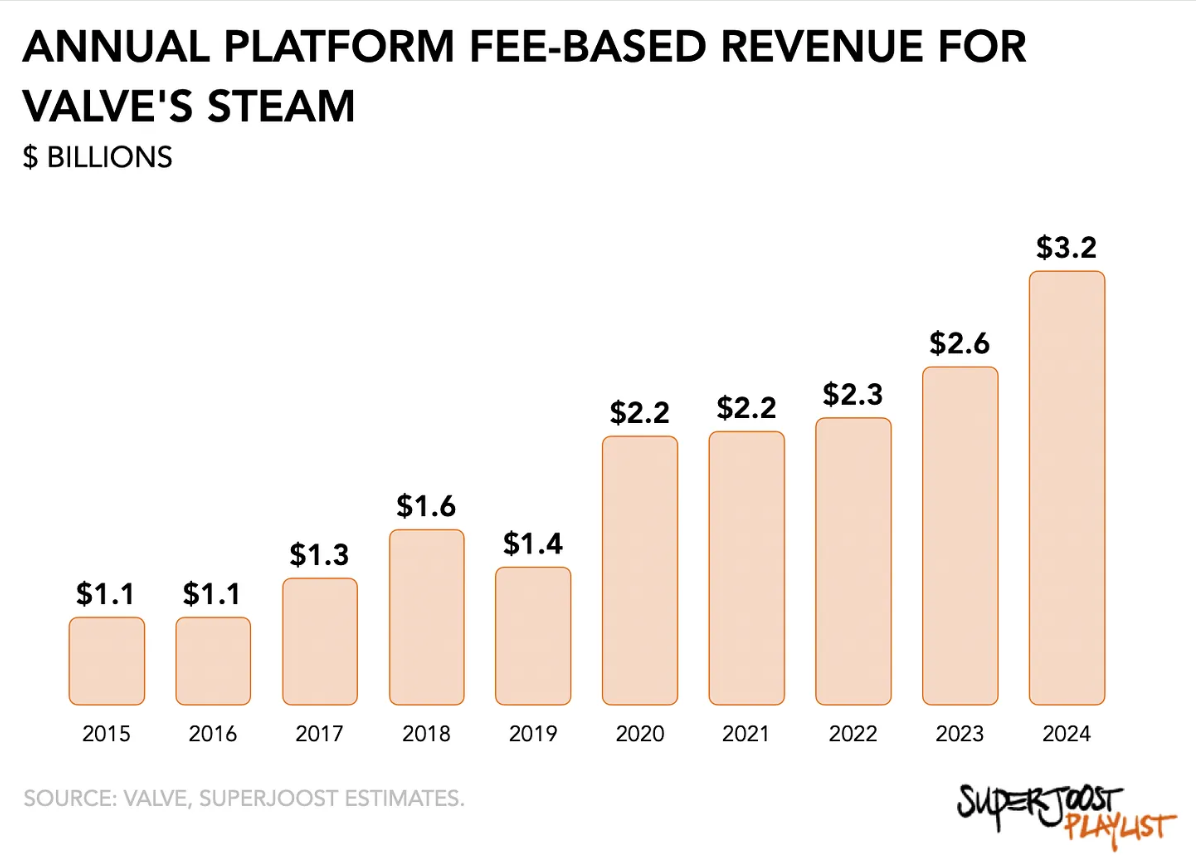
Valve generally collects a 30% commission on digital sales, which scales down to 25% after $10 million in revenue and 20% after $50 million. Even after factoring in tiered discounts for AAA publishers and localized payment processing overhead, Valve's net cut from third-party distribution alone sits securely in the $2.5 billion to $3.5 billion range annually.
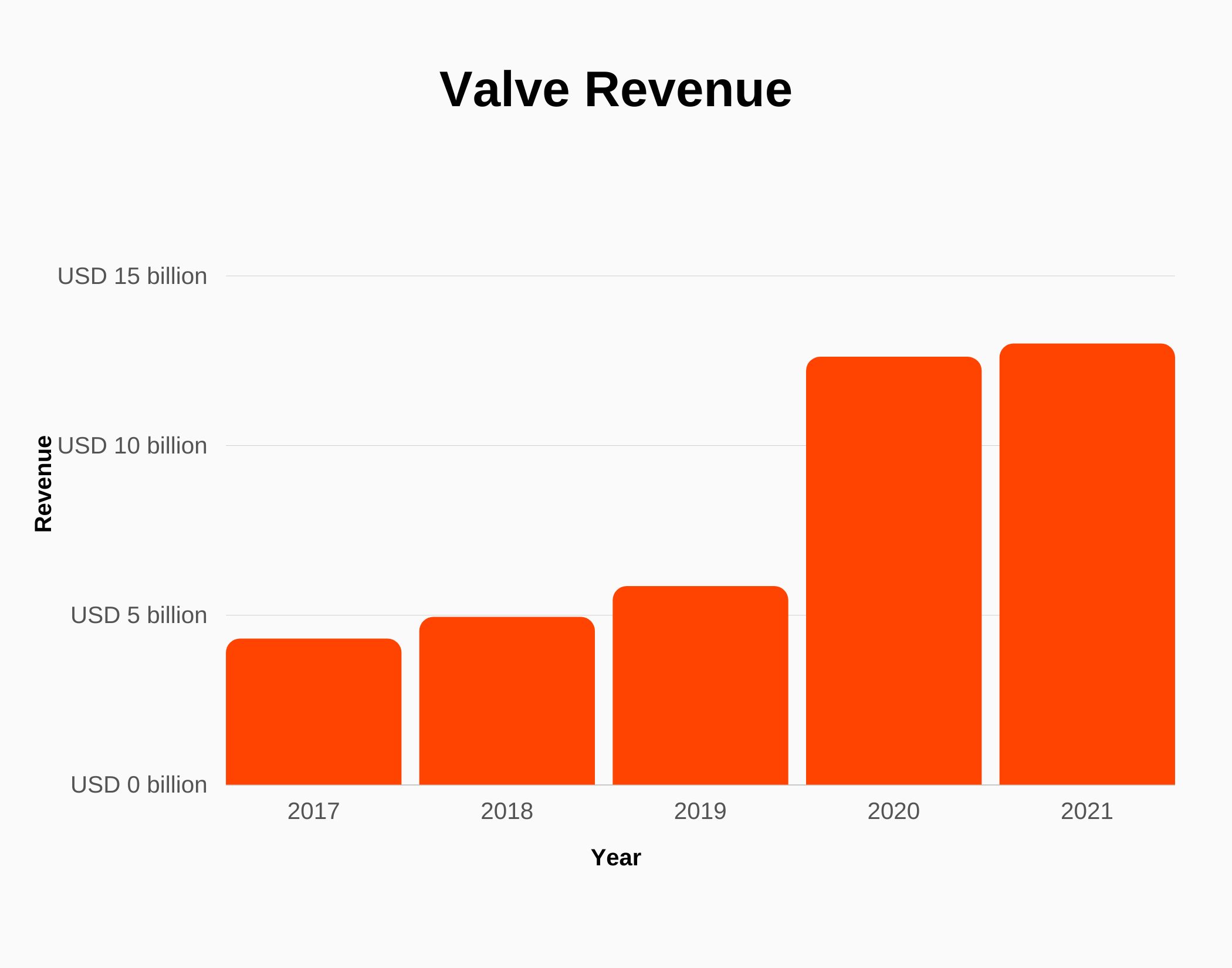
Crucially, that figure does not include Valve's first-party game monetization, marketplace transaction fees, or hardware sales. When factoring in these verticals, industry researchers estimate Valve’s total net revenue exceeds $4 billion to $5 billion per year, an all-time peak for the Bellevue-based company.
The Primary Catalysts Behind the Surge
Valve's record revenue is not accidental; it is the culmination of strategic shifts across PC gaming ecosystems, hardware adoption, and live-service monetization.
1. Relentless Growth in Active Users
Steam remains the premier digital storefront on PC. In early 2020, the platform averaged 18 to 20 million peak concurrent users. By late 2024 and into 2025, that metric shattered records, surpassing 38 million concurrent users. Steam boasts over 130 million monthly active players—a player base that outpaces many dedicated console networks.
2. The Microtransaction Powerhouse: Counter-Strike 2
While third-party sales form Valve's revenue baseline, its first-party live-service games print pure profit. Counter-Strike 2 (CS2) continues to set records in player engagement and in-game economy spending.
- In 2023 alone, players unlocked an estimated 400 million weapon cases.
- At roughly $2.50 per key, case openings generated an estimated $980 million in gross revenue from a single mechanic.
- Valve also collects a 5% platform fee plus an additional 10% game-specific fee on all Community Market transactions, taking a frictionless cut whenever rare weapon skins trade hands.
Coupled with Dota 2 battle passes and seasonal events, Valve’s internal software division functions as an immensely profitable self-funding entity.
3. Mainstream Penetration of the Steam Deck
When Valve launched the Steam Deck in 2022, skeptics questioned whether it would follow the path of the discontinued Steam Machines or Steam Controller. Instead, the Steam Deck pioneered the modern handheld gaming PC category. With several million units sold worldwide and the launch of the premium Steam Deck OLED, the hardware lineup has created a substantial new revenue stream while locking users deeper into the Steam ecosystem.
4. The Return of Major Publishers
Between 2018 and 2021, major publishers like Electronic Arts, Ubisoft, Activision, and Bethesda attempted to bypass Valve’s 30% take-rate by launching proprietary launchers or signing exclusivity deals with the Epic Games Store. That resistance has largely collapsed.
Recognizing the unmatched size of Steam’s audience, nearly every major Western and Japanese publisher has returned to Steam with day-and-date releases. Even Sony Interactive Entertainment now routinely ports its flagship PlayStation titles to Steam, transferring hundreds of millions of dollars directly through Valve's gateway.
Unrivaled Operational Efficiency: Revenue Per Employee
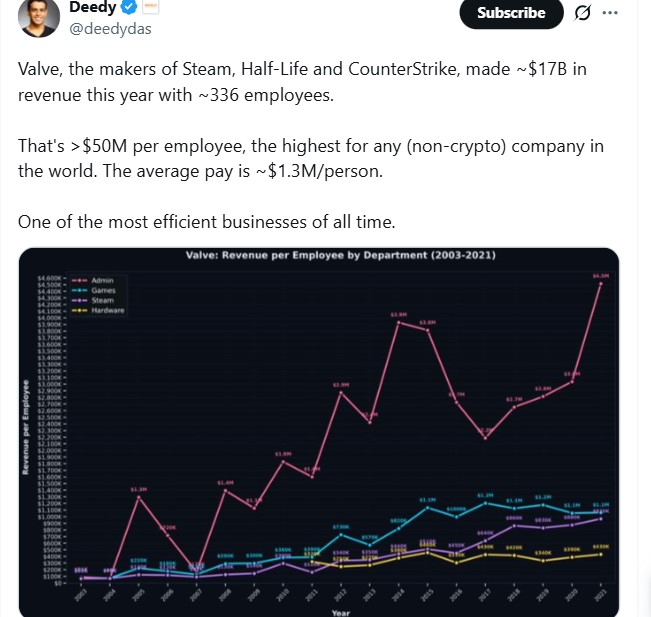
What makes Valve’s financial performance truly unprecedented is not just the top-line revenue, but the structure of the organization producing it. Data released during the Wolfire litigation exposed Valve’s internal headcount through 2021:
- Steam Division: ~79 employees
- Game Development: ~181 employees
- Hardware Division: ~41 employees
- Administrative Staff: ~35 employees
- Total Headcount: Roughly 336 full-time workers
Even if Valve’s headcount has expanded slightly to 350 or 400 employees today, generating billions in operating income with fewer than 500 staff members translates to an estimated $10 million to $15 million in net revenue per employee. For perspective, mega-cap tech giants like Apple, Alphabet, and Microsoft typically generate between $1.5 million and $2.5 million per employee. Valve is arguably the most efficient and profitable technology company per capita on Earth.
Are There Any Looming Headwinds?
While the business is performing at its peak, Valve faces several emerging challenges that could influence its financial trajectory over the next decade:
- Antitrust and Platform Fees: Global regulators are scrutinizing digital distribution fees. Valve faces ongoing legal pressure in the United States and the United Kingdom regarding its Most-Favored-Nation (MFN) clauses, which prevent developers from selling games cheaper on rival storefronts.
- Loot Box Legislation: European regulators continue to tighten rules around randomized monetization mechanics. Because Valve relies heavily on case keys in CS2, regulatory bans on loot boxes could impact high-margin revenue streams.
However, because Valve has no public shareholders demanding continuous quarter-over-quarter expansion, the company can absorb market shifts and legal challenges without destabilizing its core business.
The Bottom Line
By all measurable metrics, Valve Corporation is operating at the absolute peak of its financial power. Driven by the expansion of global PC gaming, the resilience of third-party platform lock-in, billions in high-margin microtransactions, and hardware innovation, Valve's revenue records are a reflection of an ecosystem with almost no true rivals in the PC space.