Jeffrey Dahmer Crime Scene Photos Graphic: Hidden Evidence
On the humid night of July 22, 1991, two Milwaukee police officers were flagged down by Tracy Edwards, a man with a pair of handcuffs dangling from his wrist. Edwards led the patrolmen to Apartment 213 at 924 North 25th Street, an address that would rapidly become synonymous with one of the darkest chapters in American criminological history. When investigators crossed the threshold, the physical reality they encountered shocked even seasoned homicide detectives. In the decades since, public fascination has spawned countless sensational theories, with many searching online for Jeffrey Dahmer crime scene photos graphic: the evidence they tried to hide, seeking to understand what was captured behind those closed doors and why certain visual records remain tightly controlled.

Far from a sinister government cover-up, the management of the physical and photographic evidence recovered from Dahmer’s residence followed strict judicial, ethical, and forensic protocols. Understanding what transpired requires separating internet folklore from documented criminal justice procedure.
The Discovery of Apartment 213 and the Photographic Record
When Officers Rolf Mueller and Robert Rauth entered Dahmer’s apartment, their initial objective was to retrieve the key to Edwards’ handcuffs. Dahmer was calm, but Mueller’s attention was drawn to an open bedside drawer. Inside lay a knife alongside a collection of instantly recognizable instant camera prints.
Mueller examined the pictures and immediately recognized their horrific nature. They were not ambiguous snapshots; they were methodical, staged visual records documenting dismemberment, human remains, and intermediate stages of Dahmer's crimes. Those photographs provided the immediate probable cause needed to arrest Dahmer on the spot and initiate a comprehensive search warrant.
Forensic photographers from the Milwaukee Police Department and investigators from the Milwaukee County Medical Examiner’s Office, overseen by Chief Medical Examiner Dr. Jeffrey Jentzen, arrived within hours. Their task was to log, photograph, and preserve an overwhelming crime scene containing physical evidence belonging to 17 victims killed between 1978 and 1991.
Jeffrey Dahmer Crime Scene Photos Graphic: The Evidence They Tried to Hide
A persistent claim across true-crime forums is that authorities suppressed or actively concealed critical graphic imagery from the public. While it is true that many photographs taken inside Apartment 213 have never been officially published in high-resolution public archives, the rationale behind this decision was rooted in legal necessity and human decency rather than secrecy.
1. Preservation of Victim Privacy and Family Dignity
The primary reason the most graphic crime scene photographs were kept under strict seal was to protect the dignity of the victims and shield their surviving families from severe psychological trauma. Releasing uncensored images of human remains serves no legitimate investigative purpose once an indictment is secured. Wisconsin courts, working in coordination with family advocates, restricted indiscriminate access to prevent the images from being commodified as exploitation material.
2. Judicial Integrity and Trial Admissibility
During Dahmer’s 1992 sanity trial, presided over by Judge Laurence Gram Jr., the integrity of evidence was paramount. Milwaukee County District Attorney E. Michael McCann had to ensure that the jury evaluated the defendant's mental state under Wisconsin’s bifurcated trial system. Introducing graphic evidence required meticulous foundation: demonstrating that Dahmer acted with calculated deliberation rather than an uncontrollable psychotic break. Indiscriminate leaking of crime scene photos prior to jury sequestering could have compromised the proceedings and provided grounds for a mistrial or appeal.

3. Public Records Laws and Legal Exemptions
While the Wisconsin Open Records Law generally favors government transparency, it contains explicit exemptions balancing public interest against individual privacy and potential harm. Visual depictions of autopsies, severe bodily injury, and victim degradation routinely qualify for redaction or non-disclosure under these provisions. What sensationalists describe as "evidence they tried to hide" was, in truth, the standard application of statutory privacy protections.
Inventory of Evidence Recovered from the Scene
The forensic documentation of Apartment 213 yielded an extensive evidentiary log that formed the backbone of the state’s prosecution. Beyond the photographs Dahmer took himself, official crime scene documentation cataloged several distinct categories of physical evidence:
- The Polaroid Archive: Approximately 74 instant photographs taken by Dahmer were seized from the dresser. These documented the full chronological progression of his acts and proved critical in establishing premeditation.
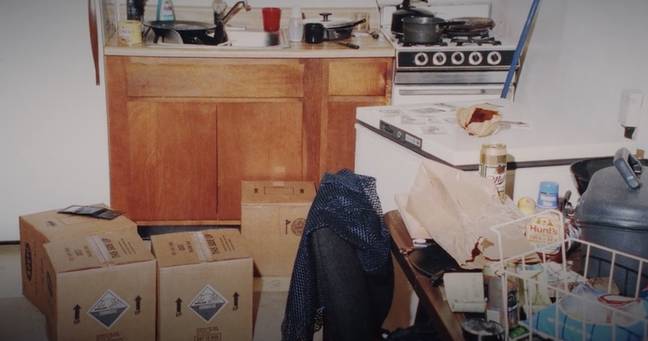
- Biological Materials: Forensic teams uncovered preserved human skulls, skeletal remains, and biological specimens stored across the kitchen, refrigerator, and freezer compartments.
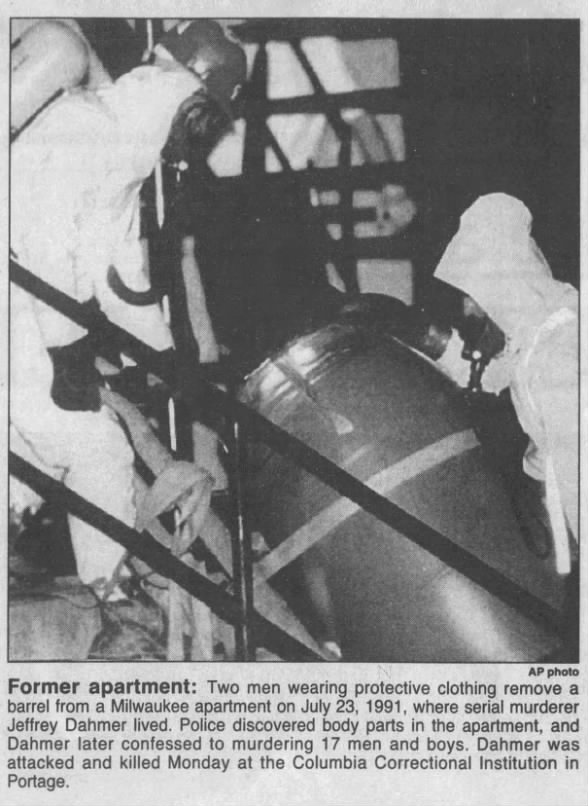
- Chemical Processing Equipment: Investigators cataloged a 57-gallon blue chemical drum containing acid, alongside jugs of muriatic acid, chloroform, formaldehyde, and industrial-grade cleaning chemicals used in an attempt to destroy evidence.
- Tools and Restraints: Saws, drills, meat cleavers, and multiple sets of commercial handcuffs were recovered, cataloged, and photographed in situ by police evidence technicians.
- Personal Property of the Victims: Wallets, identification cards, and personal effects belonging to missing men were retrieved, enabling forensic anthropologists and dental experts to identify victims whose disappearances had previously gone unsolved.
The Role of Photographic Evidence in the Sanity Defense
In court, Dahmer did not contest that he committed the killings; he entered a plea of not guilty by reason of mental disease or defect. The defense, led by attorney Gerald Boyle, argued that Dahmer suffered from an irresistible compulsion. The prosecution, spearheaded by DA McCann, countered that Dahmer possessed substantial capacity to appreciate the wrongfulness of his conduct and conform his actions to the law.
The photographic evidence played a decisive role in dismantling the insanity defense. Forensic psychiatrists testified that the staging of the bodies and the careful framing of the photographs demonstrated calculated awareness, patience, and aesthetic control. The photos revealed that Dahmer paused between acts, cleaned the environment, and waited for specific conditions before proceeding—behaviors that contradicted the assertion of an uncontrollable, impulsive frenzy. The jury agreed, finding him legally sane on all counts.
The Aftermath and the Fate of Physical Artifacts
Following Dahmer’s conviction and subsequent death in prison in 1994, intense debate arose regarding what should happen to the evidence and physical property seized from Apartment 213. A macabre collector market had emerged, with private buyers attempting to purchase Dahmer's refrigerator, tools, and clothing through an estate liquidation intended to satisfy civil judgments awarded to victims’ families.
To prevent these items from circulating as commercial commodities, a group of Milwaukee civic and philanthropic leaders raised over $400,000 in 1996 to purchase the entire inventory from the estate. Every single physical artifact—from the tools to the furniture—was transported under armed guard to an industrial incinerator and destroyed. The Oxford Apartments building itself had already been demolished in November 1992 to prevent it from becoming a spectacle.
Conclusion: Transparency Versus Sensationalism
The graphic nature of the crime scene photographs from the Jeffrey Dahmer case represents a sobering reality of criminal forensics. Law enforcement did not suppress this evidence to hide judicial mismanagement or shield the perpetrator; rather, the criminal justice system balanced evidentiary transparency with judicial integrity and victim protection. The comprehensive documentation assembled by Milwaukee forensic teams achieved its ultimate objective: securing 15 consecutive life sentences without a single evidentiary challenge succeeding on appeal.