KUB Outage: How to Report and Track Power Loss
When the lights unexpectedly flicker and go dark across Knoxville and neighboring counties, dealing with a KUB outage can disrupt your entire routine. The Knoxville Utilities Board (KUB) manages electric, gas, water, and wastewater services across an expansive footprint in East Tennessee. During severe weather, equipment failures, or vehicle collisions with utility poles, interruptions happen. Knowing exactly how to report the issue, monitor repair progress, and safeguard your household makes the waiting period far more manageable.

How to Quickly Report a KUB Outage
Never assume your neighbors have already reported a blackout. KUB relies on customer reports to pinpoint isolated faults, especially on secondary service lines. You can alert KUB to an electrical interruption using several convenient methods:
- By Phone: Call KUB’s automated outage hotline at (865) 524-2911. The automated system can recognize your service address from the phone number associated with your account, speeding up the reporting process.
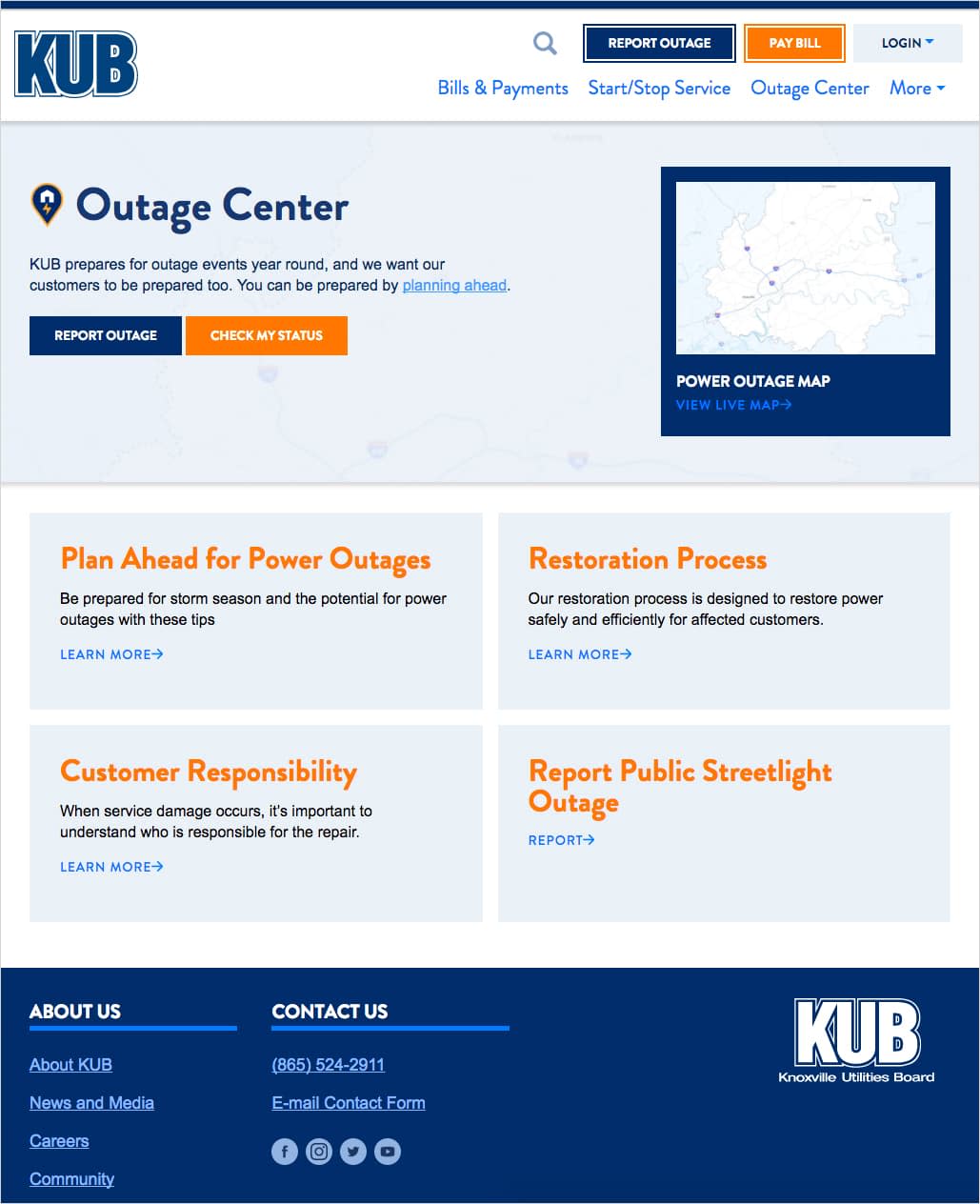
- Online Portal: Visit the official KUB Outage Center on your smartphone or connected device to submit a report without making a phone call.
- KUB Mobile App: Customers can download the official KUB mobile app (available on iOS and Android) to log outages, review billing details, and receive push notifications regarding repair work.
- SMS / Text Alerts: If your mobile number is registered with your KUB account, you can text outage updates and receive status reports directly to your phone.
When reporting, be prepared to share whether you heard a loud boom (which often indicates a blown transformer fuse), if you see downed lines nearby, or if only part of your home has lost power.
Navigating the KUB Outage Map
The interactive KUB outage map is one of the most effective tools for tracking progress during widespread storms or localized cuts. Accessible through any web browser, the map aggregates data across Knox, Grainger, Jefferson, Sevier, Blount, Anderson, and Union counties.
Interpreting Map Data and Status Labels
When viewing the map, outage areas are highlighted with color-coded boundaries or clusters indicating the number of affected customers. Clicking on a specific area reveals vital information:
- Customers Affected: The estimated number of meters currently without power in that cluster.
- Status: Typical status designations include Investigating/Assessing Damage, Crew Dispatched, or Crew on Site.
- Estimated Restoration Time (ETR): A projected time when service should return. Keep in mind that early ETRs are computer-generated estimates; they become more precise once field technicians assess physical damage on the ground.
The outage map updates periodically rather than second-by-second. If a crew finishes work on your branch line, allow 10 to 15 minutes for the public dashboard to reflect the change.
How KUB Prioritizes Restoration Work
During severe weather—such as heavy winter snow, high winds, or summer thunderstorms—damage can be widespread. KUB follows a systematic triage procedure designed to restore power safely to the greatest number of people in the shortest amount of time.
- Emergency Public Safety Facilities: First priority goes to critical infrastructure, including hospitals, emergency response centers, police and fire stations, and municipal water and wastewater treatment facilities.
- Transmission Lines and Substations: These high-voltage systems carry power from the Tennessee Valley Authority (TVA) to local distribution hubs. Repairing a substation can instantly restore electricity to thousands of customers at once.
- Main Distribution Lines (Feeders): Crews next repair the large three-phase lines that run along major thoroughfares, which feed entire neighborhoods and business districts.
- Tap Lines and Neighborhood Branches: Technicians move into residential streets to repair branch lines that serve individual blocks or cul-de-sacs.
- Individual Service Drops: The final stage involves repairing individual service wires running from the street pole directly to a single residence or business.
If you see a utility truck drive past your neighborhood without stopping, they are usually en route to repair an upstream problem at a substation or primary feeder line that must be energized before your local line can function.

What to Do If Neighbors Have Power and You Do Not
If lights are burning across the street while your house remains dark, the problem is likely localized to your property or your individual service drop. Follow these diagnostic steps:
1. Check Your Main Breaker Panel
Head to your interior electrical panel. Look for the main switch or individual branch breakers that may have tripped during a power surge. Switch them firmly to the “OFF” position, then back to “ON.”
2. Inspect the Exterior Service Mast
Examine the spot where the overhead electrical line connects to your home. KUB is responsible for the wire from the pole to the house and for the electric meter itself. However, the property owner is responsible for the weatherhead, service mast pipe, and the metal meter base attached to the exterior wall.
If falling tree limbs tore the service mast away from your exterior wall or crushed the meter socket, KUB cannot reconnect your service until a licensed private electrician repairs the hardware and passes local municipal building inspections.
Safety Precautions During an Outage
Power cuts bring safety risks beyond dark rooms. Adhering to fundamental safety protocols protects your family and utility technicians working in the field:
- Stay Away from Downed Lines: Treat any wire on the ground as energized and lethal. Keep pets and family members at least 35 feet away. Downed lines can energize chain-link fences, puddles, and tree limbs. Report downed lines to 911 and KUB immediately.
- Operate Generators Safely: Never operate a portable combustion generator indoors, in a garage, or near open windows due to the risk of carbon monoxide poisoning. Never plug a generator directly into a standard household wall outlet without a certified transfer switch, as this creates dangerous “backfeed” that can electrocute utility linemen working on external lines.
- Preserve Perishable Food: An unopened refrigerator keeps food cold for roughly four hours. A full, unopened freezer maintains safe temperatures for up to 48 hours (24 hours if half-full). Discard perishable items that register above 40°F for more than two hours.
- Protect Sensitive Electronics: Unplug expensive electronics, computers, and appliances to shield them from voltage spikes that can occur when the power grid suddenly switches back on.
Preparing for the Next Outage
While KUB actively prunes trees and reinforces its grid, unpredictable weather in the Tennessee Valley makes future interruptions inevitable. Keep an emergency outage kit accessible containing LED flashlights, extra batteries, a battery-powered radio, external power banks for mobile phones, non-perishable food, and a manual can opener. Regularly verifying that your current phone number and contact details are linked to your KUB customer profile ensures that reporting an interruption takes only seconds when severe weather hits.