Macroeconomics Unit 2 Review: Key Concepts & Formulas
Welcome to your ultimate macroeconomics unit 2 review. This unit forms the bedrock of economic measurement. While Unit 1 introduced you to basic economic thinking and scarcity, Unit 2 shifts focus to how policymakers measure the health of an entire nation. Whether you are studying for AP Macroeconomics or a college-level introductory course, understanding these core indicators is essential for mastering the rest of the curriculum.

Economic Indicators and the Business Cycle
To understand how an economy performs, economists rely on specific metrics known as economic indicators. The most prominent among these measure total output, price stability, and labor market health. These indicators do not exist in a vacuum; they fluctuate over time in a predictable pattern known as the business cycle.
The business cycle consists of four distinct phases:
- Expansion: Real GDP grows, unemployment falls, and inflation may begin to rise.
- Peak: The temporary maximum of economic growth where output is at its highest and resources are fully employed.
- Contraction (Recession): Real GDP declines for two or more consecutive quarters, unemployment rises, and output slows.
- Trough: The lowest point of economic activity before recovery begins.
Gross Domestic Product (GDP)
Gross Domestic Product is the monetary value of all final goods and services produced within a country's borders in a given time period. It is the single most important measure of economic output.
What is Included and Excluded in GDP?
To calculate GDP accurately, you must know what counts and what does not. The rule of thumb is that transactions must involve current production and final goods.
- Included: Domestically produced final goods (like a new car made in Detroit), government purchases (like road construction), and business investments in capital.
- Excluded: Intermediate goods (rubber used to make car tires), secondhand sales (used cars), financial transactions (stocks and bonds), and transfer payments (Social Security).
The Expenditure Approach
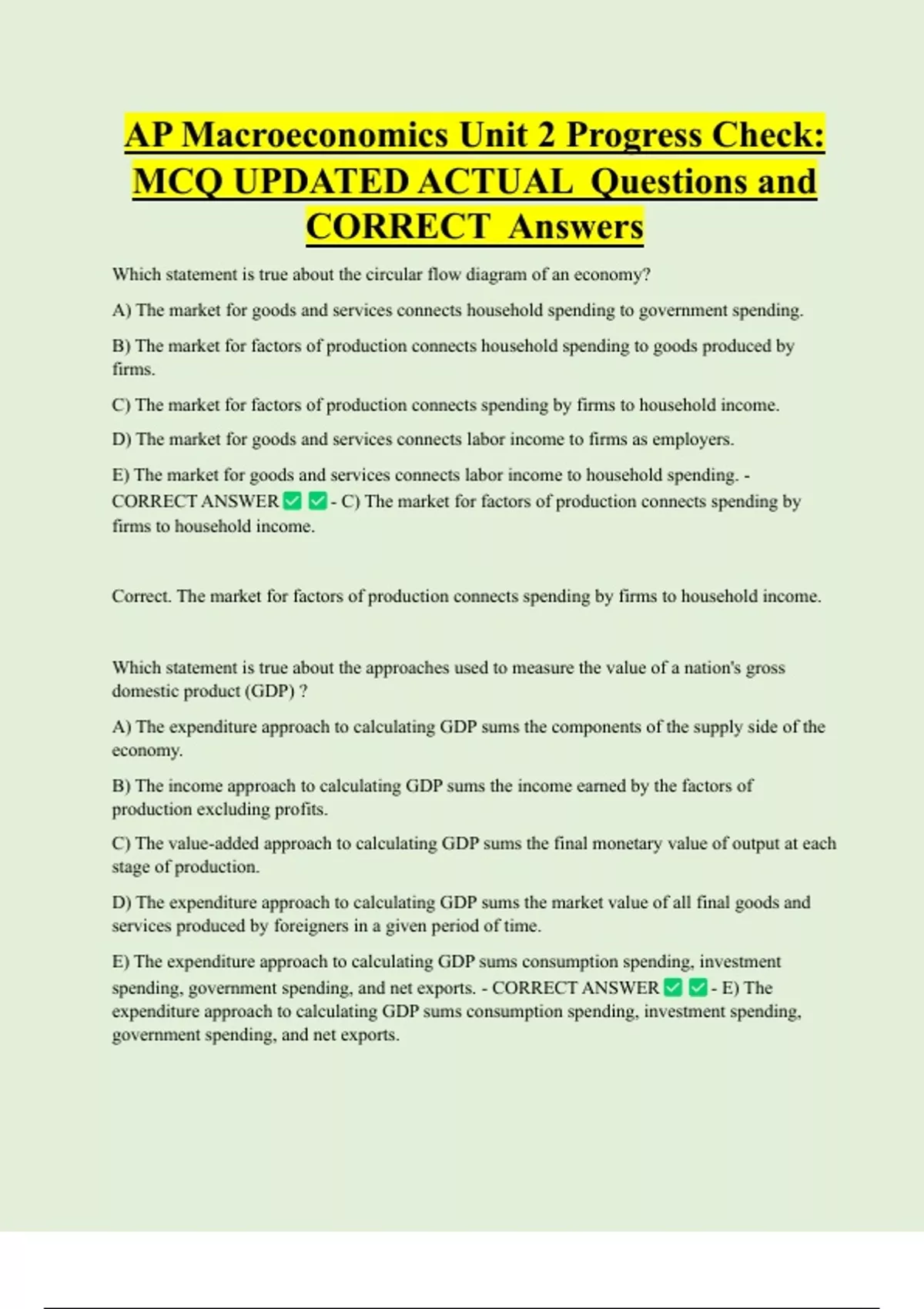
The most common way to calculate GDP is through the expenditure approach, summarized by the famous equation:
GDP = C + I + G + (X - M)
- C (Consumption): Household spending on goods and services.
- I (Investment): Business spending on tools, factories, and residential housing.
- G (Government): Public sector spending on goods and services.
- (X - M) (Net Exports): Exports minus imports.
Nominal vs. Real GDP
A critical distinction in macroeconomics is the difference between nominal and real values. Nominal GDP is measured using current prices, meaning it can rise simply due to inflation rather than increased production. Real GDP is adjusted for inflation using a base year, allowing economists to measure actual changes in physical output.
To find Real GDP, you use the GDP Deflator:
Real GDP = (Nominal GDP / GDP Deflator) × 100
Unemployment
The health of the labor market is measured by the unemployment rate. However, not everyone without a job is considered unemployed in economic terms. To be officially counted in the labor force, an individual must be at least 16 years old, able to work, and actively seeking employment.
Calculating the Unemployment Rate

The formula for the unemployment rate is:
Unemployment Rate = (Number of Unemployed / Labor Force) × 100
Note that the labor force includes both the employed and the unemployed. Individuals who are retired, full-time students, institutionalized, or discouraged workers (who have given up looking for a job) are not in the labor force.
Types of Unemployment
Economists categorize unemployment into three primary types:
- Frictional Unemployment: Workers transitioning between jobs or entering the labor market for the first time (e.g., college graduates). This is considered a natural and healthy part of a dynamic economy.
- Structural Unemployment: Unemployment caused by changes in technology or shifts in the structure of the economy, rendering certain skills obsolete (e.g., factory workers replaced by automation).
- Cyclical Unemployment: Unemployment resulting from economic downturns and recessions. This is the type of unemployment that concerns policymakers the most.
When cyclical unemployment is zero, the economy is said to be at the natural rate of unemployment, operating at full employment.
Inflation
Inflation is the general increase in prices and fall in the purchasing value of money over time. While moderate inflation is normal in a growing economy, high or hyperinflation erodes savings and destabilizes markets.
Measuring Inflation
The primary tool for measuring inflation for consumers is the Consumer Price Index (CPI). The CPI tracks the cost of a fixed basket of goods and services typically purchased by an urban household.
To calculate the inflation rate between two years using CPI:
Inflation Rate = [(CPI in Year 2 - CPI in Year 1) / CPI in Year 1] × 100
CPI vs. GDP Deflator
Students often confuse the CPI with the GDP Deflator. Remember these key differences:
- The CPI measures prices of a fixed basket of consumer goods, including imported goods.
- The GDP Deflator measures prices of all domestically produced goods and services, accounting for shifts in what businesses and governments actually buy.
Costs of Inflation
Inflation creates several economic problems:
- Loss of Purchasing Power: Fixed-income earners and savers see the real value of their money decline.
- Menu Costs: The physical cost and inconvenience of businesses constantly updating their pricing.
- Shoe-leather Costs: The wasted time and effort spent managing cash to minimize holdings of currency losing value to inflation.
Final Study Tips for Unit 2
As you prepare for your test, focus on practicing formula calculations—especially Real GDP, CPI, and the unemployment rate. Understand the limitations of these metrics; for instance, GDP does not measure income inequality, quality of life, or environmental degradation. Master these definitions, and you will easily ace this section of your macroeconomics course.