Master the NC Paycheck Calculator for Success
When most North Carolina residents look at a paycheck estimator, they treat it like a digital receipt. They plug in their salary, glance at the final net income figure to confirm their deposit, and close the browser tab. It is a transactional check: Did my employer pay me the right amount?
However, treating this tool as a mere verification step leaves massive potential on the table. The NC paycheck calculator is actually a dynamic financial sandbox. By manipulating the inputs rather than just reading the output, you can reverse-engineer your entire financial strategy, lower your tax liability, and accelerate your journey toward wealth-building. If you want to move beyond living paycheck to paycheck, it is time to look at your take-home pay estimator through a strategic lens.
Why Most People Misuse the Paycheck Calculator
The traditional approach to financial planning relies heavily on backward-looking data. People review their monthly bank statements, realize they have no money left over, and try to cut back on small luxuries like morning coffee or streaming subscriptions. While trimming expenses helps, it is a defensive strategy.
Using a North Carolina-specific salary calculator allows you to play offense. Because state income taxes, federal withholdings, and FICA contributions interact in unique ways, standard national calculators often miss critical local deductions. By inputting different variables into an NC-focused calculator before you make major life or career moves, you shift from reacting to your finances to designing them.
The Surprising Strategy: Reverse-Engineering Your Savings
The most powerful, yet overlooked, way to use the NC paycheck calculator is for reverse budgeting. Instead of calculating your net pay from your gross salary, use the tool to figure out what gross salary—or pre-tax deduction level—you need to hit a specific net savings goal.
Here is how you can put this strategy into practice:
- Define your target net income: Determine the exact monthly take-home pay you need to cover your baseline expenses, invest 15% toward retirement, and fund your short-term goals.
- Test pre-tax deductions: Plug different pre-tax contribution amounts—such as traditional 401(k), 403(b), or Health Savings Account (HSA) contributions—into the calculator.
- Observe the tax bracket shift: Watch how lowering your taxable income through pre-tax vehicles impacts your North Carolina state tax and federal tax withholdings simultaneously.
You will often discover a surprising mathematical reality: increasing your pre-tax retirement contributions by $200 a month does not reduce your net take-home pay by $200. Because your taxable income drops, the government effectively subsidizes a portion of your savings through reduced tax withholdings. The calculator exposes this hidden leverage instantly.
Optimizing Your North Carolina State Tax Withholdings
North Carolina features a flat state income tax rate, which simplifies things compared to progressive multi-tier states, but getting your withholdings precisely right still matters. Many workers treat a large tax refund as a financial win. In reality, a large refund means you gave the state government an interest-free loan all year.
Video: Paycheck Calculator and Payroll Calculator: Easy Tricks for Quick Estimation
Adjusting Your Form NC-4
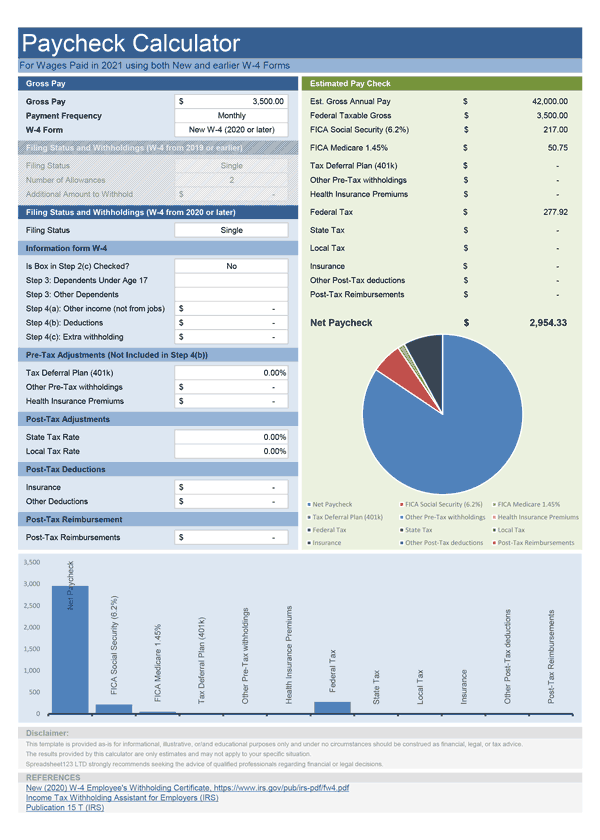
When you start a new job or experience a life change, you fill out a federal W-4 and a state-specific NC-4. The NC paycheck calculator allows you to test different allowance configurations on your NC-4 to fine-tune your monthly cash flow.
- Claiming more allowances: Reduces your state withholding, increasing your immediate take-home pay each paycheck.
- Claiming fewer allowances: Increases your state withholding, reducing your take-home pay but preventing a potential tax bill at the end of the year.
By finding the sweet spot where your tax refund is as close to zero as possible, you reclaim control of your money immediately. You can automatically route those extra dollars from each paycheck straight into a high-yield savings account or a brokerage account, putting your money to work for you every two weeks rather than waiting for an annual IRS payout.
Timing Raises, Bonuses, and Job Offers
Career advancement is the fastest lever for financial growth, but a higher salary does not always translate linearly to your bank account. North Carolina's tax structure and federal thresholds mean that bumps in income can sometimes push you into different withholding brackets temporarily.
Before you accept a counter-offer, negotiate a raise, or evaluate a performance bonus, run the numbers through the calculator:
- For a promotional pay bump, check if the increased income impacts your eligibility for certain tax credits or pushes a larger portion of your earnings into higher federal brackets.
- For commission or bonus structures, see how supplemental tax withholding rates affect the lump sum compared to spreading the earnings across regular pay periods.
Armed with this data, you can make informed decisions about whether to ask for stock options, extra paid time off, or pre-tax fringe benefits instead of a raw cash increase that might get heavily eroded by immediate withholdings.
Integrating the Calculator Into Your Annual Financial Review
Financial success is not a one-time event; it is an ongoing habit. Make it a rule to run your information through the NC paycheck calculator at least twice a year—during open enrollment and after tax season—or whenever you experience a major life change like buying a home, getting married, or having a child.
By turning a routine calculator into an interactive simulation tool for your personal economy, you stop guessing about your financial future. You gain clarity, eliminate tax-season surprises, and find hidden dollars that can be redirected toward true wealth-building.