Mastering 3D Geometry for College: A Complete Guide
Stepping into higher-level mathematics often means leaving the flat world of 2D planes behind. Whether you are taking Calculus III, Linear Algebra, or an engineering prerequisite, mastering 3D geometry for college is a critical milestone. It requires a shift from flat thinking to true spatial awareness, bridging the gap between algebraic equations and physical reality.

For many students, the transition from two variables ($x$ and $y$) to three variables ($x$, $y$, and $z$) can be jarring. Suddenly, you are dealing with surfaces, planes, and vectors in three-dimensional space. This guide breaks down the core concepts, mental models, and practical study habits you need to succeed in your college-level math courses.
Understanding the 3D Coordinate System
The foundation of all three-dimensional mathematics is the Cartesian coordinate system extended into three dimensions. Instead of a single flat plane, you work with three mutually perpendicular axes: the $x$-axis, the $y$-axis, and the $z$-axis.
The Right-Hand Rule
To establish consistency in your calculations, you must understand the right-hand rule. If you point the index finger of your right hand in the direction of the positive $x$-axis and bend your middle finger in the direction of the positive $y$-axis, your thumb will point along the positive $z$-axis. Visualizing this orientation prevents costly sign errors when setting up triple integrals or cross products.
Distance and Spheres
The distance formula expands naturally from two dimensions to three. The distance $d$ between two points $(x_1, y_1, z_1)$ and $(x_2, y_2, z_2)$ is given by:
$d = \sqrt{(x_2 - x_1)^2 + (y_2 - y_1)^2 + (z_2 - z_1)^2}$
Recognizing this formula helps you define equations of spheres, cylinders, and other quadric surfaces that frequently appear in college coursework.
Core Concepts You Must Conquer
To excel in your exams, you need to move beyond memorization and truly understand the geometric objects defined by algebraic equations. Your syllabus will likely focus heavily on the following topics:
- Vectors: Quantities with both magnitude and direction. You will need to master dot products (for finding angles) and cross products (for finding perpendicular vectors).
- Lines and Planes: Unlike 2D algebra where a line is simply $y = mx + b$, 3D lines require parametric equations, and planes require a normal vector and a point.
- Quadric Surfaces: Ellipsoids, paraboloids, hyperboloids, and cones. Knowing the traces (the intersections of these surfaces with coordinate planes) is vital for sketching them accurately.
Effective Strategies for Mastering 3D Geometry for College
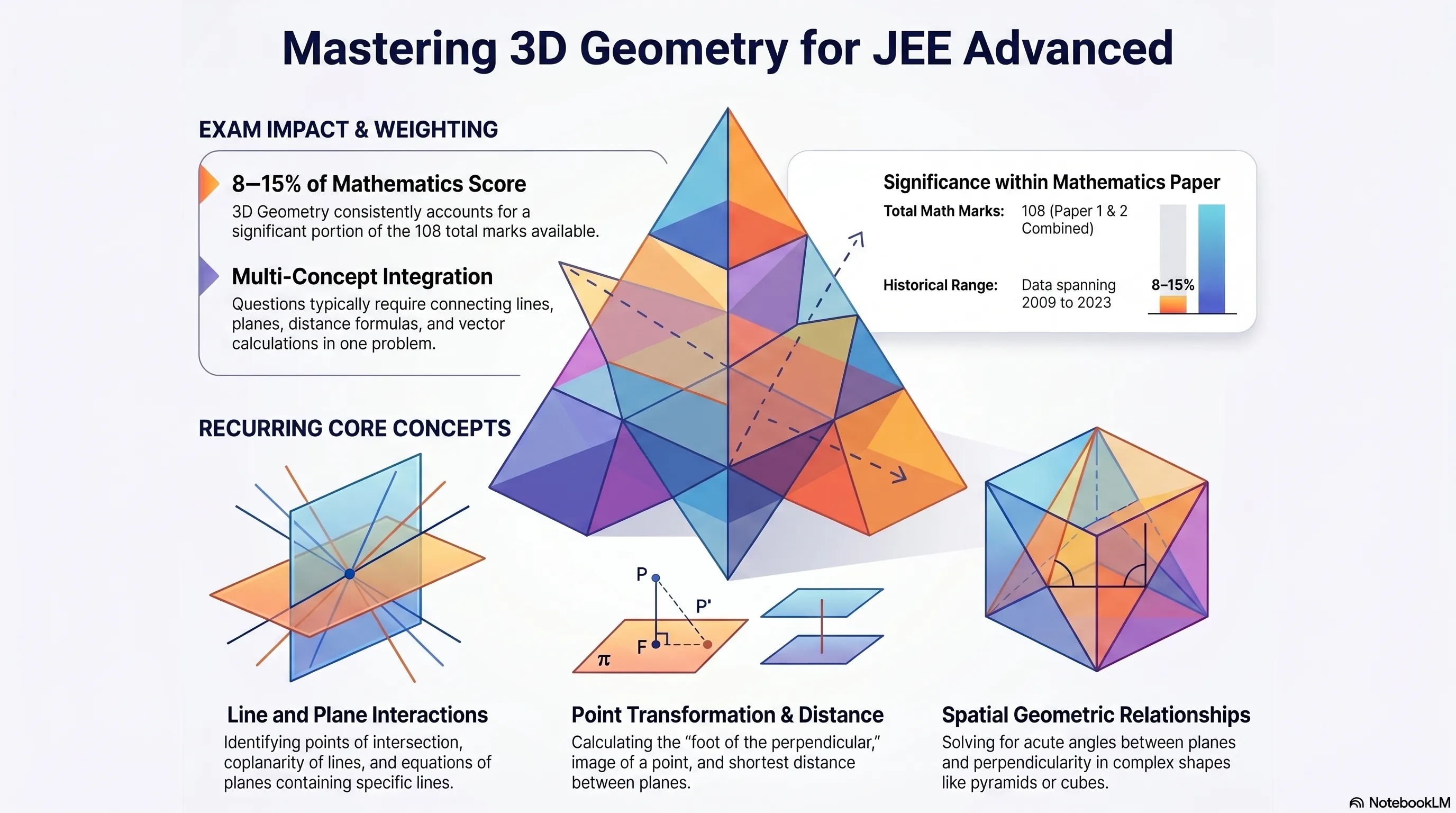
Raw intelligence is not enough to conquer advanced math; strategy is required. Use these proven tactics to improve your comprehension and grades.
1. Improve Your Spatial Visualization
The biggest hurdle in 3D math is the inability to "see" the problem. If you cannot visualize what a surface looks like, solving an integral or finding an intersection is nearly impossible. Practice sketching basic surfaces by hand. Start with the intercepts on the $x$, $y$, and $z$ axes, then draw the traces.
2. Leverage Modern Graphing Software
Do not rely solely on static textbook diagrams. Utilize digital tools to build intuition:
- GeoGebra: Excellent for plotting 3D surfaces, vectors, and planes interactively.
- Desmos 3D: A lightweight, browser-based tool that lets you quickly type in equations and rotate the resulting surfaces in real time.
- Wolfram Alpha: Useful for checking your work on complex surface intersections and vector operations.
3. Bridge Algebra and Geometry
Every geometric shape has an algebraic equation, and every algebraic equation in three variables describes a geometric shape. When you look at an equation like $x^2 + y^2 - z^2 = 1$, do not just see symbols. Mentally translate it into a hyperboloid of one sheet. When you can fluently move back and forth between algebra and geometry, exams become much more manageable.
Common Pitfalls and How to Avoid Them
Even strong students stumble when dealing with spatial math. Watch out for these frequent mistakes:
Ignoring bounds: In multivariable calculus, setting up limits of integration requires knowing which surface is "on top" or "on bottom." Always sketch the region of integration in the 2D projection plane (usually the $xy$-plane) before setting up your integrals.
Confusing vectors and scalars: Remember that the dot product yields a scalar (a single number), while the cross product yields a vector. Mixing these up in multi-step proofs will invalidate your entire solution.
Conclusion
Mastering 3D geometry for college takes patience, practice, and the willingness to train your brain to think beyond two dimensions. By strengthening your spatial reasoning, utilizing dynamic graphing tools, and connecting algebraic formulas to physical shapes, you can turn a notoriously difficult subject into one of your academic strengths. Roll up your sleeves, pick up a pencil, and start sketching.