Mastering Long E Words with Silent E
English phonics can feel like a puzzle, but few rules are as reliable and transformative as the magic 'e' rule. When beginning readers encounter closed-syllable words, they quickly learn short vowel sounds. However, adding a silent letter to the end of a word completely changes the vowel sound. Understanding long e words silent e patterns is a crucial milestone for early literacy, spelling mastery, and reading fluency.
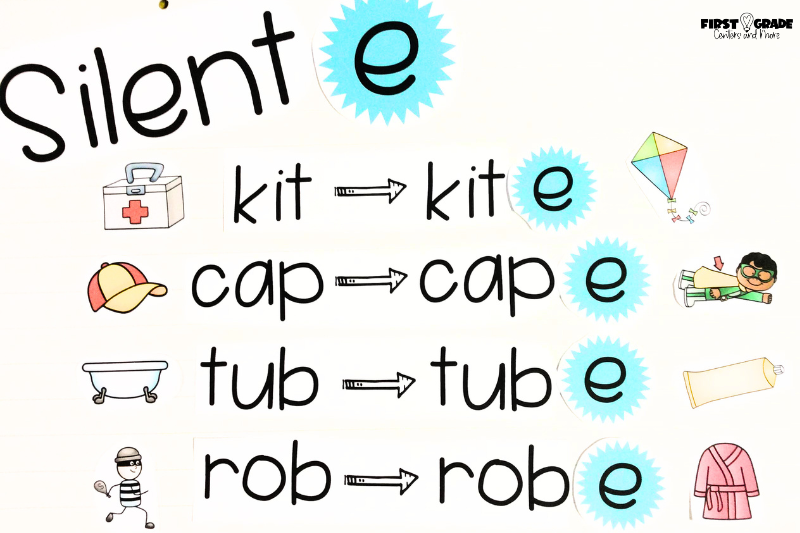
In this guide, we will break down how the silent 'e' alters vowel sounds, explore the specific spelling patterns that create the long 'e' sound, provide comprehensive word lists, and offer practical tips for teaching these concepts to kids or ESL learners.
How the Silent 'E' Changes Vowel Sounds
To understand why words like mete sound different from met, we have to look at the mechanics of English spelling. The silent 'e'—often referred to by teachers as the "magic e," "sneaky e," or "bossy e"—jumps over the consonant that precedes it and makes the main vowel say its own name.
While the silent 'e' is most commonly taught with the long 'a' sound (like in cake or make), it plays a fascinating and slightly more complex role when creating long e words with a silent e. Unlike short vowels, which are clipped and breathy, long vowels sound like the alphabet name of the letter itself. For the letter 'e', this means the sound you hear in "bee" or "me."
Common Long E Words Silent E Patterns
While the double-e spelling (as in tree or feet) is the most frequent way to spell the long 'e' sound, the silent 'e' appears in several distinct phonics patterns. Here are the most common structures you will encounter.
The 'C-V-C-E' Pattern with Vowels
In standard consonant-vowel-consonant-e (CVCE) words, the vowel usually dictates the sound. However, the letter 'e' playing the role of the silent helper at the end of a word sometimes teams up with another vowel or sits directly after a consonant to modify the syllable.
Consider the split digraph or silent 'e' structures where the long 'e' is modified. While traditional CVCE words heavily feature 'a', 'i', 'o', and 'u' (like bike, hope, cute), the long 'e' variant often appears in specific root words, loan words, and specialized vocabulary.
The 'EE' vs. Silent 'E' Distinction
It helps to contrast how the long 'e' sound is produced across different spelling families:

- Double E (EE): bee, feet, tree, green, sweep
- Silent E (E_E): these, Pete, mete, mere
Notice how words like these and Pete use a single vowel followed by a consonant and a silent 'e' to stretch out the middle sound. This is a classic long e words silent e construction.
Comprehensive Word Lists for Practice
Practice is the best way to master phonics rules. Use these curated lists to help readers identify, sound out, and spell words correctly.
Short vs. Long E Comparison List
Comparing short and long vowel words trains the ear to hear the subtle differences:
- Met vs. Mete
- Red vs. Rede
- Slit vs. Suite (though 'ui' makes the sound here, the silent 'e' closes the syllable)
- Wes vs. these (proper noun vs. pronoun)
Direct Long E Words with Silent E
Here are standard words featuring the consonant-vowel-consonant-silent-e pattern that produce the long 'e' sound:
- These: A demonstrative pronoun used to point out items nearby.
- Pete: A proper male name demonstrating the closed-long vowel rule.
- Mete: To distribute or allot something out (as in "mete out justice").
- Mere: Being nothing more than what is specified.
- Sphere: A round geometric 3D object.
Tips for Teaching Silent E Phonics Rules
Whether you are a classroom teacher, a homeschooling parent, or an ESL instructor, teaching the mechanics of the silent 'e' requires patience and multi-sensory strategies. Here are four effective ways to reinforce these concepts:
- Use Visual Markers: Have students physically draw a "magic wand" or a magical arc from the silent 'e' back to the main vowel. This visual connection emphasizes that the 'e' is not silent because it is useless, but because it is doing a job from afar.
- Incorporate Word Building: Start with a short vowel word like met. Ask the student to read it. Then, physically place a tile with an 'e' at the end. Ask the student how the sound changes. This hands-on manipulation builds strong neural pathways for decoding.
- Highlight Exceptions Early: English is full of exceptions. Words like give and have end in a silent 'e', but they do not make the preceding vowel long. Introduce these as "rule breakers" or "sight words" so learners do not get discouraged when phonics rules bend.
- Read Decodable Texts: Encourage reading practice using books specifically designed for phonics patterns. These books limit complex vocabulary and focus heavily on silent 'e' families, boosting reading confidence naturally.
Summary
Mastering long e words with a silent e unlocks a vital layer of the English language. By understanding how the sneaky final 'e' transforms short vowel sounds into long ones, readers can decode unfamiliar vocabulary and improve their spelling accuracy. Use targeted word lists, interactive games, and daily reading practice to turn these phonics rules into second nature.


