Mastering the Cornell Note-Taking System
When students and professionals look for ways to organize information, they quickly realize that one of the most recognizable note-taking systems is called the Cornell Method. Developed in the 1940s by Walter Pauk, a professor at Cornell University, this layout was designed to help students cope with the sheer volume of information presented in fast-paced college lectures.

Decades later, it remains a gold standard in academic and professional settings. By breaking a single page into distinct functional zones, the Cornell system shifts note-taking from a passive transcription exercise into an active, analytical process.
Understanding the Cornell Layout
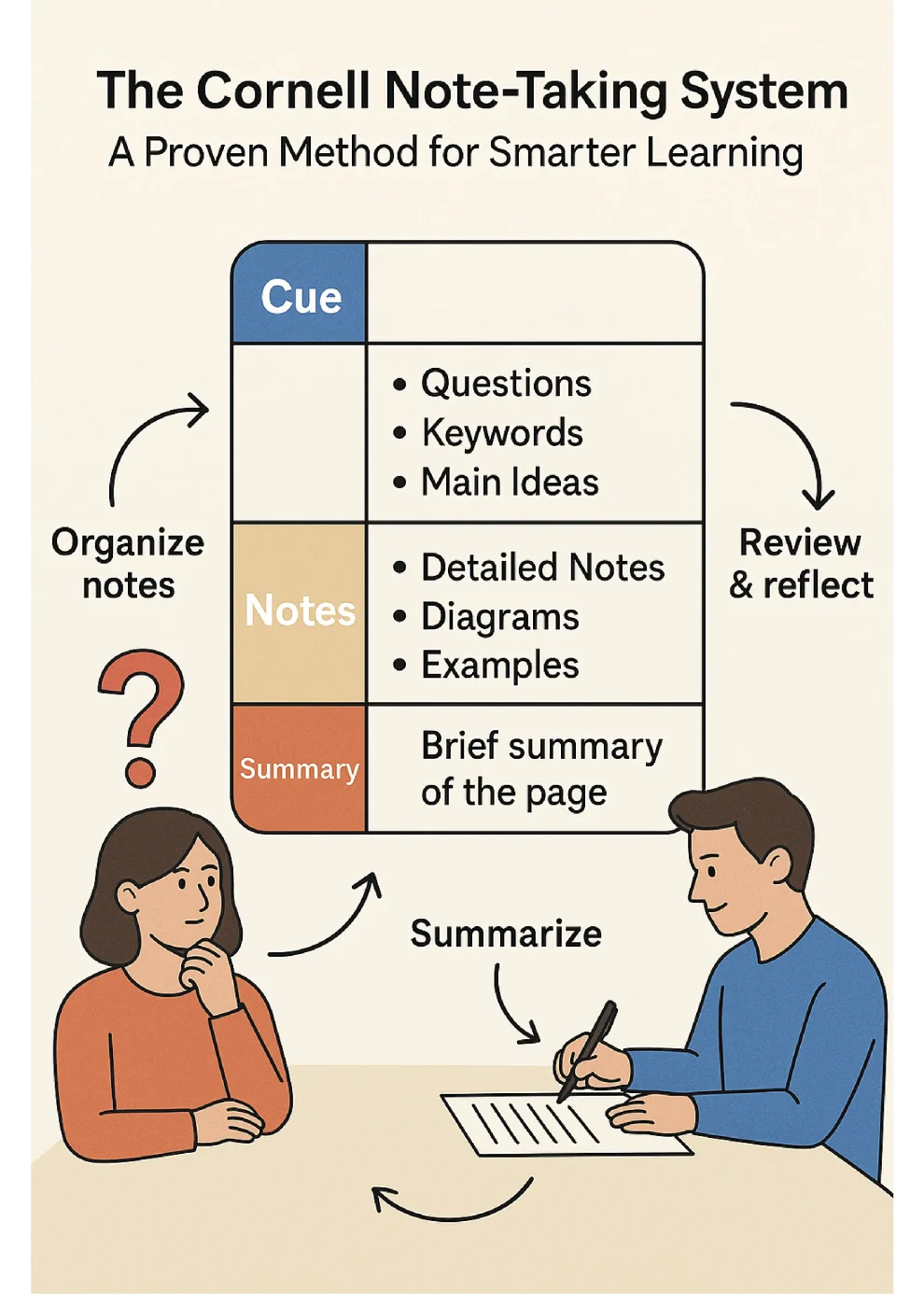
The beauty of the Cornell Method lies in its simplicity. To set up your page, you only need a blank sheet of paper and a pen. You will divide the page into three distinct sections by drawing two lines:
- The Cue Column (Left): A vertical column about 2.5 inches wide, taking up the left side of the page.
- The Note-Taking Area (Right): A larger section, about 6 inches wide, occupying the right side of the page.
- The Summary Section (Bottom): A horizontal block roughly 2 inches high spanning the bottom of the page.
Each section serves a unique purpose during different phases of learning. Understanding how to use each zone is the key to mastering this classic technique.
How to Use One of the Most Recognizable Note-Taking Systems Is Called the Cornell Method
Putting the Cornell system into practice involves a five-step process known as the 5 R's: Record, Reduce, Recite, Reflect, and Review. Here is how you apply them sequentially.
1. Record (During the Lecture)
During the lecture or reading session, use the large right-hand column (the Note-Taking Area) to capture as many meaningful facts and ideas as possible. Use shorthand, bullet points, and abbreviations. Do not worry about making your handwriting pristine or your sentences complete; focus on capturing the core concepts.
2. Reduce (After the Lecture)
As soon as possible after the class or reading session, review your notes in the right-hand column. In the left-hand column (the Cue Column), condense your notes into concise keywords, trigger phrases, or prompt questions. These cues should act as shorthand summaries of the main ideas opposite them.
3. Recite

Cover the right-hand Note-Taking Area with a blank sheet of paper, leaving only the Cue Column visible. Looking at your cues, try to recall out loud and in your own words the full concepts, facts, and ideas from the lecture. Uncover the notes to check your accuracy. This transforms passive reading into active recall.
4. Reflect
Look at the big picture. In the Summary Section at the bottom of the page, write a brief, one-to-two sentence summary of the entire page's contents. This forces your brain to synthesize the information and understand how the individual facts fit into a larger framework.
5. Review
Do not let your notes collect dust. Spend at least 10 minutes every week reviewing your past Cornell sheets. By regularly glancing over the cue columns and summaries, you reinforce the neural pathways required to move information from your short-term memory into your long-term memory.
Benefits of the Cornell Method
There is a reason this technique has survived for over half a century. It offers tangible cognitive and organizational benefits.
- Active Engagement: You are forced to interact with your notes multiple times (writing, reducing, reciting, and summarizing).
- Built-In Study Guides: By creating cue columns and summary blocks, you essentially manufacture your own flashcards and chapter summaries as you go.
- Clarity and Organization: Visual separation prevents notes from becoming an overwhelming wall of text, making review sessions far less intimidating.
Best Practices and Common Mistakes
To get the most out of the Cornell system, keep a few practical tips in mind. Avoid the temptation to fill out the cue column during the lecture; doing so splits your focus and often leads to missing important information. Save the reduction phase for after the session when you have a moment to digest the material.
Additionally, remember that digital adaptations exist. If you prefer typing or writing on a tablet, numerous PDF templates and note-taking apps incorporate the Cornell layout natively.
Ultimately, while digital tools and productivity fads come and go, foundational frameworks remain powerful. By adopting the Cornell strategy—one of the most recognizable note-taking systems is called—you can elevate your comprehension, retain information longer, and transform the way you learn.