Medi-Share 65 Plus: Complete Guide & Costs
Approaching age 65 triggers a series of critical healthcare decisions, primarily revolving around Medicare. While most seniors transition into standard Medicare Supplement (Medigap) or Medicare Advantage plans, Christian seniors seeking a faith-aligned alternative often evaluate medi share 65 plus. Offered by Christian Care Ministry, this program serves as a faith-based option designed to assist with out-of-pocket costs left behind by original Medicare.

However, health sharing operates under entirely different rules than commercial health insurance. Understanding the mechanics, costs, coverage boundaries, and legal realities of Medi-Share 65+ is essential before relinquishing standard private coverage options.
What Is Medi-Share 65+?
Medi-Share is a Health Care Sharing Ministry (HCSM) where members share each other's medical burdens according to Christian guidelines. Medi-Share 65+ is a specialized program tailored specifically for seniors aged 65 and older who are enrolled in Medicare.
It is not an insurance policy, nor is it a standardized Medigap plan. Instead, it is an organized, voluntary community sharing program. When you incur out-of-pocket medical expenses from Medicare-approved services, your eligible expenses are published to the community, and other members' monthly share contributions are applied to pay those bills.
How Medi-Share 65 Plus Works with Medicare
To participate in Medi-Share 65+, members must be enrolled in both Medicare Part A (hospital coverage) and Medicare Part B (medical coverage). Medicare acts as your primary payer, while Medi-Share 65+ acts as a secondary payer for eligible cost-sharing expenses.
- You receive care: You visit any healthcare provider that accepts Medicare. Because Medicare is primary, you do not need to worry about Medi-Share's private provider networks for Medicare-covered services.
- Medicare pays first: Your provider submits the claim directly to Medicare, which pays its standard share (typically 80% of approved Part B costs, after the Part B deductible).
- The remaining balance is submitted: The remaining out-of-pocket costs (such as deductibles, copayments, and coinsurance) are submitted to Medi-Share along with the Medicare Summary Notice (MSN).
- Sharing applies: Once you satisfy your Annual Household Portion (AHP), eligible out-of-pocket costs are shared by the membership.
The Annual Household Portion (AHP)
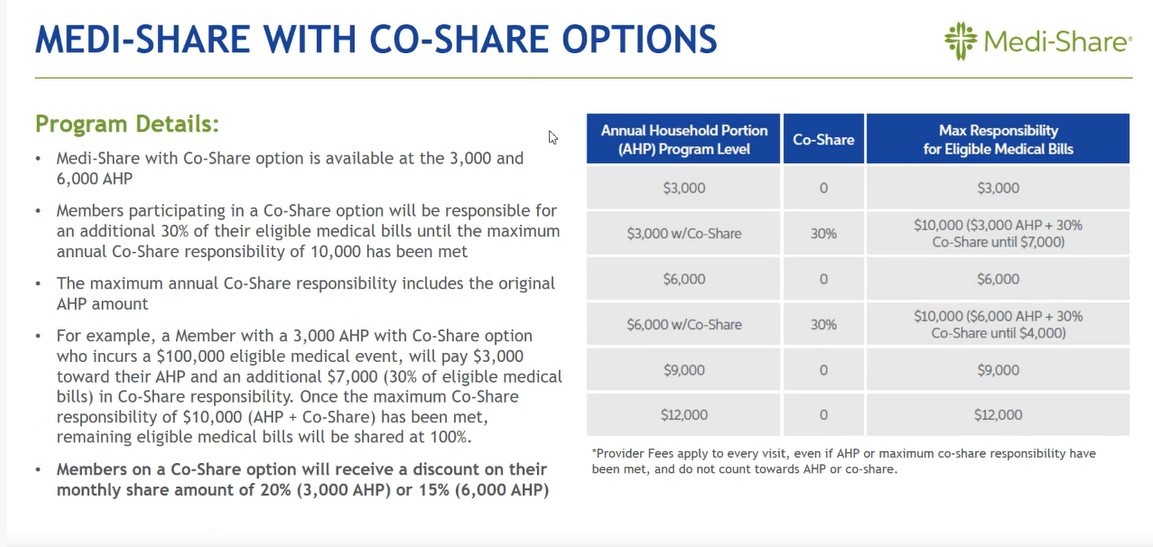
The AHP serves a function similar to a deductible. For Medi-Share 65+, the standard AHP is typically $500 per individual per year. Once you have paid $500 toward eligible out-of-pocket medical expenses, remaining eligible Medicare cost-sharing is 100% shareable across the community.
Understanding Medi-Share 65 Plus Costs and Fees
Cost is the primary reason many seniors consider health sharing. Traditional Medigap plans—such as Plan G or Plan N—can cost anywhere from $120 to over $250 per month depending on your state, age, gender, and smoking status, with premiums often rising every year.
Medi-Share 65+ offers a flat, predictable monthly share amount that is generally lower than standard Medigap policies:
- Monthly Share: Typically ranges between $70 and $115 per month per person (rates depend on ministry guidelines and whether you join as an individual or couple).
- AHP: $500 annual threshold before sharing begins.
- One-Time Application Fee: A nominal processing fee (usually around $50) upon initial enrollment.
- Monthly Administrative Fee: A small administrative and technology fee included in or added to the monthly billing (roughly $2 to $5).
Because members must also pay the standard Medicare Part B monthly premium to the federal government, your total monthly outlay includes the Part B premium plus the Medi-Share monthly share.
Video: Medi-Share 65+: A Health Sharing Alternative for Medicare Beneficiaries

What Does Medi-Share 65+ Share?
Medi-Share 65+ primarily shares in costs that Medicare approves but does not fully pay. When a service is deemed eligible by Medicare and adheres to Medi-Share’s guidelines, the program helps with:
- Medicare Part A hospital deductible and copayments.
- Medicare Part B coinsurance (the 20% Medicare does not cover).
- Skilled nursing facility daily copayments (for Medicare-approved days 21–100).
- Medicare Part B excess charges (amounts billed by doctors who do not accept Medicare assignment, subject to ministry limits).
Critical Coverage Exclusions
Health sharing programs do not cover every medical expense. Before enrolling, consider these major limitations:
- Prescription Drugs: Medi-Share 65+ does not share routine, maintenance prescription drugs. You will need to enroll in a standalone Medicare Part D plan to cover ongoing medications.
- Unapproved Medical Procedures: Services not covered by Medicare (such as routine dental, vision exams, or hearing aids) are generally not eligible for sharing unless specified under separate discount programs.
- Lifestyle Exclusions: Medi-Share will not share medical costs stemming from behaviors that violate biblical standards, such as injuries resulting from illicit drug use or driving under the influence.
Eligibility and Membership Requirements
Because Medi-Share is a faith-based community, eligibility extends beyond age and Medicare enrollment. To join and maintain membership, participants must meet specific criteria:
- Christian Faith Statement: Applicants must profess a personal faith in Jesus Christ and agree to the ministry's Statement of Faith.
- Church Involvement: Members are expected to regularly attend a Christian church and may need a pastor or church leader to verify their involvement.
- Biblical Lifestyle Standards: Members must abstain from the use of tobacco, illegal drugs, and recreational cannabis, and avoid the abuse of alcohol and prescription drugs.
- Active Medicare A & B: You must maintain continuous enrollment in both Medicare Parts A and B.
Medi-Share 65+ vs. Traditional Medigap (Medicare Supplement)
Evaluating this program requires a direct comparison against conventional Medigap insurance. While both help cover Medicare's out-of-pocket costs, their structure differs significantly.
| Feature | Traditional Medigap (e.g., Plan G) | Medi-Share 65+ |
|---|---|---|
| Legal Status | Contractual, legally binding insurance | Voluntary health sharing ministry (non-insurance) |
| Guaranteed Payment | Yes, regulated by state insurance commissioners | No legal guarantee; relies on voluntary sharing |
| Monthly Premiums/Shares | Higher ($120–$250+/month) | Lower (typically $70–$115/month) |
| Eligibility Rules | Guaranteed issue during open enrollment; strictly age/health based | Faith-based, lifestyle adherence, and Medicare A&B required |
| Prescriptions | Requires standalone Part D | Requires standalone Part D |
| Provider Network | Any provider accepting Medicare nationwide | Any provider accepting Medicare nationwide |
Advantages of Medi-Share 65+
- Cost Savings: Lower monthly contributions compared to comprehensive Medigap plans can yield substantial annual savings for seniors on fixed incomes.
- Provider Freedom: Because Medicare is primary, you can see any doctor or specialist who accepts Medicare without network limitations.
- Community Support: Members can send prayers and encouragement directly to other members through the ministry's online portal.
- Predictable Deductible: The $500 AHP provides a clear, manageable cap on initial out-of-pocket expenses.
Risks and Drawbacks to Consider
- No Legal Guarantee: By law, HCSMs cannot guarantee that medical bills will be paid. In the event of administrative disputes or ministry shortfalls, there is no state insurance commissioner or consumer guaranty fund to appeal to.
- Losing Guaranteed Issue Rights: If you choose Medi-Share 65+ when you first turn 65, you may forfeit your federal Medigap Guaranteed Issue rights. If you decide to switch back to traditional Medigap later, private insurers in most states can subject you to medical underwriting and potentially deny coverage or charge higher rates for pre-existing conditions.
- Lifestyle Scrutiny: Claims can be investigated to confirm they do not stem from prohibited lifestyle choices.
Is Medi-Share 65+ Right for You?
Medi-Share 65+ works best for Christian seniors who are in relatively stable health, actively adhere to the ministry’s lifestyle standards, and want to reduce their monthly fixed expenses. For those who prioritize having their healthcare dollars support an explicitly Christian organization, it offers an appealing community-oriented approach.
Conversely, if you prefer the certainty of state-regulated insurance, have complex medical needs that require strict contractual guarantees, or do not meet the ministry's faith and lifestyle standards, a standardized Medigap policy (such as Plan G or Plan N) remains the safer and more comprehensive path.
.png)