Must Have Transition Words for Back to School
As students shake off the summer slide and return to the classroom, reviving their writing stamina is an immediate priority. Academic prose often feels disjointed in September, characterized by abrupt shifts between thoughts and repetitive phrasing. Introducing a targeted list of must have transition words for back to school equips learners with the logical bridges they need to connect ideas, build persuasive arguments, and construct fluid narratives.
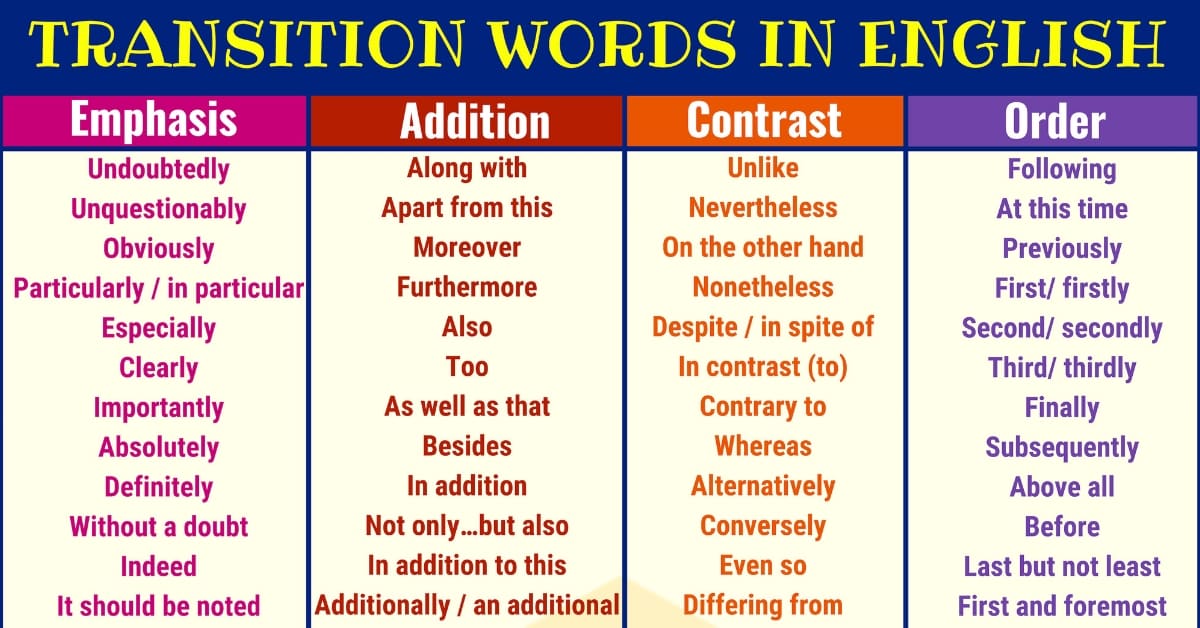
Transition words act as road signs within a text. They cue the reader on what to expect next—whether that is a sudden contrast, an additional example, or a final synthesis. By reviewing these foundational terms during the opening weeks of the term, educators and students lay the groundwork for polished, confident writing all year long.
Why Focus on Transitions Early in the Term?
During extended breaks, students often revert to simple sentence structures. When asked to write a personal narrative about their summer or summarize an introductory reading, their paragraphs can resemble disjointed lists rather than cohesive prose. Early instruction in transitional phrases accomplishes three key goals:
- Promotes Logical Thinking: Selecting the correct transition requires a student to understand the relationship between two sentences (e.g., cause and effect vs. concession).
- Improves Text Rhythm: Transitions eliminate staccato, choppy sentences by varying sentence openers and clause combinations.
- Fosters Academic Voice: Replacing conversational connectors like "and then" or "also" with precise academic signals instantly elevates a student's tone across history, science, and English assignments.
Must Have Transition Words for Back to School by Category
To help students choose transitions based on context rather than habit, organize them by communicative function. Below are the essential categories every student should review as the new academic year begins.
1. Words for Chronology and Sequence
Whether students are writing a personal narrative, outlining historical events, or documenting steps in a lab experiment, chronological transitions keep the timeline clear.
- Foundational: first, next, then, finally, before, after, soon, later
- Intermediate: initially, subsequently, meanwhile, previously, simultaneously, eventually
- Advanced: prior to, concurrently, ultimately, in the wake of, henceforth
Example: "Initially, the researchers observed no change in the culture. Subsequently, temperature adjustments triggered rapid bacterial growth."
2. Words for Contrast and Counterpoint
Analytical writing relies on the ability to acknowledge counterarguments and highlight contradictions. These words show shifts in direction or condition.
- Foundational: but, yet, however, although, instead, still
- Intermediate: whereas, on the other hand, in contrast, nonetheless, even though, despite
- Advanced: conversely, notwithstanding, on the contrary, albeit, regardless
Example: "The protagonist claims to value honesty. Nevertheless, his actions throughout the second act reveal a pattern of deliberate deception."
3. Words for Addition and Reinforcement
When stacking evidence or elaborating on a claim, students must avoid repeating the word "also" at the start of every sentence.
- Foundational: also, another, besides, too, in addition
- Intermediate: furthermore, moreover, additionally, along with, as well as
- Advanced: equally important, coupled with, not to mention, in tandem with
Example: "Regular exercise improves cardiovascular health. Furthermore, clinical studies demonstrate that it sharpens cognitive retention."
4. Words for Cause, Effect, and Result
Cause-and-effect transitions clarify causality, preventing readers from guessing how one event led to another.
- Foundational: because, so, since, therefore
- Intermediate: as a result, consequently, due to, for this reason, thus
- Advanced: accordingly, hence, thereby, inevitably, stemming from
Example: "The city failed to upgrade its drainage infrastructure. Consequently, the torrential rains caused severe localized flooding."
5. Words for Illustration and Emphasis

Evidence carries weight only when readers understand what it proves. These words introduce textual evidence, data points, or particular examples.
- Foundational: for example, for instance, such as, especially
- Intermediate: in particular, specifically, to illustrate, notably, indeed
- Advanced: to demonstrate, chief among these, markedly, in particularity
Example: "Modern mammals exhibit diverse behavioral adaptations. Specifically, cetaceans rely on complex vocalizations to navigate and coordinate hunting."
6. Words for Synthesis and Conclusion
Closing paragraphs often collapse into clichés like "In conclusion." Providing alternatives helps students tie their arguments together naturally.
- Foundational: in the end, all in all, finally, to sum up
- Intermediate: in summary, overall, therefore, as demonstrated, in brief
- Advanced: ultimately, taken as a whole, in essence, to encapsulate
Example: "Taken as a whole, the data underscores an urgent need for revised municipal water policies."
Grade-Level Strategies: Scaffolded Implementation
Dumping an exhaustive list of fifty words on a student's desk on day one rarely yields results. Tailor the introduction of transition words to their developmental stage:
Elementary (Grades 3–5)
Focus on chronological order and basic reasoning. Use visual organizers like flowcharts and "first, next, then, finally" graphic organizers. Encourage young writers to place transition words at the start of sentences, followed by a comma, to build punctuation muscle memory.
Middle School (Grades 6–8)
Shift focus toward argumentative transitions: contrasting perspectives (whereas, however) and supplying evidence (for instance, as an illustration). Challenge students to banish "and then" from their work for an entire week to force the adoption of varied connectors.
High School and Beyond (Grades 9–12+)
Emphasize internal and conceptual transitions rather than formulaic paragraph starters. Advanced writers should learn to embed transitions mid-sentence using parenthetical commas, semicolons, and correlative conjunctions (e.g., "The hypothesis, however, failed scrutiny").
Three Common Transition Pitfalls to Address Early
Diagnosing these common transitional errors during the first few weeks of school saves hours of grading time later in the term:
- The "Sticker Effect": Students often drop transition words into essays like decorative stickers without checking if the logic matches. For example, using "furthermore" when the second sentence actually contradicts the first creates cognitive friction for the reader.
- The Comma Splice Trap: Words like however, therefore, and furthermore are conjunctive adverbs, not coordinating conjunctions. Joining two independent clauses with only a comma and "however" produces a run-on sentence. Teach the semicolon-comma pattern early:
[Independent Clause]; however, [Independent Clause]. - Paragraph-Opening Monotony: When every paragraph in a five-paragraph essay begins with the exact same structure (e.g., "First," "Second," "Third"), the essay sounds mechanical. Encourage students to bridge paragraphs by referencing the previous paragraph's core noun in the opening sentence of the next.
Classroom Activities to Reinforce Transitions
Interactive reinforcement helps transition words stick far better than static worksheets:
- Transition Word Wall: Reserve a bulletin board where students can pin high-impact transitions they uncover in class novels or primary source texts. Organize the board by the functions outlined above.
- The Logical Reverse Game: Give students two unrelated sentences (e.g., "The bell rang" and "The students remained seated"). Ask them to test different transitions (yet, because, consequently) and explain how each word radically alters the narrative meaning.
- Peer Editing Scavenger Hunt: During the first peer-review workshop of the year, have students highlight all transitions in green. If a partner's draft has zero green marks or relies on the same word more than twice, the author must revise using a transition reference sheet.
Equipping students with a versatile vocabulary of transitions at the start of the school year does more than enhance writing style—it develops critical thinking, trains organizational discipline, and builds the confidence required to tackle complex writing assignments across the curriculum.


