NASCAR Number 36: History, Drivers, and Legacy
When longtime racing fans think of nascar number 36, their minds often drift to vibrant paint schemes, fearless underdogs, and some of the most dramatic moments in stock car history. While it may not boast the towering championship totals of numbers like 3, 24, or 43, the #36 holds a unique, storied place in the NASCAR Cup Series garage.

From oddball historical victories in the sport’s earliest decades to the golden era of candy-colored Pontiacs and modern superspeedway shockers, car #36 has consistently defied the odds. Here is the full story of NASCAR’s famous #36, its most celebrated drivers, and its lasting mark on stock car racing.
The Early Days: Groundbreakers and Bizarre Finishes
The history of car #36 dates back to the formative years of NASCAR’s Strictly Stock and Grand National divisions. Long before multi-car corporate juggernauts ruled the paddock, independent owner-drivers took the green flag in whatever equipment they could build or buy.
Al Keller’s Historic 1954 Road Course Triumph
One of the earliest and strangest milestones in NASCAR history belongs to car #36. On June 13, 1954, driver Al Keller piloted a foreign-built 1954 Jaguar XK120 carrying the #36 at the Linden Airport road course in New Jersey. Keller claimed victory that afternoon, marking the first time an imported car ever won a premier NASCAR event—an anomaly that stood as a trivia staple for decades.
Larry Frank and the Controversial 1962 Southern 500
Perhaps the most famous early win for the number came on Labor Day in 1962 at Darlington Raceway. Driving a #36 Pontiac owned by automotive parts pioneer Frank Steffan, Larry Frank drove the race of his life at one of NASCAR's most punishing tracks.
However, an official scoring error initially awarded the victory to Junior Johnson, who was celebrated in victory lane. Frank protested immediately, insisting he had completed the 500 miles ahead of Johnson. After a grueling overnight recount of the manual scoring cards, NASCAR confirmed Frank was indeed the winner, officially awarding him the trophy roughly 14 hours after the checkered flag fell.
H.B. Bailey: The Ultimate Independent
No account of the number's grassroots history is complete without mentioning H.B. Bailey. The Texas racer campaigned the #36 Pontiac across multiple decades as an independent owner-driver. Between 1962 and 1993, Bailey logged 85 premier series starts with the number, representing the blue-collar backbone of the sport that kept NASCAR thriving at local short tracks and superspeedways alike.
The MB2 Era: When NASCAR Number 36 Became a Fan Favorite
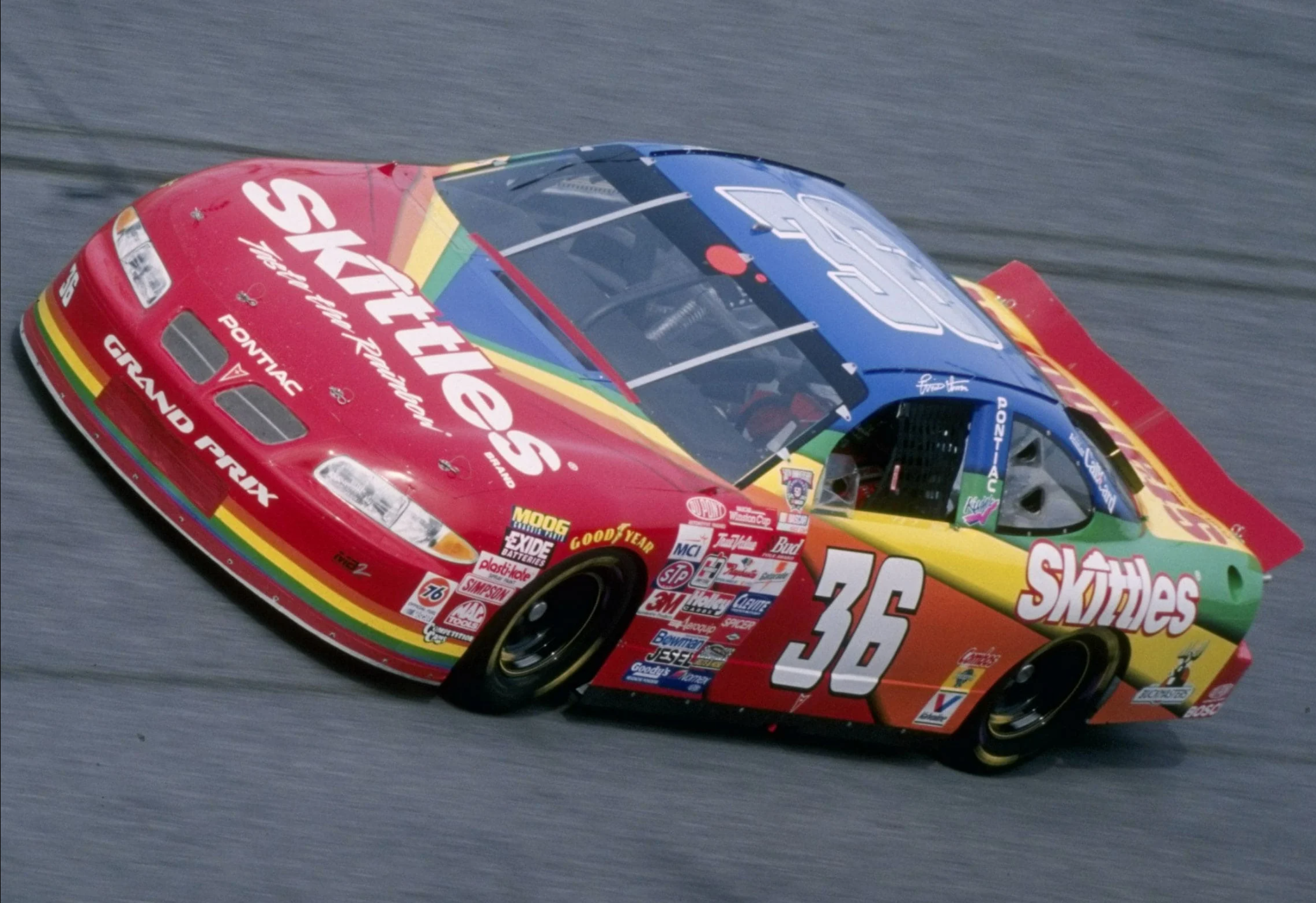
In the late 1990s, the number underwent an unforgettable renaissance with the founding of MB2 Motorsports. Backed by eye-catching, family-friendly sponsorships, the team turned car #36 into a household fixture for a generation of NASCAR enthusiasts.
Ernie Irvan and the "Taste the Rainbow" Comeback
In 1998, veteran driver Ernie Irvan took the wheel of the newly formed MB2 Motorsports entry, proudly backed by Skittles. Irvan, beloved by fans for his miraculous recovery from a near-fatal 1994 crash at Michigan, brought instant credibility and speed to the fledgling operation.
Piloting the vivid, rainbow-striped Pontiac Grand Prix, Irvan captured three top-five finishes and 11 top-ten results in 1998, including an emotional pole position at Indianapolis Motor Speedway for the Brickyard 400. Irvan gave the team legitimate front-running pace before injuries ultimately cut his driving career short late in the 1999 season.

Ken Schrader and the M&M’s Era
In 2000, fan favorite Ken Schrader climbed into the #36 seat, welcoming a new primary sponsor that would create some of the most popular die-casts and apparel in NASCAR lore: M&M’s.
Schrader raced the #36 Pontiac from 2000 through 2002. While victory lane narrowly eluded them, the combination was fiercely competitive, regularly qualifying near the front and delivering memorable top-ten runs on intermediate tracks and short tracks. The colorful yellow machine, often customized with special Halloween or character-driven paint schemes, cemented the #36 as one of the most recognizable cars on Sunday afternoons.
The Gritty Underdog Years: Tommy Baldwin Racing
Following MB2's renumbering and eventual sale in the mid-2000s, long-time crew chief Tommy Baldwin Jr. resurrected the #36 in 2009 under his own banner, Tommy Baldwin Racing (TBR).
TBR represented a gritty, low-budget operation that fought tooth and nail against the sport's wealthier multi-car dynasties. Baldwin used the #36 to give seasoned veterans and hungry young drivers an opportunity to compete at stock car racing's highest level.
Dave Blaney and the 2012 Daytona 500 Near-Miss
The Tommy Baldwin Racing era produced one of the most suspenseful "what-if" moments in modern NASCAR history during the 2012 Daytona 500. Driven by veteran dirt-track ace Dave Blaney, the #36 car stayed out on track during a sequence of pit stops and suddenly found itself leading the "Great American Race."
Moments later, Juan Pablo Montoya collided with a jet dryer under caution, triggering an enormous fire and an immediate red flag that halted the field for more than two hours. Had track officials determined the race track could not be safely repaired, Blaney and the underdog #36 team would have been declared Daytona 500 champions. Though track crews eventually resumed the race—leaving Blaney to finish 15th—it remains an iconic chapter of superspeedway lore.
Modern Appearances: Front Row Motorsports and Beyond
In more recent years, car #36 has made strategic appearances, notably serving as an open entry or supplemental car for Front Row Motorsports (FRM).
- Matt Tifft (2019): Tifft ran the full 2019 Cup season in the #36 Ford Mustang for FRM, picking up a top-ten finish at Daytona before medical issues prematurely sidelined his rookie campaign.
- Riley Herbst (2023): In an open entry prepared by FRM, Herbst made his Cup Series debut in the 2023 Daytona 500 behind the wheel of the #36. He navigated multiple late-race wrecks to finish an impressive 10th.
- Kaz Grala (2024): Grala raced the #36 Ford at the Daytona 500, battling through the grueling Bluegreen Vacations Duels to lock the open car into the field on speed and race craft.
Key Milestones of Car #36 in the Cup Series
- Total Premier Series Victories: 6 wins across the number's full historical timeline.
- First Official Win: Al Keller (Linden Airport, 1954).
- Most Prestigious Win: Larry Frank (Darlington Southern 500, 1962).
- Most Starts in the Number: H.B. Bailey (85 starts), followed closely by Ken Schrader (108 starts under MB2).
- Iconic Sponsors: Skittles, M&M's, Ollie's Bargain Outlet, and Golden Corral.
The Enduring Legacy of the #36
In a sport driven by pedigree and multi-million-dollar sponsorships, nascar number 36 embodies the full spectrum of stock car racing. It has tasted the sweetness of historic, barrier-breaking victories, carried beloved candy liveries that welcomed millions of young fans to the sport, and provided a gritty, relentless platform for grassroots racers who refused to go quietly into the night.
Whenever the #36 rolls out of the inspection line at Daytona, fans are reminded that in NASCAR, any number can find its moment in the sun—as long as there is an ambitious driver behind the wheel and a dedicated crew turning the wrenches.