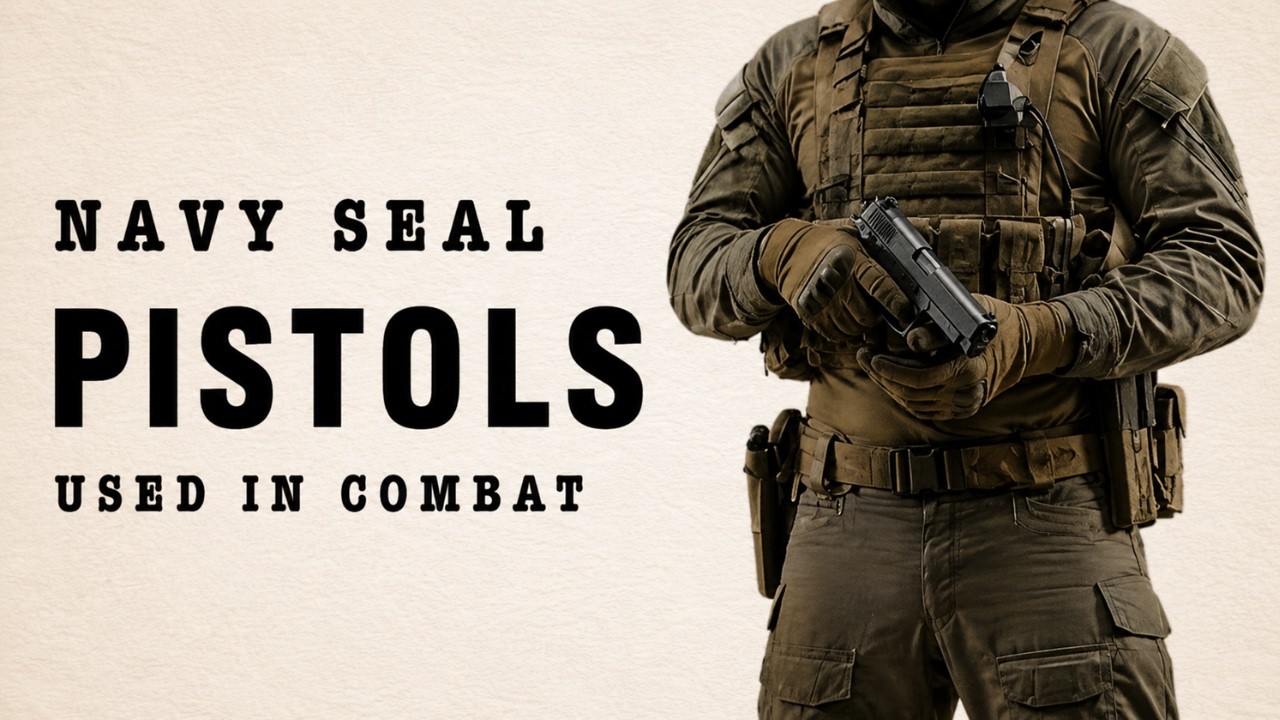
Navy SEALs Pistols: Inside The Mindset of a Deadly Marksman
In close-quarters combat, a primary weapon failure leaves an operator with mere fractions of a second to decide whether they live or die. When examining the topic of Navy SEALs pistols: inside the mindset of a deadly marksman, the conversation cannot simply be about steel, polymer, and ballistics. It is fundamentally about the seamless interface between lethal human intent and mechanical reliability under extreme biological stress.

For the elite operators of Naval Special Warfare (NSW), a sidearm is rarely the tool of choice for initiating a fight. Instead, it serves as the ultimate life-insurance policy—a compact, rapid-deployment weapon that must operate flawlessly in maritime salt spray, desert grit, and tight structural clearances.
The Evolution of NSW Handguns: From Mk 23 to Modern Polymer
The weapons carried by SEALs have evolved over decades of operational feedback, shifting from heavy offensive platforms to ultra-reliable, compact defensive weapons optimized for speed and human ergonomics.
The Heckler & Koch Mk 23 Mod 0: The Offensive Handgun
In the early 1990s, USSOCOM sought an "Offensive Handgun Weapon System" (OHWS). The result was the legendary HK Mk 23 Mod 0 chambered in .45 ACP. Built like a tank, the Mk 23 included a match-grade barrel, threaded muzzle for Knight’s Armament suppressors, and an early laser aiming module (LAM).
While indestructible and exceptionally accurate, the Mk 23 had a major drawback: its massive footprint. Weighing nearly 2.5 pounds unloaded, it proved unwieldy for operators who needed to move fast and carry heavy primary weapon loads. It taught NSW a critical lesson: a pistol in tier-one units should complement primary weapon movement, not hinder it.
The SIG Sauer P226 (Mk 25): The Decades-Long Standard
Following trials in the late 1980s, the SIG Sauer P226 became the benchmark sidearm for the SEAL Teams, designated officially as the Mk 25. Chambered in 9x19mm Parabellum, the Mk 25 featured a hard-anodized aluminum frame, stainless steel slide, and a proprietary phosphate corrosion-resistant coating applied to its internal springs and controls.
The P226's traditional double-action/single-action (DA/SA) trigger mechanism offered a built-in safety measure: an initial long, heavy trigger pull to prevent accidental discharges under adrenal dump, followed by crisp, short-reset single-action follow-up shots. For nearly three decades, the Mk 25 defined maritime combat reliability.
The Glock 19 (Mk 27): The Compact Shift
As tactics shifted deeper into low-visibility operations, CQB, and micro-footprint gear, NSW adopted the Glock 19, designated the Mk 27. The shift from metal-framed, hammer-fired handguns to striker-fired polymer sidearms was driven by simple physics: lighter weight, fewer parts, unified trigger pulls, and easier integration with modern optics.
- Weight reduction: Carrying polymer saves vital ounces over a multi-day mission profile.
- Consistent trigger break: Striker systems eliminate the distinct transition between the first DA shot and subsequent SA shots.
- Miniature Red Dot Sights (MRDS): Modern Mk 27 platforms accept slide-mounted optics, accelerating target acquisition in pitch-black environments.
Navy SEALs Pistols: Inside the Mindset of a Deadly Marksman
Having a precision firearm strapped to your battle belt does not make you a deadly shooter. The true differentiator between a weekend target shooter and an NSW operator is the human software: the mental architecture built through thousands of hours of high-stress conditioning.
1. Subconscious Weapon Manipulation
Under sympathetic nervous system activation (the "fight-or-flight" response), fine motor skills deteriorate rapidly. Heart rates spike above 160 beats per minute, auditory exclusion sets in, and tunnel vision narrows perception. A lethal marksman cannot afford to consciously think about sight alignment, trigger prep, or magazine seating.
SEAL marksmanship relies on developing autonomous neural pathways. Through endless dry-fire repetitions, weapons handling moves entirely to the subconscious mind. The operator's conscious brain remains focused entirely on situational assessment, threat identification, and muzzle discipline in proximity to teammates.

2. The Myth of Speed: "Smooth is Fast"
Novice shooters often attempt to snatch the pistol from the holster rapidly, resulting in poor grip acquisition, muzzle wobble, and missed first-round hits. Elite combat marksmen teach the exact opposite: establish a deterministic, mechanical economy of motion.
- Aggressive master grip: The firing hand drives deep into the beaver-tail before the weapon clears Kydex.
- Direct linear draw stroke: The pistol moves straight up the ribcage and drives outward toward the threat in an efficient line, rather than bowling out in an arc.
- Early sight acquisition: Sights or red-dot reticles are picked up during extension, allowing trigger prep before full lockout.
3. Absolute Threat Focus and Red Dot Integration
Traditional marksmanship dogma dictated hard focus on the front sight post, leaving the target blurred in the background. Modern tactical training challenges this. In a gunfight, human biology naturally forces vision onto the lethal threat.
By transitioning to red dot optics on modern combat handguns, operators maintain direct, binocular threat focus. The illuminated dot simply floats in their field of vision over the specific anatomical structure they intend to penetrate, drastically increasing split times and target-to-target transitions.
Drills That Build Combat Lethality
To cultivate this level of proficiency, Naval Special Warfare marksmen rely on demanding evaluation standards that measure both accuracy and temporal control under fatigue.
The Mozambique Drill (Failure Drill)
Designed to counter body armor or chemically altered combatants, the failure drill requires two rapid hits to the high-center chest followed instantly by a calibrated, single precision shot to the ocular-cranial cavity (the head). The transition forces the brain to shift instantly from cadence shooting to absolute precision under recoil.
The Transition Drill: Primary to Secondary
When a rifle runs dry or suffers a catastrophic stoppage inside room distances (within 5 to 7 meters), fixing the malfunction takes too long. Operators are drilled to drop the rifle to its sling, simultaneously drop the support hand to clear garments or open the holster, and press the sidearm into action in under 1.2 seconds.
The Accountability of Every Round
The defining characteristic of an elite marksman is not body count; it is accountability. In hostile urban environments or hostage-rescue operations, missing the target by mere inches can cost the life of an innocent civilian or a fellow operator. SEALs train under the philosophy that every round fired carries a legal, tactical, and ethical consequence.
This reality requires immense emotional control. While heart rate surges and environmental chaos reigns, the shooter must maintain the discipline to break a smooth, unhurried trigger press. Precision under pressure is not an innate gift—it is an intensely conditioned state of calm.
Final Thoughts
The story of modern combat sidearms proves that the arrow is only as good as the archer. While platforms have shifted from the massive HK Mk 23 and the venerable SIG P226 to optic-equipped Glocks and modular systems, the core requirement remains unchanged. Lethality is achieved through uncompromising mastery of the fundamentals, strict mental discipline, and the understanding that when the primary rifle goes silent, the pistol must speak with surgical precision.