Palm Beach County Arrest Report: Lookup Guide
Finding an official palm beach county arrest report is a straightforward process thanks to Florida’s expansive open-records framework. Whether you are checking on a friend or relative, researching a criminal matter, or conducting a background assessment, the state makes booking and arrest data readily accessible to the public.

However, the process can become confusing if you do not know which agency handled the incident or where the records are housed. While the Palm Beach County Sheriff’s Office (PBSO) manages the county detention facilities and logs bookings, individual municipal police departments and the county court system also maintain distinct records. This guide breaks down exactly where to look, how to interpret the documents you find, and what legal protections apply to arrest histories in Florida.
How to Find a Palm Beach County Arrest Report Online
Depending on how recent the incident occurred, you have two primary public databases to search: the Sheriff’s booking system and the County Clerk’s criminal court system.
1. The Palm Beach County Sheriff's Office (PBSO) Booking Blotter
If someone was taken into custody within the last few hours or days, your first stop should be the PBSO online booking portal. PBSO operates the county's primary correctional facilities—the Main Detention Center in West Palm Beach and the West County Detention Center in Belle Glade.
To use the PBSO booking search:
- Visit the official Palm Beach County Sheriff's Office website (pbso.org) and navigate to the Arrest & Jail Info section.
- Enter the individual's legal first and last name. You can narrow the results if you know their date of birth or booking date range.
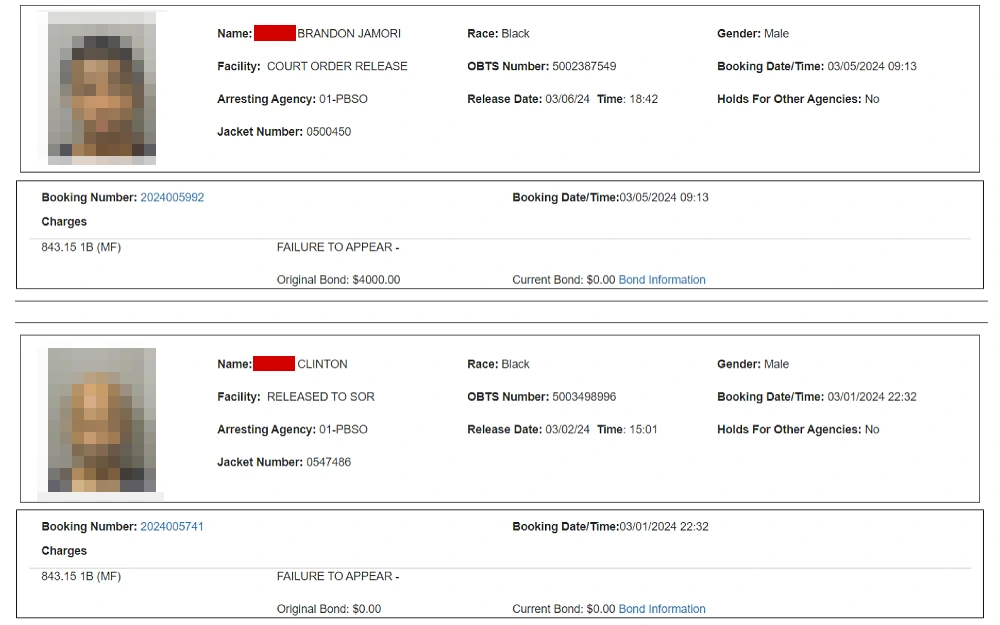
- Review the results list to find the matching entry. Clicking on the subject’s name reveals their booking details, including the booking number, mugshot, physical description, charges, and bond information.
The PBSO booking log is updated constantly, making it the fastest way to confirm whether an individual is currently incarcerated or was recently processed.
2. The Palm Beach County Clerk of the Circuit Court & Comptroller (eCaseView)
Once a person is booked, their case transfers into the judicial system. To review formal charges, sworn arrest affidavits, court filings, and scheduled hearings, search the Clerk’s public docket system known as eCaseView.
Here is how to search court records through the Clerk:
- Navigate to the Palm Beach County Clerk’s portal (mypalmbeachclerk.com).
- Access the eCaseView court records search tool. You can search as an unregistered guest, though registered accounts obtain access to additional document types.
- Select "Criminal/Traffic" and search by the person’s legal name or specific case number.
- Open the docket sheet. Inside, look for entries titled Probable Cause Affidavit or Arrest Affidavit. This sworn statement, written by the arresting officer, describes the precise facts and evidence that led to the arrest.
Understanding the Information on an Arrest Record
Arrest reports contain precise legal terminology and bureaucratic codes. When reading a report, focus on the following key fields:
- Booking Number: A unique numerical identifier assigned to that specific incarceration event.
- Arresting Agency: Identifies which law enforcement body made the arrest (e.g., PBSO, West Palm Beach Police Department, Boca Raton Police, or the Florida Highway Patrol).
- Statute Numbers & Charge Descriptions: The specific Florida statutes the individual is accused of violating (e.g., F.S. 812.014 for Theft). The report will specify whether each count is classified as a misdemeanor or a felony.
- Bond / Bail Status: States whether the arrestee is eligible for release on bail, the exact dollar amount required per charge, or if they are held on a "No Bond" status pending their First Appearance hearing.
- Court Case Number: Assigned once the State Attorney's Office receives the referral and files the formal charging documents.
Arrest Reports vs. Police Incident Reports
It is important to distinguish between a jail booking log, a formal arrest report, and a general police incident report:

A Booking Log simply confirms that an individual was brought to jail, processed, photographed, and held. It contains high-level information such as charges, bond, and booking date.
An Arrest Report (Probable Cause Affidavit) outlines the legal justification for taking the person into custody. It includes the officer’s detailed narrative of what occurred, witness statements collected on the scene, and preliminary evidence gathered.
A Police Incident Report documents an initial call for service. If an officer responded to a scene but made no immediate arrest, or if the investigation remains active, the resulting document is an incident or offense report, not an arrest report. Incident reports must be requested directly from the records division of the specific department that handled the call.
Requesting Official Certified Copies
If you require certified copies of an arrest report for employment, immigration, licensing, or legal proceedings, an online search printout is usually insufficient. You must obtain certified records directly from the appropriate custodian:
- For Court Dockets and Affidavits: Contact the Palm Beach County Clerk of Court’s Records Center. You can order certified dockets online through eCaseView or visit the Main Courthouse in downtown West Palm Beach.
- For Full Law Enforcement Incident Narratives: Contact the Central Records Bureau of the arresting agency. For PBSO cases, submit a public records request online through the PBSO public records portal. For municipal arrests, reach out to the records division of that city’s department (such as Delray Beach, Jupiter, or Boynton Beach).
Florida Public Records Law and Privacy Protections
Florida is widely recognized for having some of the strongest transparency laws in the United States, governed by Florida Statutes Chapter 119 (the "Government-in-the-Sunshine Law"). Under this statute, government records—including arrest data—are presumed public unless a specific statutory exemption applies.
However, certain details within an arrest report are routinely redacted to comply with state and federal privacy mandates:
- Marsy’s Law (Florida Constitution Article I, Section 16): Crime victims can invoke their right to prevent their names, home addresses, and identifying information from being released in public records.
- Juvenile Records: In Florida, records involving the arrest of minors are generally confidential, except in cases where a juvenile is charged with a serious or violent felony.
- Active Investigations: Portions of records tied to active, ongoing criminal investigations or confidential informants remain exempt from release until the investigation concludes.
- Personal Identifying Information: Social Security numbers, bank account details, and certain home addresses (such as those of active or retired law enforcement personnel) are automatically redacted.
Arrest vs. Conviction: An Important Distinction
An arrest report reflects only that law enforcement found probable cause to detain an individual; it is not proof of guilt. Under Florida law, the State Attorney's Office evaluates every arrest referral to decide whether to file formal charges, dismiss the counts, or divert the case into pre-trial intervention.
A subject listed on an arrest report may ultimately have their charges dropped (nolle prosequi), plead to reduced counts, or win an acquittal at trial. Therefore, always cross-reference an arrest report with the active court docket on the Clerk’s website to verify the final outcome of the case.
Sealing or Expunging a Palm Beach County Arrest Record
If an arrest did not result in a conviction—such as cases where charges were dismissed or the defendant completed a pre-trial diversion program—the subject may qualify to have the record sealed or expunged under Florida Statute 943.0585 or 943.0595.
The process requires applying for a Certificate of Eligibility from the Florida Department of Law Enforcement (FDLE), followed by filing a formal petition with the Palm Beach County Circuit Court. Once a judge grants the order, public agencies, including PBSO and the Clerk of Court, are legally required to remove the arrest record from public databases, allowing the individual to legally deny the arrest in most circumstances.