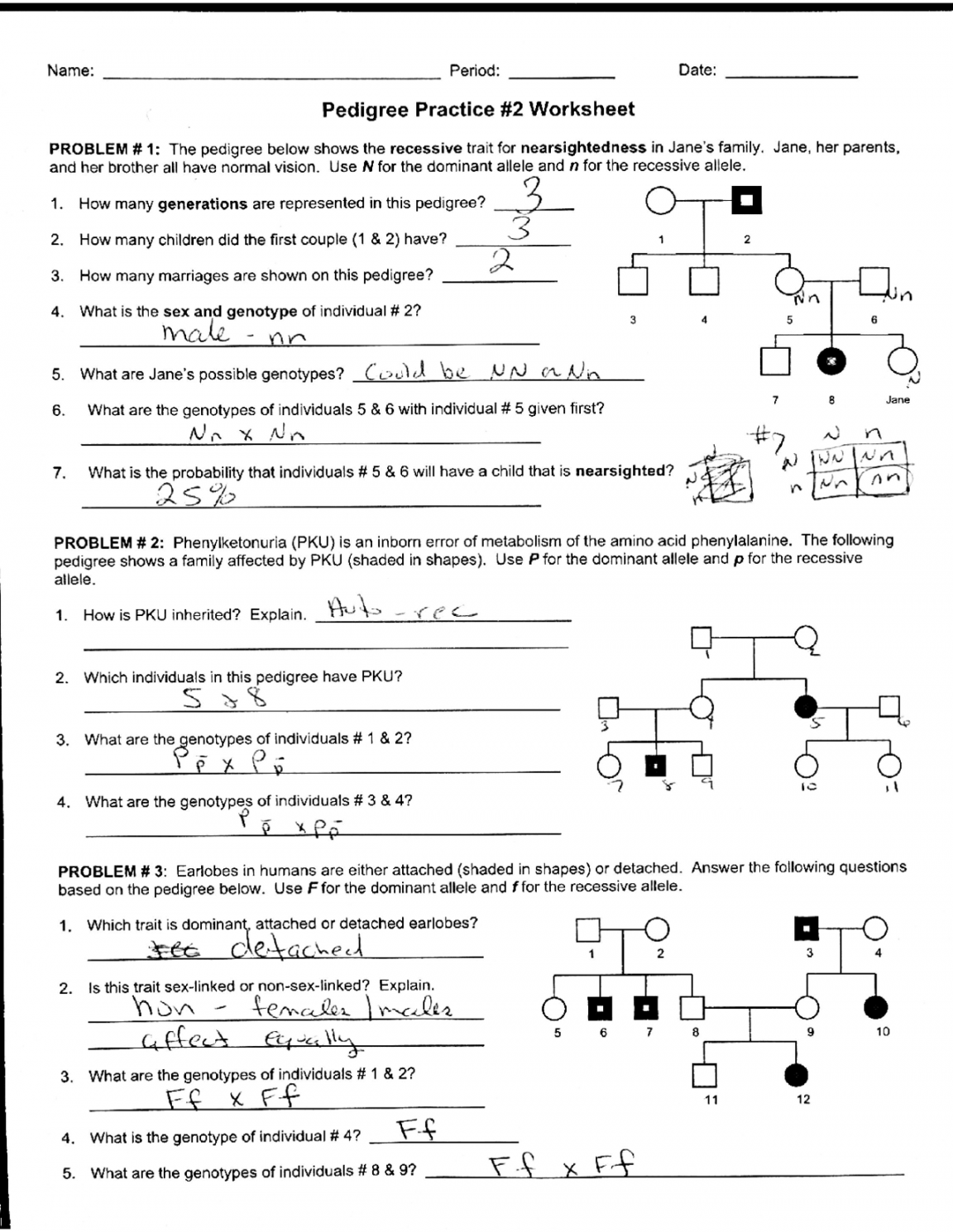
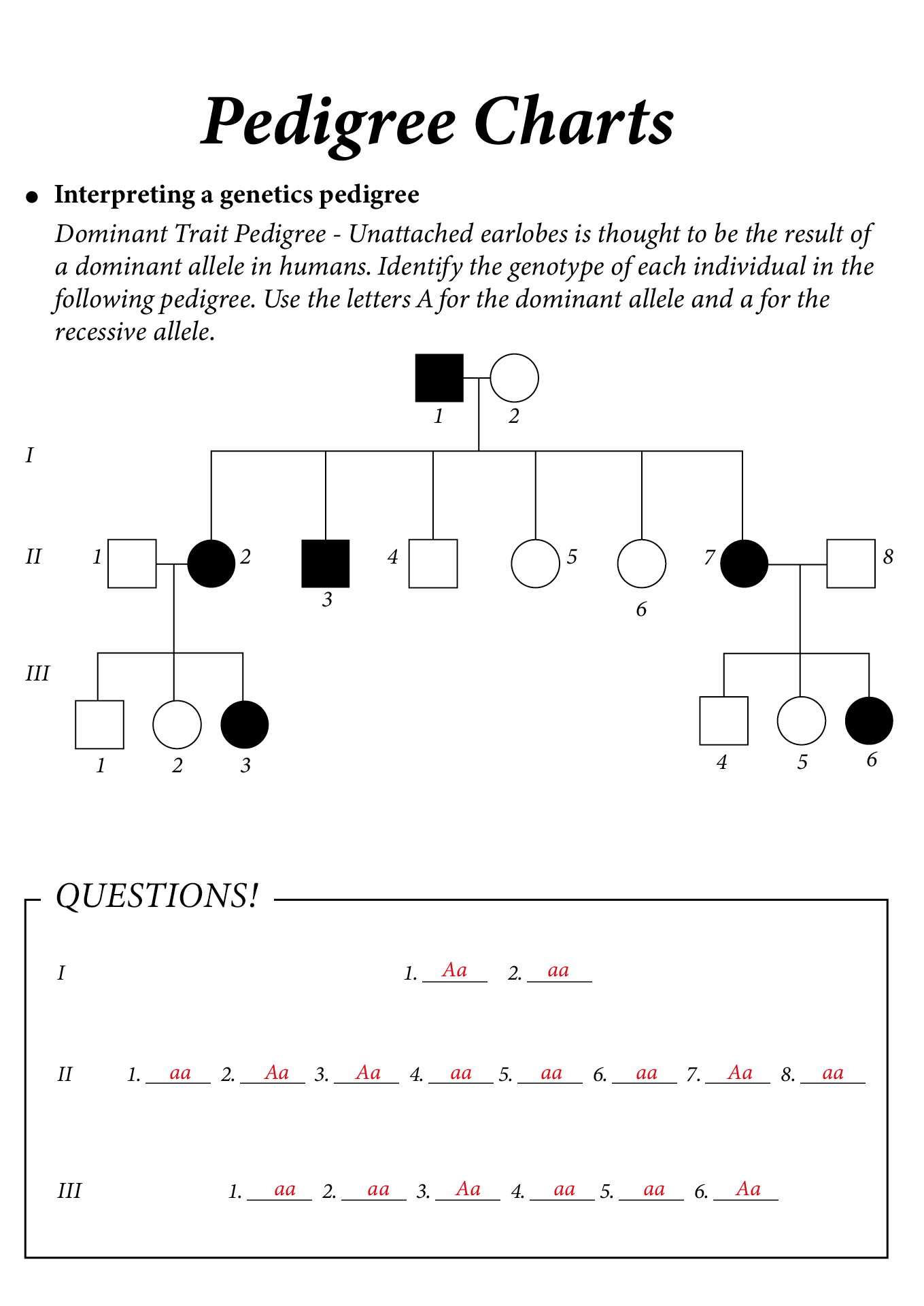
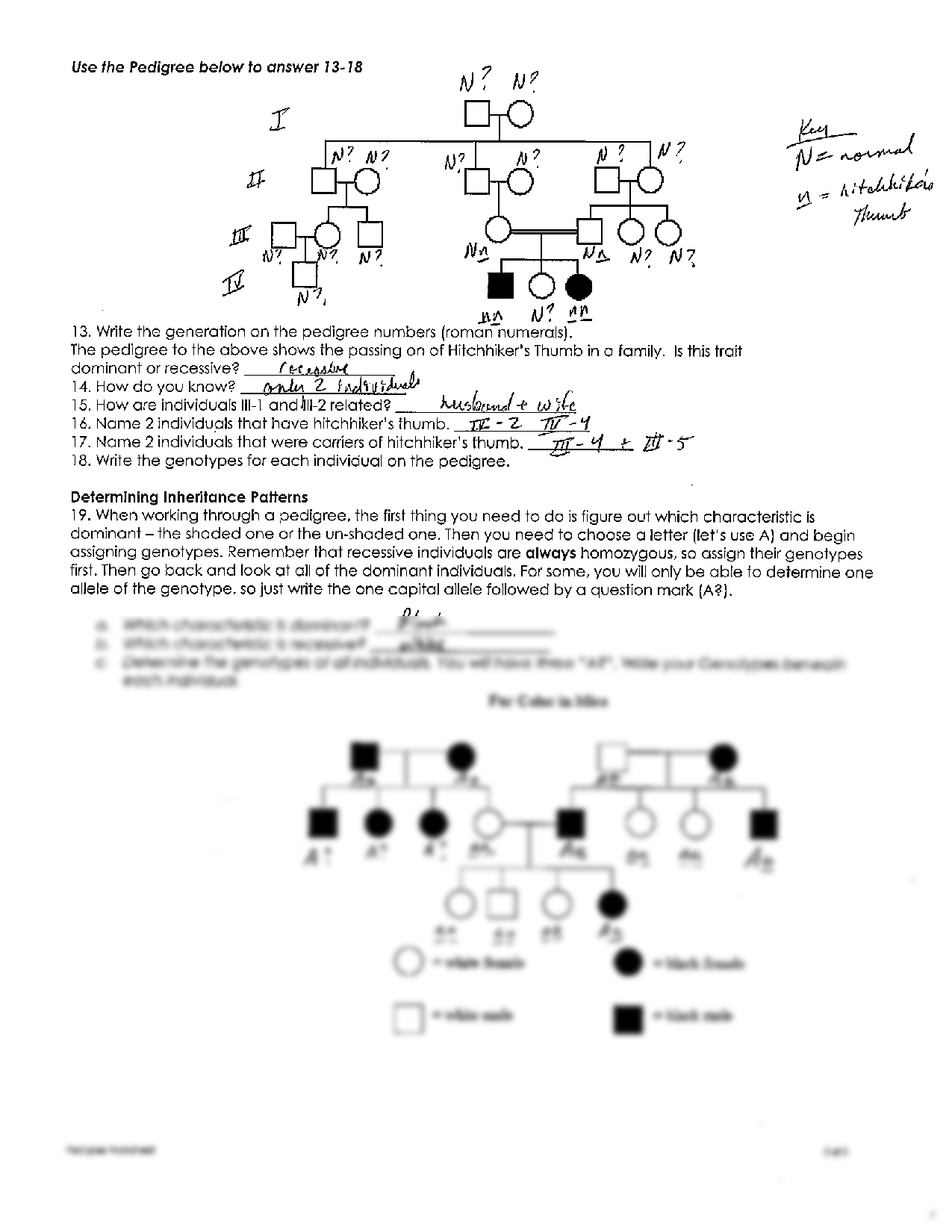
Pedigree Worksheet A Answer Key & Guide
When studying Mendelian genetics in high school or college biology, analyzing family trees is one of the most practical skills you will develop. If you are working through your genetics unit and looking for a reliable pedigree worksheet a answer key, this guide breaks down the standard problems, explains how to deduce unknown genotypes, and teaches you the rules needed to solve any pedigree chart on your own.

The Anatomy of a Pedigree Chart
Before jumping into solutions, you must be fluent in the basic shorthand used in pedigree charts. Standard worksheets rely on universally accepted symbols to represent individuals, relationships, and phenotypes:
- Squares: Represent biological males.
- Circles: Represent biological females.
- Horizontal lines connecting two individuals: Represent a mating pair.
- Vertical lines dropping from a union: Point to offspring, arranged from left to right by birth order.
- Fully shaded shapes: Indicate an individual expressing the trait or disorder being tracked.
- Unshaded shapes: Indicate an individual who does not express the trait.
- Half-shaded shapes (or a dot inside): Often represent known heterozygous carriers (especially in recessive traits, though many worksheets omit half-shading to test your deduction skills).
- Roman numerals (I, II, III): Label generations vertically down the chart.
- Arabic numerals (1, 2, 3): Label individuals within each generation from left to right.
How to Determine the Mode of Inheritance
Most questions on Pedigree Worksheet A ask you to state whether a trait is autosomal recessive, autosomal dominant, X-linked recessive, or X-linked dominant. Follow these diagnostic tests to identify the pattern immediately.
1. Autosomal Recessive
An autosomal recessive condition requires two copies of the mutant allele (e.g., aa) to express the phenotype. Look for these hallmark clues:
- The trait frequently skips generations.
- Two unaffected parents can produce an affected child (both parents are heterozygous carriers, Aa).
- Males and females are affected in roughly equal proportions.
- If both parents have the condition (aa × aa), all of their biological children must also have it.
2. Autosomal Dominant
An autosomal dominant trait requires only one copy of the mutant allele (e.g., Aa or AA) to produce the phenotype.
- The trait appears in every generation without skipping.
- Every affected individual has at least one affected parent.
- Two affected parents can have an unaffected child if both parents are heterozygous (Aa × Aa yields a 25% chance of an aa child).
- Two unaffected parents can never produce an affected child (aa × aa cannot produce A-).
3. X-Linked Recessive
X-linked recessive traits reside on the X chromosome and exhibit distinct sex-based disparities.
- The condition appears far more frequently in males than in females, because males need only one recessive allele (XaY) to express it.
- An affected mother will pass the trait to all of her sons (since sons inherit their single X from the mother).
- An affected female must have an affected father (XaY) and a mother who is at least a carrier (XAXa).
- The trait is never passed directly from father to son (fathers contribute their Y chromosome to sons).
Step-by-Step Pedigree Worksheet A Answer Key and Solutions
Standard versions of "Worksheet A" present three common pedigree case studies. Below are typical problem sets, accompanied by complete genotype determinations and logic breakdowns.
Case Study 1: The Albinism Pedigree (Autosomal Recessive)

Scenario: Albinism is a classic recessive condition caused by a lack of melanin production. Let A = normal pigmentation and a = albinism.
Sample Chart Details:
- Generation I: Individual I-1 (unaffected male) mates with I-2 (unaffected female).
- Generation II: They have four children: II-1 (unaffected female), II-2 (affected male, aa), II-3 (unaffected male), and II-4 (unaffected female).
- II-2 mates with II-5 (unaffected female from outside the family) and produces two unaffected children (III-1 and III-2).
Answer Key & Genotypes:
- What is the mode of inheritance? Autosomal recessive. Unaffected parents (I-1 and I-2) produced an affected child (II-2).
- What are the genotypes of I-1 and I-2? Both must be Aa. Because child II-2 is aa, he had to receive one a allele from each parent. Since neither parent shows albinism, both must carry the dominant A allele.
- What is the genotype of II-2? aa (affected individuals display the homozygous recessive phenotype).
- What is the genotype of child III-1? Aa. Because father II-2 is aa, he can only pass an a allele. Mother II-5 is unaffected; since III-1 is unaffected, III-1 must have received an A from the mother.
- Can we know for certain if II-1 is homozygous dominant (AA) or heterozygous (Aa)? No. II-1 has a 1/3 chance of being AA and a 2/3 chance of being Aa. Without seeing their offspring, their exact genotype remains A_.
Case Study 2: Polydactyly Pedigree (Autosomal Dominant)
Scenario: Extra fingers or toes (polydactyly) is often inherited via an autosomal dominant allele. Let P = polydactyly and p = normal five digits.
Sample Chart Details:
- Generation I: Individual I-1 (affected male) mates with I-2 (unaffected female).
- Generation II: They have three children: II-1 (affected female), II-2 (unaffected male), and II-3 (affected male).
- II-1 mates with II-4 (unaffected male) and they have one affected child (III-1) and one unaffected child (III-2).
Answer Key & Genotypes:
- What is the mode of inheritance? Autosomal dominant. Affected individuals have affected parents, and unaffected individuals (pp) cannot pass on the trait.
- What is the genotype of I-2? pp. Any unaffected individual in an autosomal dominant system is homozygous recessive.
- What is the genotype of I-1? Pp. He is affected, meaning he has at least one P allele. Because he produced an unaffected child (II-2, pp), he must have contributed a p allele.
- What is the genotype of II-1? Pp. She inherited P from her father and must have received p from her unaffected mother (I-2).
- What is the probability that II-1 and II-4 have another unaffected child? 50% (1/2). The cross is Pp × pp. The offspring possibilities are 50% Pp (affected) and 50% pp (unaffected).
Case Study 3: Red-Green Color Blindness (X-Linked Recessive)
Scenario: Red-green color blindness is an X-linked recessive trait. Let XB = normal vision and Xb = color blindness.
Sample Chart Details:
- Generation I: Individual I-1 (unaffected male) mates with I-2 (unaffected female).
- Generation II: They have two children: II-1 (color-blind male) and II-2 (unaffected female).
- II-2 mates with II-3 (unaffected male) and has a color-blind son (III-1).
Answer Key & Genotypes:
- What is the genotype of father I-1? XBY. Males carry only one X chromosome; since he has normal vision, his X chromosome carries the dominant allele.
- What is the genotype of mother I-2? XBXb (carrier). Her son II-1 is color blind (XbY). Sons inherit their Y chromosome from their father, so the mutant Xb came from I-2. Because I-2 has normal vision, her second X must carry XB.
- What is the genotype of daughter II-2? XBXb. She produced a color-blind son (III-1, XbY), proving she is a carrier.
- If II-1 (color-blind male) marries a woman with no history of color blindness (homozygous dominant), what percentage of their daughters will be color blind? 0%. All daughters will receive his Xb and the mother's XB, making them carriers (XBXb) with normal vision.
Four Golden Rules for Solving Any Pedigree Problem
Whenever you encounter an unfamiliar pedigree worksheet or test question, use these four rules to avoid getting stuck:
- Assign homozygous recessives first: If the trait is autosomal recessive, shade in every affected person as aa. If it is dominant, label every clear symbol as aa (or pp). Establishing definite genotypes first limits the possibilities for everyone else.
- Work backwards from children to parents: Every individual receives one allele from each parent. An affected recessive child requires a recessive allele from both parents, immediately identifying heterozygous carriers.
- Check paternal inheritance for sex linkage: If an affected father has a normal daughter, the trait cannot be X-linked dominant. If an affected mother has a normal son, the trait cannot be X-linked recessive.
- Use underscores for ambiguous alleles: If an unaffected individual in an autosomal recessive pedigree has unaffected parents and siblings, write their genotype as A_ until you have concrete evidence of their second allele.