Permanent Product Recording Is an Indirect Method of Data Collection
In behavioral assessment, choosing the right measurement strategy is critical to gathering accurate, actionable information. Within Applied Behavior Analysis (ABA) and educational settings, clinicians and researchers frequently observe that permanent product recording is an indirect method of data collection because it assesses the tangible byproduct of a behavior rather than the behavior itself as it occurs in real time.

Understanding how this measurement system functions—along with its distinct advantages and inherent vulnerabilities—allows practitioners, teachers, and clinicians to select appropriate data collection systems that balance precision with clinical feasibility.
What Is Permanent Product Recording?
Permanent product recording is a measurement procedure that evaluates the lasting, physical results left behind after an individual engages in a target behavior. Unlike event recording, momentary time sampling, or duration tracking, permanent product recording does not require the observer to be physically present while the individual performs the action.
Behaviors can be either transient or productive:
- Transient behaviors: Actions that leave no physical residue after they end, such as vocalizations, motor tics, hand-flapping, or waving. These require direct, real-time observation.
- Productive behaviors: Actions that produce a measurable environmental change or tangible item, such as completing a math worksheet, vacuuming a carpet, assembling an industrial component, or breaking a pencil.
When measuring permanent products, the clinician evaluates the end result—counting the completed homework pages, assessing the cleanliness of the room, or tallying the number of assembled units.
Why Permanent Product Recording Is an Indirect Method of Data Collection
In behavioral science, measurement methods are generally categorized by the closeness of the observer to the actual behavioral event. Direct measurement requires recording the behavior at the exact moment it occurs. In contrast, permanent product recording is an indirect method of data collection because it relies on ex-post-facto evidence.
There is an important nuance highlighted in foundational behavioral texts, such as Cooper, Heron, and Heward’s Applied Behavior Analysis: permanent product recording directly measures the product, but it indirectly measures the behavior. The observer infers that the target response occurred based entirely on the existence and quality of the physical residue.
Consider an educator grading an essay submitted by a student. The teacher directly measures the words, structure, and mechanics of the written essay. However, the teacher did not directly observe the student typing, researching, or editing. The process of behavioral execution is inferred rather than observed, making the assessment of the behavior itself indirect.
The Distinction Between Direct and Indirect Data Collection
- Direct observation: The practitioner watches a child initiate a peer interaction on the playground and marks a frequency tally immediately. The measurement and the behavior are contemporaneous.
- Indirect assessment: The practitioner reviews third-party reports, rating scales, behavioral interviews, or permanent environmental artifacts after the event has concluded. The measurement occurs post hoc.
Common Examples Across Different Environments
Permanent product recording is widely utilized across academic, vocational, and clinical environments due to its practicality.
Academic and School Settings
- Worksheet completion: Counting the percentage of math problems completed correctly after independent seatwork.
- Spelling tests: Tallying correct letter sequences on a graded paper.
- Art and handwriting tasks: Evaluating letter formation, tracing precision, or finished craft assemblies.
Vocational and Daily Living Skills
- Janitorial tasks: Checking whether trash cans are emptied, mirrors are wiped, and floors are swept using a standardized rubric.
- Inventory stocking: Verifying the count of grocery shelves stocked according to a visual planogram.
- Meal preparation: Inspecting a set table or a plated meal against hygiene and presentation standards.
Clinical and Maladaptive Behaviors
While often used for constructive behaviors, permanent product recording can also track certain destructive or disruptive responses:
Video: Permanent Product Recording
- Property destruction: Documenting the number of torn workbook pages, broken toys, or holes punched in materials.
- Self-injurious behavior (SIB): In specialized medical and clinical settings, clinicians track visible tissue damage (e.g., scratches, bruising) under strict medical oversight, though direct observation remains the clinical gold standard for safety.
Key Advantages of Permanent Product Data Collection
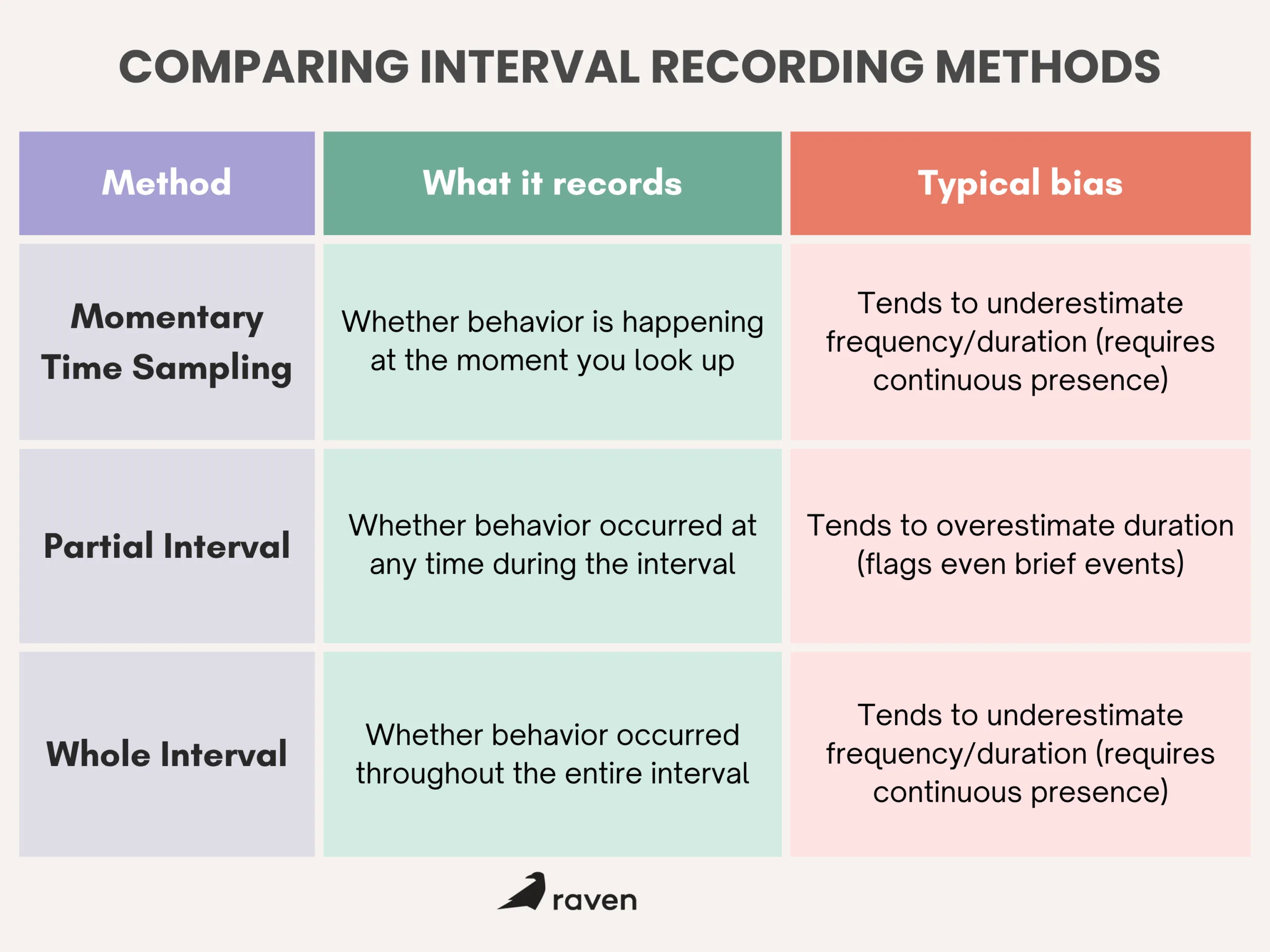
Using permanent products to measure behavior offers distinct operational advantages over continuous, direct observation.
1. Observer Freedom and Efficiency
Direct observation requires uninterrupted attention. Teachers and clinicians often juggle multiple individuals simultaneously and cannot continuously monitor one learner for an hour. Permanent products allow the practitioner to teach, manage a room, or attend to other duties while the behavior occurs, analyzing the results at a convenient time.
2. High Interobserver Agreement (IOA)
Because physical products do not disappear, they can be stored, photographed, duplicated, and reviewed by multiple independent observers. This permanence makes calculating Interobserver Agreement (IOA) straightforward and reliable, minimizing disputes over whether a response met operational definitions.
3. Minimization of Reactivity
Reactivity occurs when an individual alters their behavior simply because they know someone is watching them. Because permanent products can be evaluated after the individual has left the area, reactivity is significantly reduced or eliminated entirely.
Limitations and Clinical Considerations
Despite its efficiency, using permanent product recording as an indirect method introduces unique methodological challenges that practitioners must actively address.
The Attribution Problem
The primary threat to the validity of permanent product data is attribution: can you prove that the target individual performed the behavior that created the product? If a student turns in a perfectly completed math sheet, did they solve the problems themselves, use an automated software tool, or copy answers from a peer? Unless safeguards are present, the product may not accurately reflect the target individual’s independent performance.
Loss of Topographical and Temporal Data
Permanent products show what was produced, but not how or how fast it was produced. An artifact reveals little about:
- Topography: Did the student hold the pencil correctly, or did they display awkward motor posture?
- Duration and latency: Did completing the 10 math problems take 5 minutes or 90 minutes? How long did the student stare at the paper before writing the first answer?
- Emotional or physiological context: Did the learner complete the task calmly, or did they display signs of severe distress, pacing, or frustration throughout the process?
Best Practices for Implementing Permanent Product Recording
To maximize the reliability of permanent product recording while accounting for its indirect nature, follow these clinical guidelines:
- Confirm behavioral ownership: Ensure the environment is controlled sufficiently so that only the target individual could have produced the artifact (e.g., individualized digital logins, designated workstations, or intermittent spot-checks).
- Establish clear operational definitions for the product: Define exactly what constitutes an acceptable product. Instead of defining a “clean room,” specify that “clothes are placed inside the hamper, bedsheets are pulled to the headboard, and no objects larger than a coin remain on the floor.”
- Pair with direct measurement when introducing new skills: When a learner is first acquiring a behavior, use direct observation to monitor technique, latency, and form. Transition to permanent product recording only after the behavior is reliably established and fluency is demonstrated.
- Archive artifacts systematically: Store physical samples or high-resolution digital photographs alongside dated records. This documentation supports longitudinal progress monitoring and transparent audits.
Conclusion
Permanent product recording is an indispensable tool in the behavioral measurement toolkit. By recognizing that permanent product recording is an indirect method of data collection concerning the behavior itself, practitioners can deploy it deliberately—reaping the benefits of time efficiency and objective IOA while implementing checks to ensure that the resulting data remain accurate, valid, and clinically useful.