Piecewise Functions Simplified: Domain and Range
Piecewise functions often intimidate algebra and precalculus students at first glance. With their stacked brackets, multiple formulas, and distinct inequality conditions, they look far more complicated than standard functions. However, once you break them down into individual segments, analyzing them becomes straightforward. Welcome to Piecewise Functions Simplified: A Comprehensive Domain and Range Resource, designed to give you a reliable, step-by-step framework for finding inputs, outputs, and graphical behaviors without second-guessing yourself.

What Is a Piecewise Function?
A piecewise function is a single mathematical function defined by multiple sub-functions, where each sub-function applies to a specific interval of the independent variable (usually x). Instead of applying one continuous formula across all real numbers, the function changes its mathematical rule depending on the value you input.
In standard mathematical notation, a piecewise function looks like this:
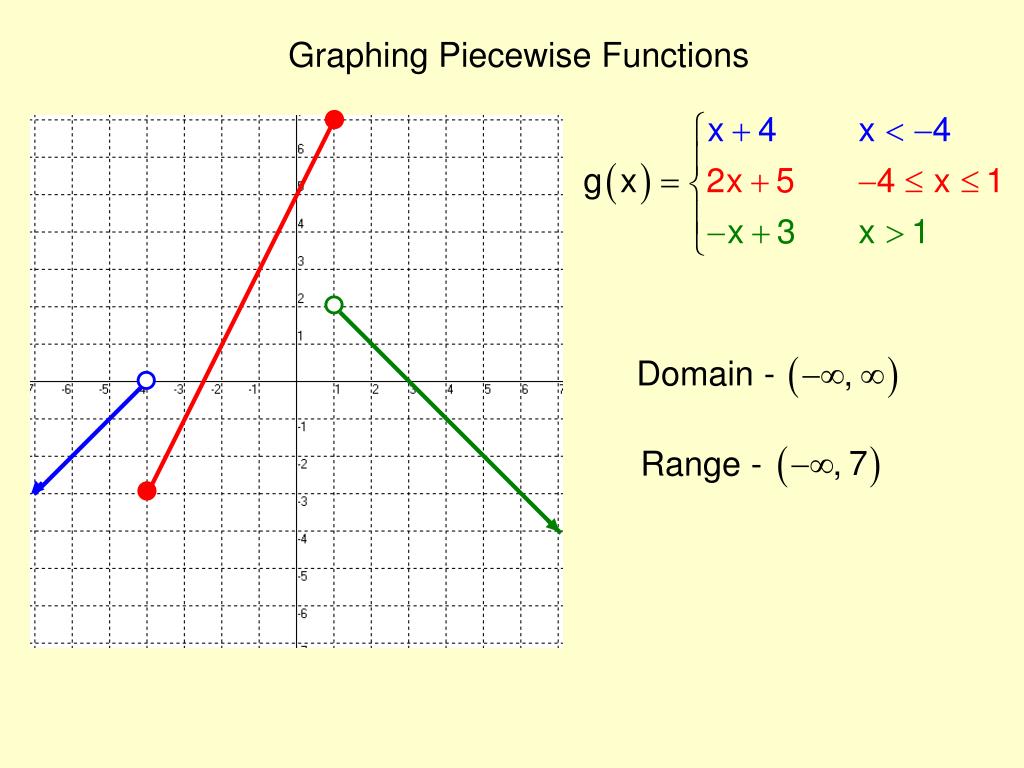
f(x) = { 2x + 3 if x < -1; x² if -1 ≤ x ≤ 2; 5 if x > 2 }
In this expression, the expressions on the left represent the rules or formulas, while the inequalities on the right dictate the conditions (or restricted sub-domains). You can think of a piecewise function like a progressive income tax system or a tiered shipping fee: the rate you pay depends strictly on which numerical bracket your input falls into.
Piecewise Functions Simplified: A Comprehensive Domain and Range Resource
To successfully evaluate and graph these expressions, you must master two foundational concepts: domain and range. While they share the same overarching definitions used across all of algebra, piecewise functions require special attention to how boundaries join or separate.
- Domain: The complete set of allowable input values (x-values) across all sub-functions where the function is defined.
- Range: The complete set of resulting output values (y-values) generated by the sub-functions across their respective intervals.
Finding the domain usually involves analyzing the condition statements directly. Finding the range requires evaluating the outputs produced by each piece and combining them into a unified set.
How to Find the Domain of a Piecewise Function
Finding the domain of a piecewise function is primarily an exercise in examining the conditions listed alongside each formula. Follow these four steps to determine the total domain accurately:
Step 1: Write Down the Condition Intervals
Convert each inequality condition into interval notation. For example, if a piece is restricted to x < 2, that segment covers the interval (-∞, 2). If another piece applies to 2 ≤ x ≤ 6, its interval is [2, 6].
Step 2: Check for Inherent Algebraic Restrictions
Sometimes, a sub-function contains its own natural domain restrictions regardless of the piecewise conditions. Look out for:
- Fractions: Denominators cannot equal zero.
- Even roots: Values under radical signs must be greater than or equal to zero.
- Logarithms: Arguments must be strictly positive.
If a sub-function formula has an undefined point that falls within its designated condition interval, you must remove that point from the domain.
Step 3: Take the Union of the Intervals
Combine the valid intervals from all pieces using the union symbol (∪). If the pieces connect seamlessly without missing numbers, your domain might be all real numbers, represented as (-∞, ∞).
Step 4: Account for Gaps and Excluded Points
Check the boundary points between intervals. If one piece ends at x < 3 and the next begins at x > 3, the value x = 3 is not included in either condition. In this scenario, the domain contains a gap at x = 3, written as (-∞, 3) ∪ (3, ∞).
How to Find the Range of a Piecewise Function

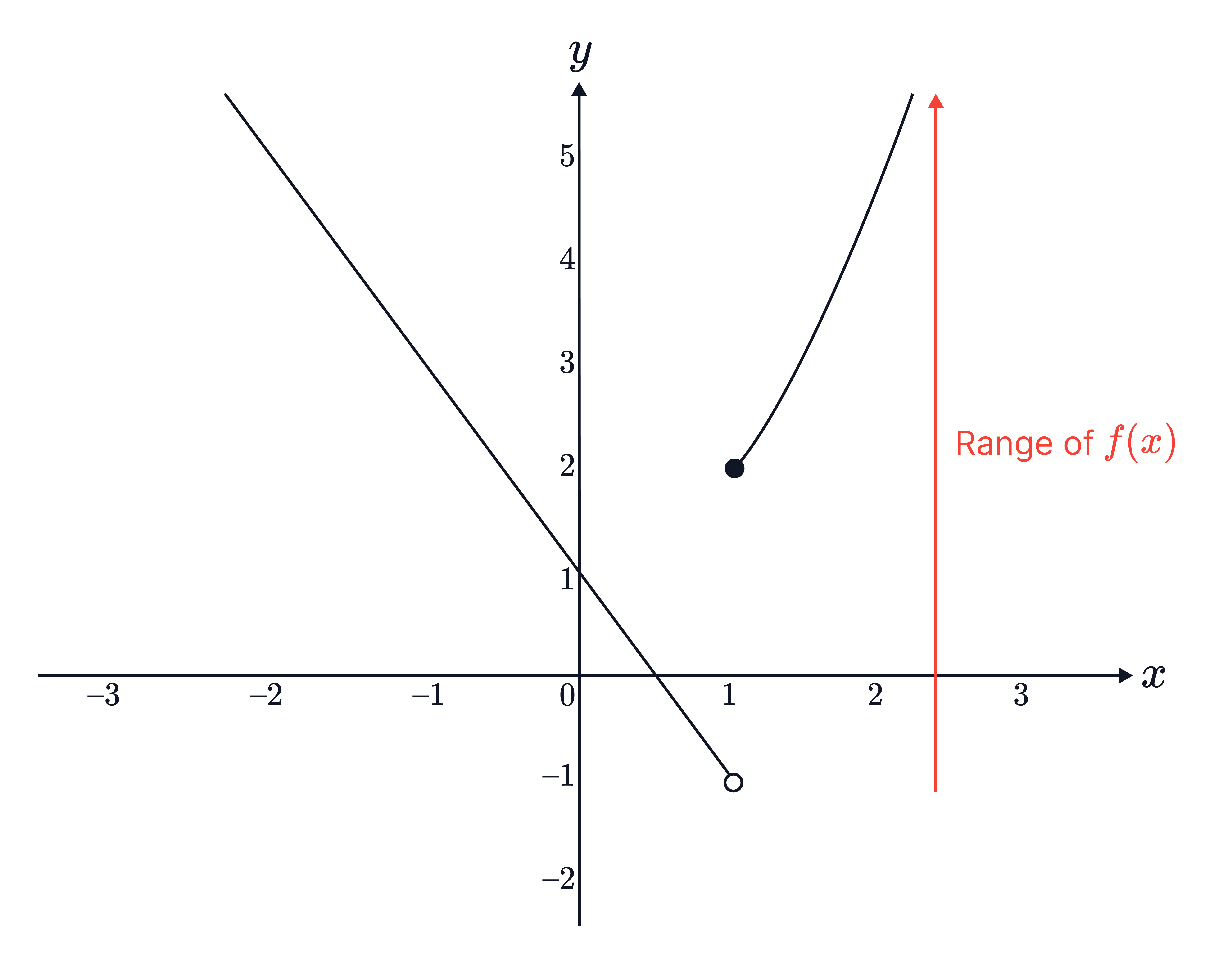
Determining the range is often more challenging than determining the domain because you cannot rely solely on looking at inequalities. You must assess the behavior of each sub-function on its specific domain.
Step 1: Evaluate Boundary Endpoints
Calculate the output of each piece at the endpoints of its assigned interval. Even if an inequality uses a strict comparison (< or >) with an open circle on a graph, plug that boundary value into the formula to find the open boundary value for the range.
Step 2: Identify Critical Behavior Within Intervals
Functions do not always travel in straight lines between their endpoints. Be mindful of:
- Parabolas (Quadratic pieces): Does the vertex fall within the piece's domain? A parabola opening upward has a minimum value at its vertex that could be lower than either endpoint.
- Linear pieces: Linear functions are strictly monotonic (always increasing or always decreasing), meaning their maximum and minimum outputs on a closed interval always occur at the endpoints.
- Constant pieces: A horizontal line like f(x) = 4 contributes only a single discrete value ({4}) to the range.
Step 3: Combine and Merge the Output Sets
Gather the output intervals from every piece and merge them onto a single number line. If Piece 1 produces outputs (-∞, 4] and Piece 2 produces [2, 10), their combined range is (-∞, 10) because the intervals overlap between 2 and 4.
Worked Example: Finding Domain and Range Step-by-Step
Let us analyze the following piecewise function:
g(x) = { x + 4 if x < 0; -x² + 3 if 0 ≤ x ≤ 2; 2 if x > 3 }
Finding the Domain of g(x)
- The first condition covers x < 0 → (-∞, 0).
- The second condition covers 0 ≤ x ≤ 2 → [0, 2].
- The third condition covers x > 3 → (3, ∞).
Merging pieces 1 and 2 covers (-∞, 2]. However, notice the interval between x = 2 and x = 3: neither condition includes inputs between 2 and 3, nor is x = 3 included. Therefore, the overall domain is:
Domain: (-∞, 2] ∪ (3, ∞)
Finding the Range of g(x)
- Piece 1: g(x) = x + 4 for x < 0. As x approaches -∞, y approaches -∞. As x approaches 0 from the left, y approaches 0 + 4 = 4 (with an open circle). Output set: (-∞, 4).
- Piece 2: g(x) = -x² + 3 for 0 ≤ x ≤ 2. This is a downward-opening parabola with its vertex at (0, 3). At x = 0, y = 3 (maximum). At x = 2, y = -(2)² + 3 = -1 (minimum). Output set: [-1, 3].
- Piece 3: g(x) = 2 for x > 3. This is a constant function yielding only the value y = 2. Output set: {2}.
Now, combine all outputs: (-∞, 4), [-1, 3], and {2}. Notice that both [-1, 3] and {2} are completely contained inside (-∞, 4). Thus, the union simplifies cleanly:
Range: (-∞, 4)
Common Pitfalls When Analyzing Piecewise Functions
Students frequently lose points on exams due to subtle missteps. Watch out for these three common traps:
- Confusing Open and Closed Circles: Strict inequalities (<, >) produce open boundaries represented by parentheses in interval notation. Non-strict inequalities (≤, ≥) produce closed boundaries represented by square brackets.
- Ignoring Vertices in Non-Linear Pieces: Do not just plug in interval endpoints for quadratic or polynomial pieces. If the vertex lies within the domain interval, it represents an absolute peak or trough that directly shapes the range.
- Violating the Vertical Line Test: Remember that piecewise definitions must remain valid functions. If condition intervals overlap—for instance, x ≤ 1 and x ≥ 1—both rules must produce the exact same y-value at x = 1. If they yield different outputs, the relation fails the vertical line test and is not a function.
Summary Checklist
Whenever you encounter a piecewise function on a test or homework assignment, use this quick mental checklist:
- Check conditions for gaps or undefined points to write your domain.
- Evaluate each formula's behavior across its assigned sub-domain.
- Find local extrema, such as parabola vertices, within each sub-interval.
- Plot endpoints using open circles for strict inequalities and closed dots for non-strict inequalities.
- Combine all output intervals into a single range statement using standard interval notation.
By treating each piece as a separate, manageable problem before combining the results, you can solve any piecewise function with total confidence.