Precise and Accurate Definition: The Key Differences
In everyday conversation, people often use the words “accurate” and “precise” interchangeably to describe something that is correct or exact. However, in scientific disciplines, engineering, statistics, and manufacturing, these two terms mean fundamentally different things. Anyone working with metrics, laboratory findings, or technical specifications requires a clear, precise and accurate definition of both terms to prevent miscommunication and costly errors.

Conflating accuracy with precision can lead to flawed experiments, miscalibrated machinery, and misleading statistical models. To make sound decisions based on measurement, you must understand what each term evaluates, how they interact, and why a measurement can easily be one without being the other.
What Does Accuracy Mean?
Accuracy refers to how close a measured value is to the true, accepted, or standard value of a quantity. When an observation matches reality or a certified reference benchmark, it is accurate. The greater the deviation from the true value, the lower the accuracy.
In metrology (the science of measurement), accuracy is primarily threatened by systematic errors. Systematic errors are predictable, consistent inaccuracies caused by flawed equipment, poor calibration, or an incorrect experimental setup. For instance, if an electronic scale is zeroed incorrectly and consistently adds 5 grams to every reading, every measurement will suffer from systematic bias, resulting in poor accuracy.
Consider a standard medical thermometer. If a healthy patient's true body temperature is 98.6°F (37.0°C) and the thermometer reads 98.6°F, the reading is accurate. If it reads 101.2°F, it is inaccurate.
What Does Precision Mean?
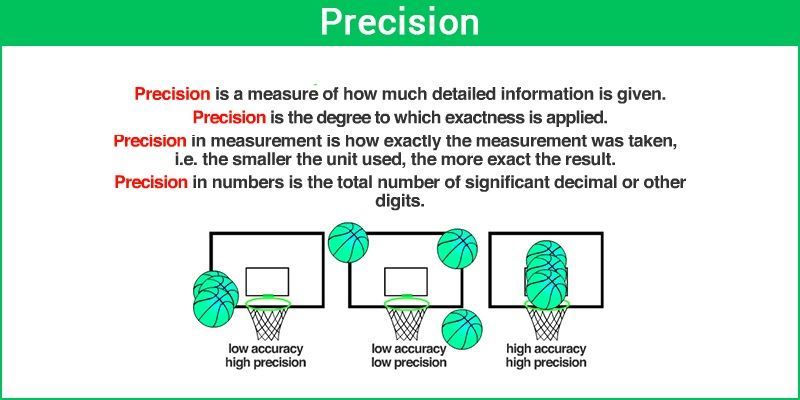
Precision refers to the repeatability and consistency of measurements under unchanged conditions. Rather than comparing an observation to an external standard or truth, precision evaluates how close independent measurements are to each other.
A set of measurements can be exceptionally precise even if all of them are completely wrong. Precision is primarily influenced by random errors—unpredictable fluctuations caused by environmental conditions, mechanical noise, or limitations in human reading capability. When random variations are minimized, precision increases.
Precision also relates to the level of detail or resolution a measuring device provides. A digital scale that reports weights to three decimal places (0.001 g) has higher potential precision than an analog kitchen scale that measures only to the nearest 10 grams.
The Precise and Accurate Definition: Core Differences
To grasp the relationship between the two terms, it helps to examine their attributes side by side across several key dimensions:
- Target of Comparison: Accuracy compares a measurement to a true, external value. Precision compares multiple measurements to each other.
- Sample Size Required: Accuracy can technically be assessed on a single measurement if the true value is known. Precision requires multiple repeated measurements to evaluate consistency.
- Associated Errors: Accuracy is linked to systematic error (bias). Precision is linked to random error (scatter).
- Primary Goal: Accuracy aims for correctness. Precision aims for reproducibility and detail.
Neither property guarantees the other. High precision does not imply high accuracy, and an accurate average across multiple readings does not mean the individual measurements were precise.
The Dartboard Analogy: Visualizing the Difference
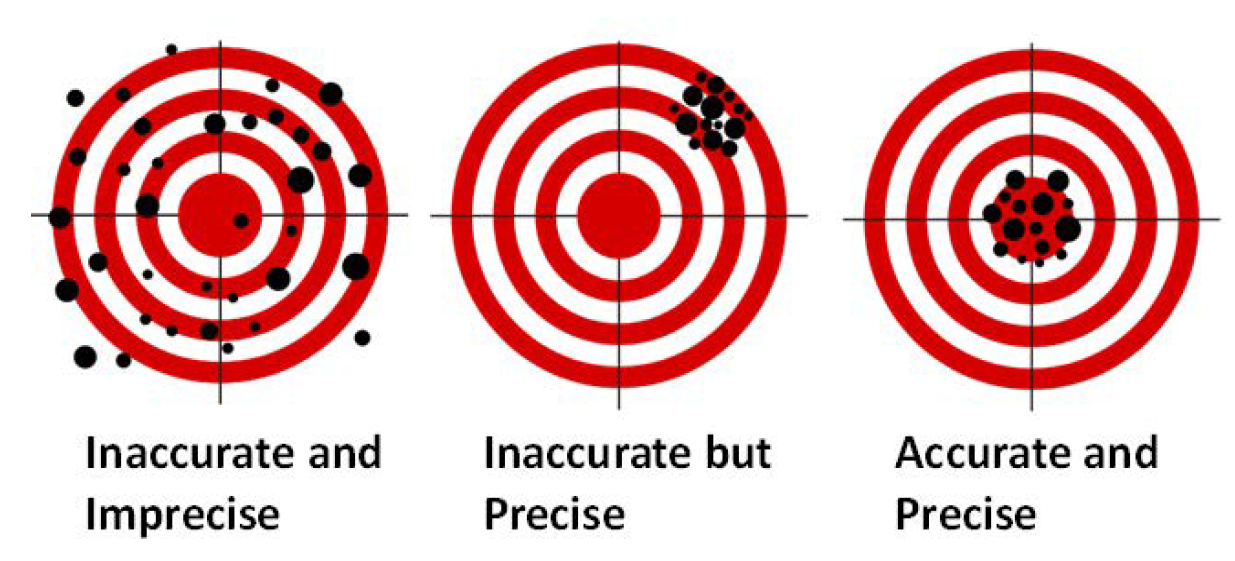
The standard visual model for teaching accuracy versus precision is the classic target or dartboard. Imagine throwing four darts at a bullseye:
1. Low Accuracy, High Precision
All four darts strike tightly grouped together, but they land in the upper-left corner of the board, far from the center. The throws are highly repeatable (precise), but they are consistently off-target (inaccurate). This is the hallmark of a systematic error—such as a rifle with misaligned sights.
2. High Accuracy, Low Precision

The darts land scattered evenly across the entire board, surrounding the bullseye at varying distances. No two darts are close to each other (low precision). However, if you calculate the geometric average or center of all four throws, it sits directly over the bullseye. The average is accurate, but individual consistency is poor.
3. Low Accuracy, Low Precision
The darts are scattered erratically across the board and biased far away from the center. There is no repeatability, and no individual throw or average hits the target.
4. High Accuracy, High Precision
All four darts form a tight cluster directly in the dead center of the bullseye. Every measurement is both consistent with the others and aligned with the true value. This represents the gold standard in scientific inquiry and quality engineering.
Real-World Applications Across Industries
The distinction between precision and accuracy is not merely academic. It shapes operations and outcomes across many professional fields:
Medicine and Diagnostics
Consider a patient monitoring their blood glucose levels. A diagnostic test strip must be both accurate and precise. If a monitor is precise but inaccurate, a diabetic patient might consistently receive a false reading of 120 mg/dL when their real glucose level is dangerously low at 70 mg/dL, leading them to withhold necessary treatment.
Manufacturing and Machining
In aerospace manufacturing, components must fit together within strict dimensional tolerances. A CNC milling machine needs high precision so every batch of turbine blades is identical. It also needs high accuracy so those blades meet the exact engineering blueprints. If the machine drifts out of calibration, it will produce identical parts (high precision) that do not fit into the engine assembly (low accuracy).
Data Science and Machine Learning
In predictive modeling, accuracy and precision have formal mathematical definitions. Model accuracy is the fraction of total predictions that were correct. Precision, meanwhile, calculates how many of the items flagged as positive were actually true positives. In spam detection, high precision ensures the algorithm does not accidentally send critical business emails to the junk folder.
How to Improve Accuracy vs. Precision
Because accuracy and precision stem from different types of errors, fixing them requires different approaches:
- To improve accuracy:
- Calibrate instruments regularly against certified reference standards.
- Identify and compensate for environmental variables, such as thermal expansion or atmospheric pressure.
- Eliminate operator bias by using automated data collection or double-blind testing.
- To improve precision:
- Upgrade to measuring instruments with higher resolution and sensitivity.
- Standardize operating procedures so measurements are conducted identically every time.
- Control the testing environment to minimize vibrations, electrical noise, and drafts.
- Take multiple readings and calculate the mean to dampen the effect of random fluctuations.
Summary
Mastering measurement requires recognizing that being consistent is not the same as being correct. Accuracy reflects your proximity to the truth, while precision reflects your ability to reproduce a result reliably. By keeping these concepts distinct, engineers, researchers, and analysts can diagnose errors more effectively, maintain rigorous standards, and ensure the reliability of their data.