Premarket Stock Quotes CNBC: How to Read Early Movers
Financial markets rarely sleep, and long before the opening bell rings on Wall Street, institutional players and early-rising retail traders are already placing orders. For millions of market participants, tracking premarket stock quotes CNBC provides is the first step in sizing up overnight catalysts, evaluating economic data, and spotting the stocks poised for volatile moves at 9:30 a.m. Eastern Time.
While looking at early morning price quotes seems straightforward, trading before normal market hours carries distinct mechanics and risks. Understanding how CNBC aggregates this data—and what those flashing green and red numbers actually signify—can keep you from misinterpreting early market signals.
What Premarket Stock Quotes Actually Tell You
Premarket quotes reflect transactions executed outside normal exchange trading hours. While the New York Stock Exchange (NYSE) and Nasdaq operate regular sessions from 9:30 a.m. to 4:00 p.m. ET, premarket trading officially begins as early as 4:00 a.m. ET and runs until the market opens.
When you check early quotes on financial platforms like CNBC, you are primarily monitoring three main elements:
- U.S. Index Futures: Contracts tracking the S&P 500, Dow Jones Industrial Average, and Nasdaq 100 trade almost 24 hours a day. They provide a general gauge of market sentiment influenced by Asian and European trading sessions.
- Earnings Reactions: Companies reporting quarterly financial results before the bell (typically between 6:30 a.m. and 8:00 a.m. ET) see immediate, sharp price recalibrations.
- Economic Indicator Impact: Critical macroeconomic reports—such as the Consumer Price Index (CPI), Nonfarm Payrolls, and retail sales—are routinely released at 8:30 a.m. ET, often triggering immediate moves across currencies, bonds, and stock futures.
How Premarket Trading Operates
During the regular session, individual orders are routed through national exchanges and executed under strict National Best Bid and Offer (NBBO) regulations designed to ensure investors get the best available price. In the premarket session, the setup is fundamentally different.
Electronic Communication Networks (ECNs)
Premarket trades take place over Electronic Communication Networks (ECNs). These digital systems match buy and sell orders directly between participants without traditional floor specialists or designated market makers. Major ECNs include platforms like Arca, Instinet, and Bats. Because trades happen across decentralized networks, liquidity is fragmented.
Order Types and Restrictions
Most retail brokerages place tight parameters on extended-hours orders:
- Limit Orders Only: Market orders are generally prohibited. You must set an exact maximum price you are willing to pay or a minimum price you will accept.
- Session-Specific Expirations: Premarket orders do not automatically carry over into the regular session unless specifically tagged with extended-session designations (e.g., GTC + Extended).
- Tiered Access: While institutions and certain brokers allow trading starting at 4:00 a.m. ET, many retail brokerages do not permit client orders until 7:00 a.m. or 8:00 a.m. ET.
Key Features of Premarket Stock Quotes CNBC Offers
CNBC organizes its premarket data to give market watchers rapid access to broad market indices and single-stock anomalies. Making the most of these tools requires knowing where to look and how the platform displays information.
1. The Pre-Market Movers Dashboard
Video: 🔴LIVE: First Trade Strategy | Pre Market Analysis | Anuj Singhal | CNBC Awaaz | 16th October 2026
CNBC maintains a dedicated screener highlighting the top percentage gainers, losers, and most active stocks before the bell. To qualify for meaningful inclusion, a stock usually needs a minimum price and a threshold level of share volume. An asset surging 40% on just 300 traded shares is statistically insignificant, whereas a mega-cap stock shifting 3% on two million shares points to heavy institutional repositioning.

2. Fair Value and Futures Spreads
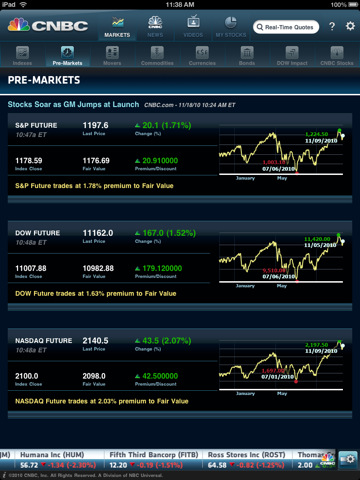
On CNBC's market pages, index futures are frequently shown alongside a metric called "Fair Value." Futures prices naturally trade at a slight premium or discount to the underlying cash index due to interest rates and expected dividend payouts between the current date and the futures contract expiration. CNBC's "Futures vs. Fair Value" calculation shows whether the cash market is expected to open higher or lower once regular trading begins.
3. Live Ticker and Breaking News Integration
Premarket volatility is almost always event-driven. CNBC pairs quotes with immediate headlines—such as FDA drug approvals, M&A announcements, executive turnover, or analyst upgrades and downgrades. Viewing the price quote directly next to the catalyst helps traders quickly evaluate whether an early price swing is an overreaction or a fundamental shift.
Why Early Market Quotes Can Be Deceptive
While premarket quotes offer valuable clues, interpreting them as a guaranteed indicator of how a stock will perform during regular hours is a common trap for beginner traders.
- Thin Liquidity: Far fewer participants trade at 7:30 a.m. than at 10:00 a.m. A relatively modest institutional block order can move a stock's price substantially in the premarket, creating an exaggerated price spike that collapses once general liquidity enters the market.
- Wide Bid-Ask Spreads: Because fewer market makers quote prices in the early morning, the gap between what buyers are bidding and what sellers are asking can be massive. Executing a trade inside a wide spread guarantees immediate paper losses if the market does not continue moving in your favor.
- The Opening Cross Reversal: At 9:30 a.m. ET, the NYSE and Nasdaq run automated opening crosses that match overnight buy and sell interest to establish the official opening price. Huge volumes of institutional orders execute simultaneously, frequently reversing early premarket trends.
Best Practices for Using Premarket Data
To use CNBC's early data productively without falling into liquidity traps, incorporate these disciplined practices into your routine:
Confirm the Volume: Never look at percentage change in isolation. A stock up 8% on 5,000 shares carries almost no predictive value. Look for stocks already trading a sizable fraction of their average daily volume before 9:00 a.m.
Identify the Primary Driver: Distinguish between sympathy plays and direct catalysts. If an industry peer reported strong earnings, other sector components may tick upward in sympathy on thin volume. Direct catalysts (like an earnings beat from the company itself) provide more dependable follow-through.
Watch the 8:30 a.m. Economic Window: If major economic data is slated for 8:30 a.m. ET, treat premarket quotes from 7:00 a.m. to 8:29 a.m. as provisional. A hot inflation print or surprise employment figure can instantly erase early morning gains across the board.
Let the Open Settle: Many professional traders monitor CNBC's premarket quotes to build a daily watchlist, but deliberately wait 5 to 15 minutes after the 9:30 a.m. bell before taking action. Waiting allows the opening auction imbalances to clear and reveals whether the broader market agrees with the early morning price trajectory.
Summary
Premarket stock quotes provide a valuable early look at market sentiment, breaking news reactions, and shifting momentum. By utilizing CNBC's futures dashboards, mover lists, and headline feeds—while keeping the risks of low volume and wide spreads in check—you can enter the regular trading session prepared, alert, and positioned to make informed decisions.