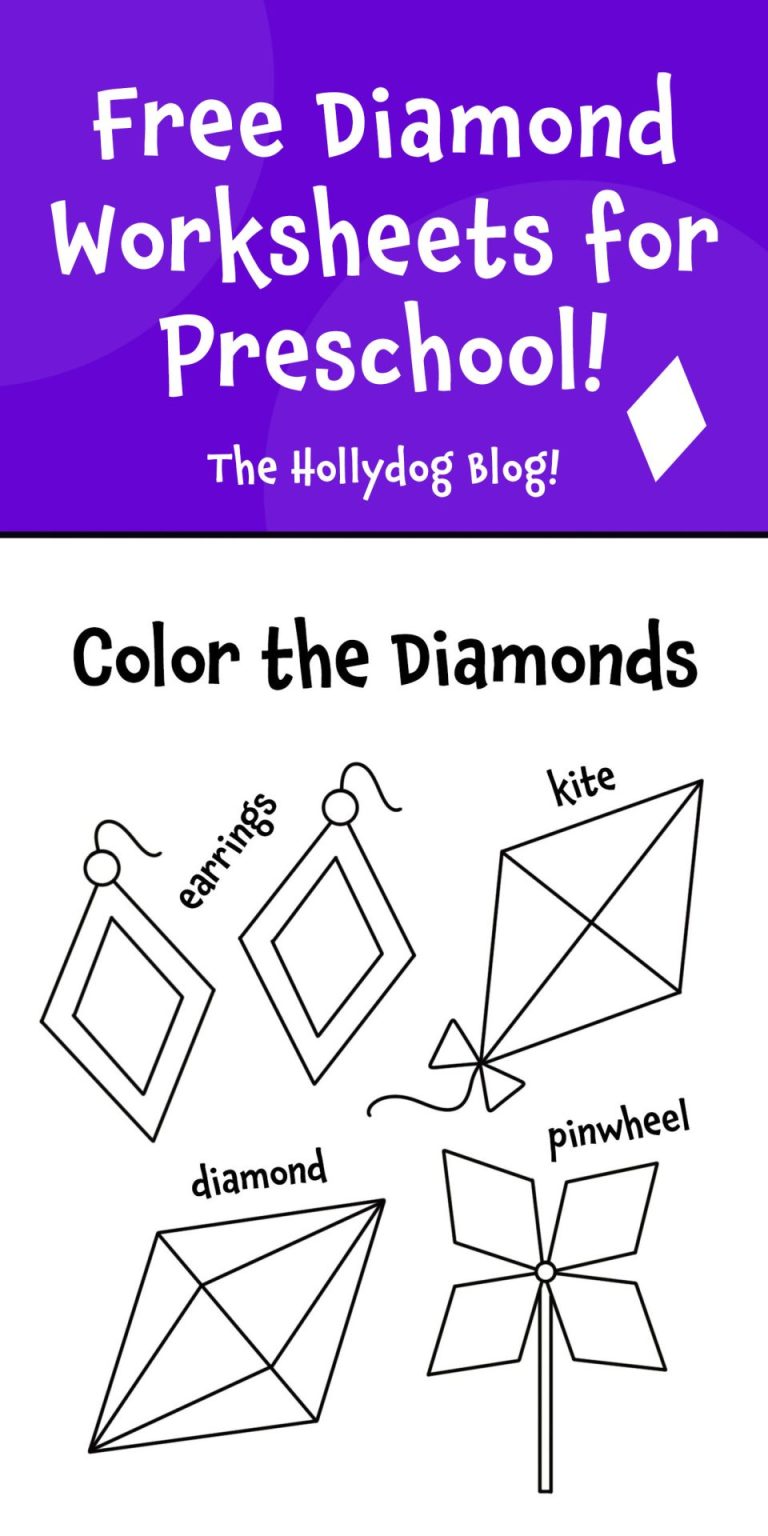
Preschool Diamond Worksheets for Skillful Little Hands
When young children first begin exploring geometric shapes, they typically start with circles and squares. Circles require a continuous, sweeping curve, while squares rely on simple horizontal and vertical strokes. However, introducing preschool diamond worksheets for skillful little hands gives early learners an engaging, developmentally appropriate challenge that bridges basic shape identification with advanced motor planning. Drawing a diamond—technically an equilateral rhombus standing on a point—demands sophisticated hand-eye coordination that prepares children for handwriting and independent drawing.

Why the Diamond Shape Is a Major Developmental Milestone
In occupational therapy and developmental psychology, drawing shapes follows a predictable sequence known as visual-motor integration. Most children can imitate a vertical line by age two, a circle by age three, and a cross or square by age four. Drawing a diamond, however, rarely emerges naturally before age four-and-a-half to five.
The reason lies in the diagonal lines. Drawing diagonally requires a child to cross their visual midline and control pencil direction in two planes at once (moving both down and across). Unlike a square, where lines meet at right angles on flat planes, a diamond requires the child to judge sharp angles and stop pencil momentum at precise points. Working with diamond worksheets helps children train the intrinsic muscles of the hand to execute these stops and turns with confidence.
Preschool Diamond Worksheets for Skillful Little Hands: Core Benefits
Printable worksheets focusing specifically on the diamond shape offer targeted benefits that extend well beyond rote memorization. When thoughtfully designed, they serve as multipurpose developmental tools.
- Pre-Writing Stroke Mastery: Many uppercase and lowercase letters depend heavily on diagonal strokes, including A, K, M, N, V, W, X, Y, and Z. Practicing the four diagonal sides of a diamond directly builds the muscle memory needed for legible alphabet formation.
- Pincer Grasp Strengthening: Guiding a writing instrument along angled paths requires constant micro-adjustments from the thumb, index, and middle fingers, discouraging clumsy whole-arm or palmar grip movements.
- Spatial Awareness and Symmetry: A diamond is inherently symmetrical. As children trace and color both halves, they develop an intuitive grasp of balance, proportions, and spatial orientation.
- Visual Discrimination: Diamonds often appear in the real world in varied forms—from street signs and playing cards to kites and fabric patterns. Dedicated worksheets help preschoolers isolate and identify the shape regardless of its size or orientation.
Types of Diamond Worksheets to Introduce Progressively
Children learn best when tasks build gradually in difficulty. Offering a complex, small-scale diamond tracing sheet to a three-year-old can lead to frustration. Instead, sequence your printable activities to match your child’s developing fine motor control.
1. Large-Format Finger and Dot Tracing
Begin with sheets that feature one massive diamond occupying most of the page. Before handing the child a pencil, invite them to trace the shape using their index finger. Worksheets with large dotted circles or hollow outlines are ideal for dot-marker (bingo dauber) activities or placing stickers along the border. This builds a gross-motor concept of the shape before demanding fine pencil control.
2. Directional Path Tracing with Arrows
Once a child understands the four-pointed structure, move to tracing sheets equipped with numbered directional arrows. A common challenge for preschoolers is drawing a diamond as a rounded oval or a lopsided square. Arrows instruct the hand to start at the top apex, slide down and out to the side vertex, cut inward to the bottom point, and travel back up to close the loop.
3. Scissor Cutting Strips and Cards

Fine motor development involves more than just holding a crayon; bilateral coordination (using both hands together) is equally essential. Diamond worksheets designed for cutting practice feature thick, dashed outer borders. Cutting out a diamond requires the non-dominant hand to pivot the paper four separate times while the dominant hand operates the scissors, providing an outstanding workout for bilateral dexterity.
4. Visual Discrimination and Color-by-Code
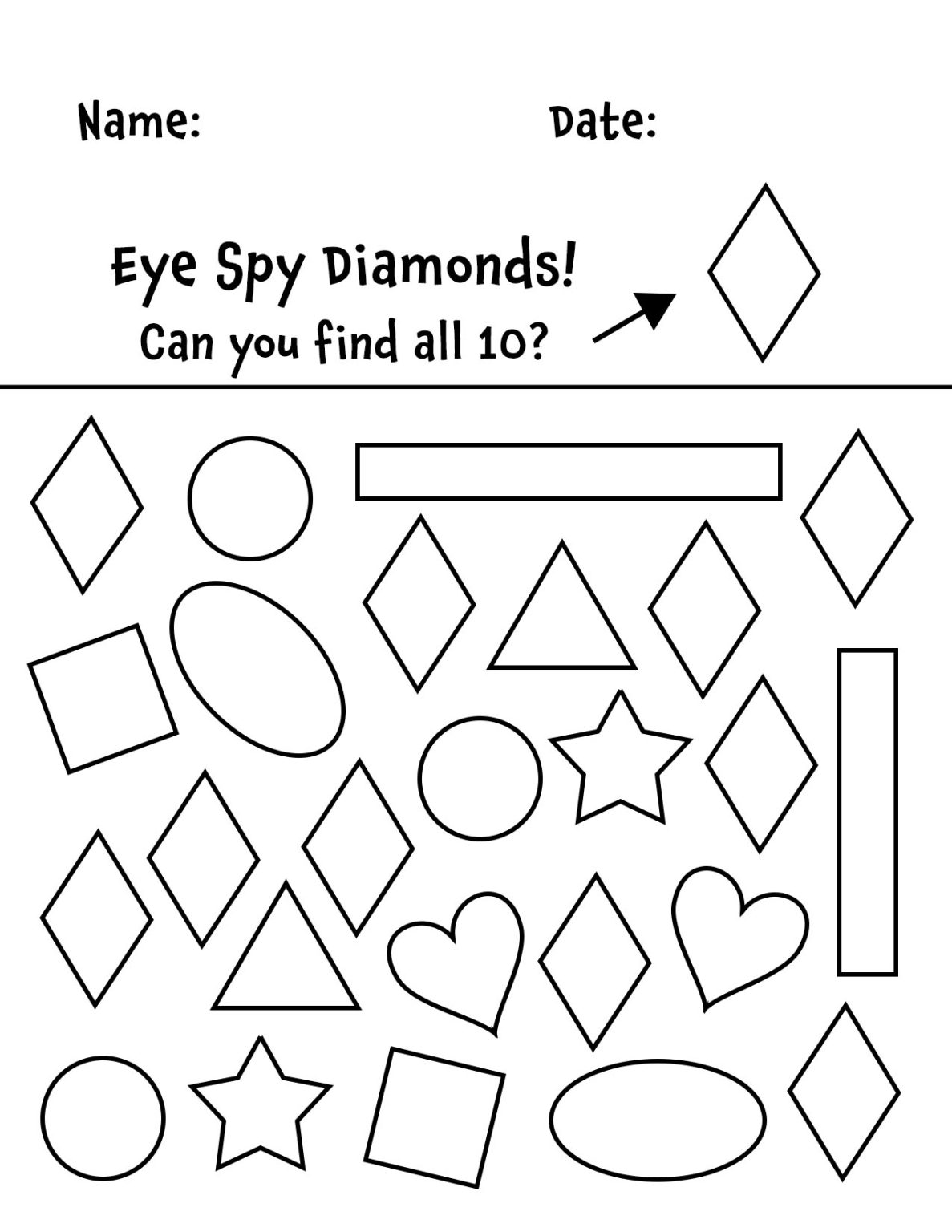
Combine cognitive sorting with coloring by using sheets that hide diamonds among triangles, squares, and hexagons. Asking the child to find and color only the diamonds (often framed as kites in the sky or gems in a treasure chest) reinforces geometric classification while allowing them to practice coloring within slanted boundaries.
Creative Ways to Enhance Printable Worksheets
Worksheets do not need to be limited to pencil-and-paper drills. You can dramatically increase engagement and sensory input by pairing diamond printables with everyday craft items:
- Textured Tracing: Run a bead of liquid school glue along the diamond outline on the worksheet and let the child press yarn, dry lentils, or small buttons onto the lines. Once dry, the child can trace the tactile ridge with their fingertips.
- Q-Tip Painting: Provide washable tempera paint and cotton swabs. Have the child dip the swab and make neat dots along the perimeter of the diamond. This activity demands extreme finger precision and stabilizes the hand arch.
- Playdough Shaping Mats: Slip the worksheet into a clear plastic sleeve or laminate it. Instruct the child to roll playdough into thin “snakes” and press them down to form the four slanted walls of the diamond.
Tips for Supporting Children Who Struggle with Diagonals
If a child finds it difficult to connect the points or consistently rounds the corners, take a step back and apply these supportive teaching strategies:
Use the “Two Triangles” Metaphor: Explain that a diamond is simply two triangles touching bases—one right-side up, and one upside-down. This mental model demystifies the shape for children who already know how to draw basic triangles.
Emphasize the Vertices: Put brightly colored dot stickers at the four points: top, bottom, left, and right. Instead of asking the child to draw an abstract diamond, instruct them to “drive their pencil from the red dot down to the blue dot, then to the green dot.” Giving clear destination targets eliminates hesitation.
Keep Sessions Short: Muscle fatigue sets in quickly for small hands. Five to ten minutes of focused, positive engagement with a diamond worksheet produces better developmental outcomes than forcing completion of multiple pages in one sitting.
Building Confidence for Kindergarten
Mastering the diamond shape is a satisfying achievement for preschoolers. By providing high-quality, sequential diamond worksheets paired with multisensory play, parents and educators supply the exact resistance and repetition little fingers need. With steady practice, children gain the hand strength, spatial judgment, and pencil control necessary to tackle formal handwriting and early math with complete confidence.