Radio Scanner Frequencies: The Complete Guide
Understanding Radio Frequencies for Scanners

Radio scanners allow hobbyists, emergency responders, and news enthusiasts to listen in on live radio communications. However, simply turning on a scanner is not enough to hear anything. You need to know the correct frequency for scanners to monitor specific agencies, services, or events.
Radio spectrum allocation is divided into different bands, each with unique propagation characteristics and uses. Understanding how these bands work is the first step toward successful radio monitoring.
The Radio Spectrum: VHF vs. UHF
Most monitoring takes place in two primary frequency ranges:
- VHF (Very High Frequency - 30 MHz to 300 MHz): VHF signals travel further and bend better around obstacles, making them ideal for rural areas, marine communications, and aviation. The VHF Low band (30–50 MHz) and VHF High band (136–174 MHz) host local government, forestry, and older police channels.
- UHF (Ultra High Frequency - 300 MHz to 3 GHz): UHF signals have shorter wavelengths that penetrate concrete and steel better, making them the standard for urban areas, businesses, and modern public safety agencies. Key allocations include the 400–512 MHz range.
Key Frequency Ranges to Program
Depending on what you want to listen to, you will need to search specific segments of the radio spectrum. Knowing where to look saves hours of manual scanning.
Public Safety and Emergency Services
Emergency services are the most popular targets for scanner enthusiasts. While many agencies have transitioned to digital or encrypted systems, traditional analog frequencies are still active in many regions:
- Police: Traditionally found in the 150–170 MHz (VHF) and 450–470 MHz (UHF) ranges. Many agencies now use 700 MHz and 800 MHz trunked systems.
- Fire and EMS: Frequently operate on dedicated VHF channels around 153–155 MHz or UHF channels around 453–458 MHz. Dispatch channels are typically the most active.
- Marine Radio: VHF marine channels span from 156 MHz to 174 MHz, with Channel 16 (156.800 MHz) reserved for emergency and hailing.
Aviation and Rail Monitoring
If you live near an airport or train line, these bands offer constant, fascinating chatter:
- Air Traffic Control (Civil Aviation): Operating in the AM mode between 108 MHz and 137 MHz. The universal emergency frequency is 121.500 MHz.
- Railroads: Spans from 160.200 MHz to 161.600 MHz across 97 standard narrow-band channels in North America.
How to Find Frequencies for Your Area
Finding the exact frequency for scanners in your specific geographic location requires using dedicated databases rather than guessing. Radio technology varies wildly by county and state.
Using Online Databases
The internet has revolutionized scanner programming. Websites like RadioReference.com maintain exhaustive, crowdsourced databases of frequencies for almost every country, state, and county.

To find local channels:
- Visit a reputable scanner frequency database.
- Select your country, state, and county or independent city.
- Browse categories such as Law Enforcement, Fire, EMS, Business, and Aviation.
- Note the tone frequencies (CTCSS/PL or DCS/DPL) if your scanner supports squelch filtering to avoid interference.
Searching with Your Scanner
If you are traveling or want to discover active signals without a database, most modern scanners feature a "Search" or "Close Call" function. This feature sweeps through frequency ranges and automatically stops on nearby, strong transmissions, allowing you to identify active local channels on the fly.
Analog vs. Digital and Trunked Systems
Before purchasing or programming a scanner, you must determine what type of signals your local agencies use. Buying an analog-only scanner is useless if your local police department utilizes a modern digital trunked radio system.
Conventional Channels
Conventional systems assign one specific frequency to one specific channel or user group. These are the easiest to program: you simply enter the frequency into your scanner, set the modulation (AM, NFM, or FM), and you are ready to listen.
Trunked Radio Systems
Modern cities and counties often use trunked radio systems (such as P25 Phase I/II, DMR, or NEXEDGE). Instead of a dedicated frequency per agency, a pool of frequencies is shared dynamically among multiple user groups using computer control.
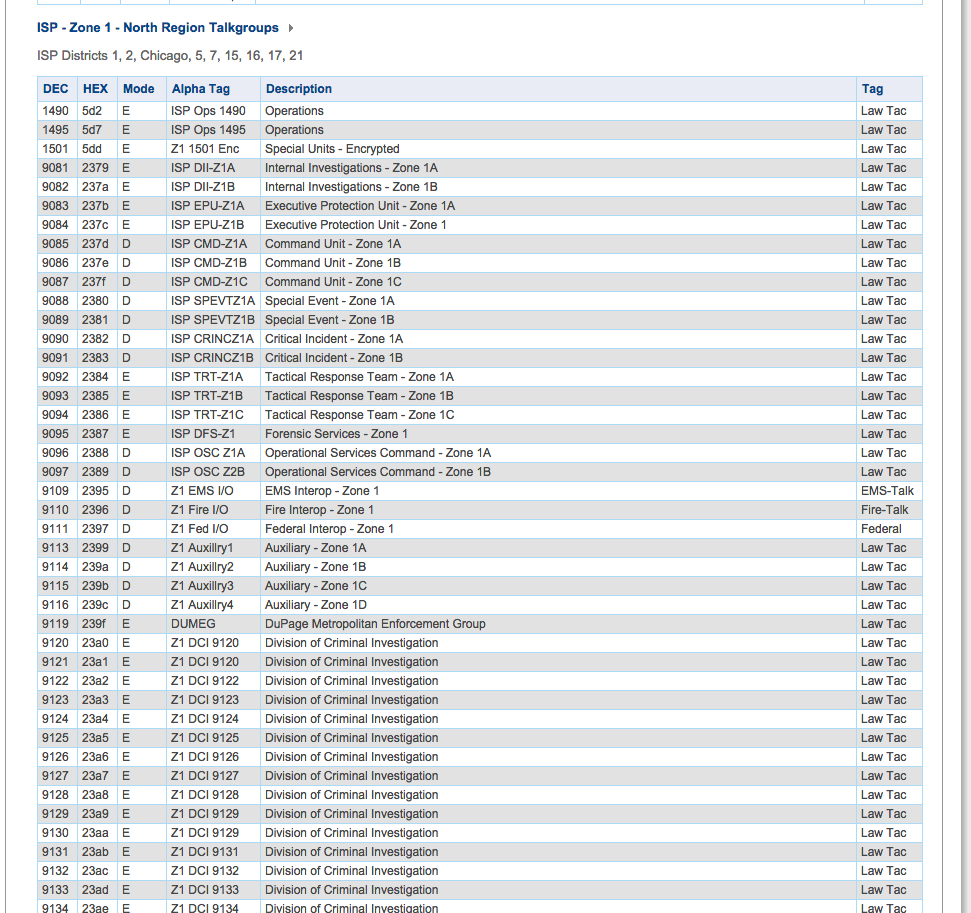
To monitor trunked systems, you need a trunk-tracking scanner. You must program the system's control channel frequencies and then enter "Talkgroups"—numerical IDs assigned to specific police precincts, fire battalions, or public works departments—rather than standard frequencies.
Tips for Better Reception
Having the right frequency is only half the battle; your hardware and antenna setup dictate how well you actually receive the signal.
- Upgrade the Antenna: The stock rubber duck antenna that comes with handheld scanners is usually a compromise. Installing an outdoor discone antenna or a tuned mobile antenna can dramatically increase your reception range.
- Check the Squelch Setting: Adjust your squelch knob just until the background static disappears. If set too high, you might miss weak transmissions; if set too low, the scanner will constantly break squelch on static.
- Understand Modulation: Ensure your scanner matches the modulation type of the frequency. Most public safety and business bands use Narrow FM (NFM), while civil aviation requires Amplitude Modulation (AM).
Conclusion
Finding the right frequency for scanners transforms a silent piece of hardware into a window on your local community. By understanding VHF and UHF bands, utilizing online databases like RadioReference, and matching your scanner's capabilities to local analog or trunked systems, you will capture crystal-clear emergency, aviation, and public safety communications.