Rahu Kaal Today in My Location: Find Timings
Understanding Rahu Kaal and Its Importance

In Vedic astrology, timing plays a critical role in determining the success or failure of any new venture. Among the various daily inauspicious periods, Rahu Kaal (or Rahu Kalam) holds a prominent place. Believed to be the time of day when the shadow planet Rahu exerts its maximum negative influence, it is traditionally avoided for auspicious undertakings, travel, or financial investments.
Because sunrise times vary drastically depending on where you are in the world, people often search for rahu kaal today in my location to get precise, localized timings rather than relying on generic charts. Understanding how this period is calculated empowers you to plan your day effectively without falling prey to unnecessary anxiety.
What is Rahu Kaal Today in My Location?
To pinpoint Rahu Kaal for your specific city or town, you first need to understand the underlying astronomical formula used in Hindu panchang (calendar) systems. Rahu Kaal is not a fixed clock time. Instead, it occupies a specific portion of daylight hours for any given geographical coordinate.
The daylight period—calculated strictly from the moment of local sunrise to local sunset—is divided into eight equal parts. Each of these segments lasts for approximately one and a half hours (though the exact duration fluctuates slightly depending on the season and the length of the day).
The Weekly Schedule of Rahu Kaal
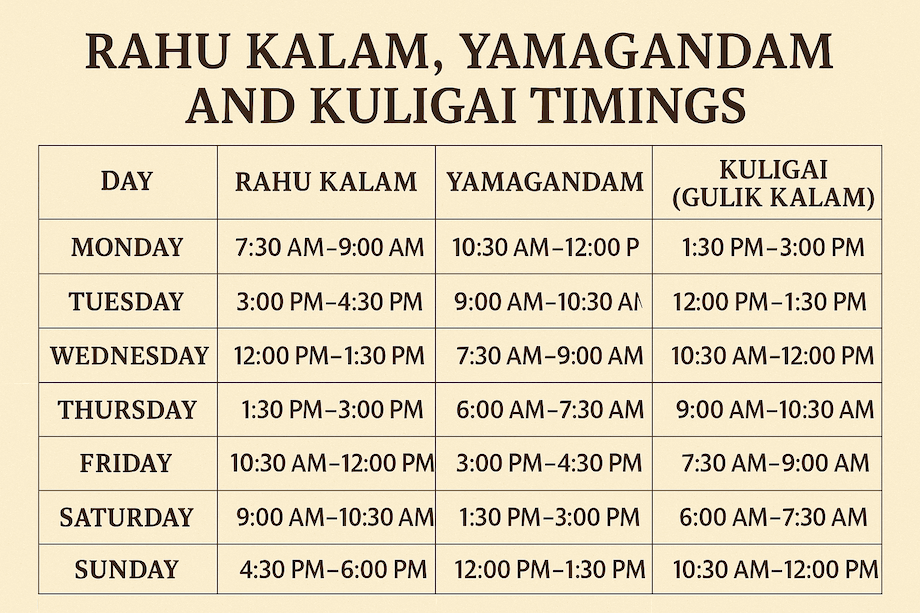
While the exact clock hours change daily based on sunrise, the sequential placement of Rahu Kaal remains constant throughout the week. It follows a fixed formula based on the days of the week, running from Monday to Sunday:
- Monday: 2nd part of the day (approx. 07:30 AM to 09:00 AM)
- Tuesday: 7th part of the day (approx. 03:00 PM to 04:30 PM)
- Wednesday: 5th part of the day (approx. 12:00 PM to 01:30 PM)
- Thursday: 6th part of the day (approx. 01:30 PM to 03:00 PM)
- Friday: 4th part of the day (approx. 10:30 AM to 12:00 PM)
- Saturday: 3rd part of the day (approx. 09:00 AM to 10:30 AM)
- Sunday: 8th part of the day (approx. 04:30 PM to 06:00 PM)
Note: The sample times listed above assume a standard 6:00 AM sunrise and 6:00 PM sunset. Because actual sunrise and sunset times vary in your city, you must adjust these windows accordingly.
How to Calculate Rahu Kaal for Your City
If you want to calculate the exact timing of Rahu Kaal for your exact geographic position, you can follow a straightforward mathematical process using local panchang data:
- Find the exact time of sunrise and sunset for your city today.
- Calculate the total duration of daylight by finding the difference between sunrise and sunset.
- Divide that total daylight duration by 8 to get the length of a single segment (Muhurat).
- Consult the day of the week to determine which segment belongs to Rahu (e.g., the 8th segment on Sunday).
- Multiply the segment length by the sequence number to find the start and end times relative to sunrise.
For instance, if the sun rises at 6:00 AM and sets at 6:00 PM, the total daylight is 12 hours (720 minutes). Dividing 720 by 8 gives 90 minutes (1.5 hours) per segment. On a Sunday, Rahu Kaal falls in the 8th segment, translating to the final 90 minutes before sunset (4:30 PM to 6:00 PM).
Video: What is Rahu Kaal | Rahu Kaal | What is Rahu Kaal, when and at what time does Ashubh Muhurt occur...
Dos and Don'ts During Rahu Kaal

Traditional belief holds that starting important tasks during Rahu Kaal can lead to obstacles, delays, or undesirable outcomes. While routine daily activities do not need to be halted, many people prefer to avoid major undertakings during this window.
What to Avoid During Rahu Kaal
- Starting a new business venture, signing contracts, or launching products.
- Embarking on long-distance travel or shifting to a new home.
- Performing important religious rituals, housewarming ceremonies (Griha Pravesh), or weddings.
- Making major financial investments, buying property, or purchasing high-value assets like vehicles.
What You Can Still Do
- Continue your regular office work, ongoing projects, and daily professional duties.
- Pay bills, buy groceries, and handle routine household chores.
- Feed stray animals, give charity, or engage in spiritual meditation and prayer, which are believed to mitigate negative planetary influences.
Frequently Asked Questions
Does Rahu Kaal apply at night?
No, Rahu Kaal is calculated strictly using daylight hours, spanning from sunrise to sunset. There is a separate set of inauspicious periods for nighttime, but Rahu Kaal itself does not occur after sunset.
Are time zone differences important?
Yes. Because Rahu Kaal is anchored to local solar events (sunrise and sunset), a generic chart for a country will not be accurate for every city within that country. Always look for local panchang details specific to your region.
Can I ignore Rahu Kaal if an emergency arises?
Astrologers generally agree that genuine emergencies, medical needs, and critical life-saving tasks supersede astrological timings. Practical necessity always takes precedence over astrological precautions.
Conclusion
Checking Rahu Kaal today in my location is a simple yet effective way to align your daily schedule with traditional Vedic timing principles. By avoiding critical decisions during this 90-minute window, many people find peace of mind and better organization. Remember to base your calculations on your local sunrise and sunset times for the highest degree of accuracy.