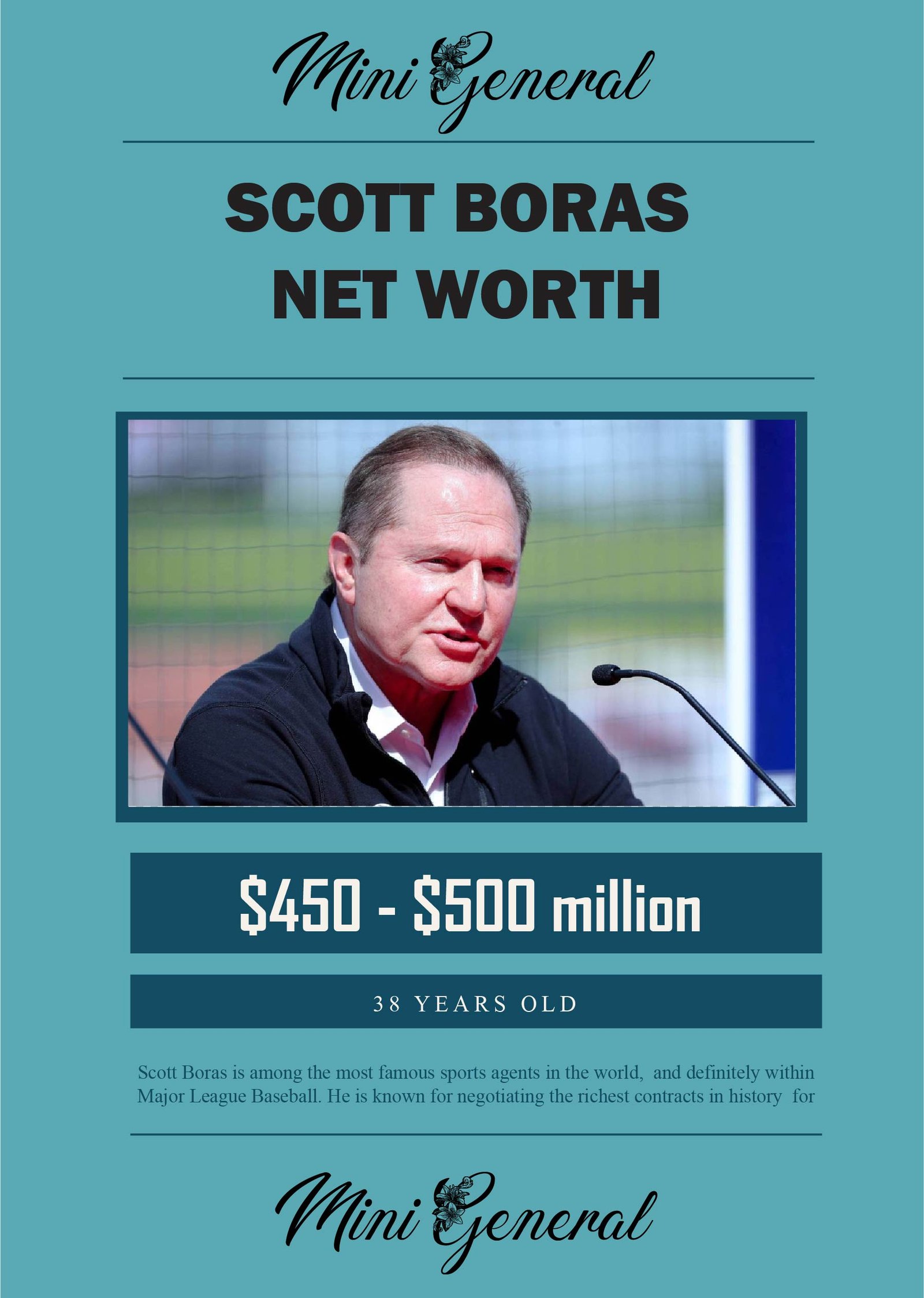
Scott Boras’ Net Worth: Did He Rip Off Tennis Money?
In the high-stakes world of sports representation, no name carries quite as much weight, fear, and admiration as Scott Boras. Over four decades, the founder of the Newport Beach-based Boras Corporation has negotiated billions of dollars in Major League Baseball player contracts, single-handedly resetting market benchmarks for elite athletes. Yet, a peculiar internet rumor has persisted across sports forums and search trends: The Real Mystery Behind Scott Boras’ Net Worth: Did He Rip Off Tennis Money?

To uncover the truth, one must examine where Boras’ estimated $450 million net worth actually comes from, how modern sports agency commissions function, and why an agent exclusively tied to baseball has suddenly become linked to professional tennis finances.
How Scott Boras Built a $450 Million Fortune
Unlike traditional agencies that diversify across football, basketball, golf, and entertainment, Scott Boras built his empire on a singular, relentless focus: baseball. Boras, a former minor-league center fielder who later earned an industrial doctorate in pharmacy and a law degree, recognized early on that Major League Baseball possessed unique economic advantages for athletes.
Chief among these advantages is the fully guaranteed contract. Unlike the NFL, where contracts are routinely terminated with non-guaranteed money left unpaid, MLB contracts must be honored in full regardless of injury or declining performance. Boras capitalized on this structure by leveraging rigorous statistical analysis—decades before “sabermetrics” became common parlance—to demand unprecedented sums for his clients.
Over his career, Boras has negotiated historic, record-shattering agreements, including:
- Alex Rodriguez: A 10-year, $252 million deal with the Texas Rangers in 2000, followed by a 10-year, $275 million pact with the New York Yankees in 2007.
- Bryce Harper: A 13-year, $330 million contract with the Philadelphia Phillies in 2019.
- Gerrit Cole: A 9-year, $324 million deal with the New York Yankees in 2019.
- Corey Seager: A 10-year, $325 million contract with the Texas Rangers in 2021.
By industry standards, the Major League Baseball Players Association (MLBPA) regulates agent fees. Agents typically earn around 5% commission on team contracts, alongside 10% to 20% on marketing and endorsement deals. When an agency represents active player contracts totaling over $3 billion to $4 billion at any given time, a 5% commission yields tens of millions of dollars annually in baseline revenue. Combined with shrewd real estate acquisitions, private investment portfolios, and cutting-edge sports training facilities, Boras’ personal wealth is entirely transparent and well-documented.
The Real Mystery Behind Scott Boras’ Net Worth: Did He Rip Off Tennis Money?
Given Boras' baseball-centric career, the question of whether he somehow "ripped off" or appropriated tennis money seems bizarre at first glance. However, search trends and forum discussions repeatedly pair Boras with tennis revenue. Did Boras quietly divert funds from tennis tournaments, launch a covert tennis division, or profit at the expense of professional tennis players?
The short, definitive answer is no. Scott Boras has never represented professional tennis players, has never managed tennis prize funds, and has never faced legal action, regulatory sanctions, or civil suits involving professional tennis. The idea that he diverted or "ripped off" tennis money is a factual fiction. However, the rumor did not emerge in a total vacuum; it arose from a confluence of three distinct sports business phenomena.
1. The "Tennis Needs a Scott Boras" Economic Debate
For the past two decades, professional tennis has grappled with an intense internal crisis regarding revenue sharing. In tennis, only the top 50 to 100 players in the world make a sustainable living, despite Grand Slam tournaments generating hundreds of millions of dollars. Tennis players receive roughly 15% to 20% of tournament revenues, whereas MLB, NBA, and NFL players receive roughly 48% to 50% of league revenues through collective bargaining.
Video: How much is Scott Boras worth?

Whenever tennis players—such as Novak Djokovic and Vasek Pospisil with the Professional Tennis Players Association (PTPA)—fight for higher prize pools, sports economists and commentators frequently write headlines asking: "Where is the Scott Boras of tennis?" Over time, algorithmic content farms and poorly indexed search snippets truncated these analytical comparisons into garbled queries like "Scott Boras tennis money" and eventually "Did Scott Boras rip off tennis money?"
2. Confusion with Multi-Sport Agency Giants and Ion Țiriac
Another source of confusion stems from casual observers conflating Boras with other legendary sports business magnates. Pioneers like Mark McCormack (the founder of IMG) built massive fortunes specifically through tennis players such as Rod Laver and Björn Borg before expanding into other sports. Similarly, Donald Dell dominated tennis representation through ProServ in the 1970s and 1980s.
Furthermore, Ion Țiriac, the former Romanian tennis player turned billionaire manager and tournament owner, amassed an empire exceeding $1.5 billion through banking and licensing. Readers unfamiliar with sports agency history frequently mix up Boras' name with these tennis power-brokers when researching the world's richest sports agents.
3. The Newport Beach Facility and Tennis Club Rumors
The Boras Corporation is headquartered in Newport Beach, California—a region renowned for elite private clubs, high-end tennis complexes, and affluent sporting facilities. Local real estate dealings, commercial leases, and community zoning disputes regarding sporting complexes often become distorted on social media. Rumors that Boras acquired or altered local tennis assets to expand his private baseball training institute circulated locally, but none involved financial impropriety or theft of tennis assets.
Tennis Economics vs. Baseball Contracts: Why the Disparity Exists
The persistent linkage between Boras and tennis discussions highlights a stark contrast in how money is earned and distributed in professional sports. Understanding this difference helps explain why tennis prize money remains a hot-button issue while Boras clients routinely secure nine-figure payouts.
- Union Power and Collective Bargaining: MLB players belong to the MLBPA, widely regarded as the most powerful labor union in sports history. The union enforces minimum salaries, arbitration rights, and free-agency structures. Tennis players, conversely, are classified as independent contractors without a formalized, universally recognized union.
- Guaranteed Team Revenue: Baseball teams operate with massive regional sports network (RSN) television deals, national broadcast rights, and corporate sponsorship that guarantee steady cash flow regardless of individual player performance. Tennis players must physically play and win matches each week to earn prize money.
- Travel and Operating Expenses: MLB players have travel, equipment, coaching, medical treatment, and lodging covered entirely by their franchises. Tennis players bear their own travel expenses, international coaching staff salaries, and physio costs out of their individual winnings.
Because baseball provides a legally protected, collectively bargained financial framework, agents like Scott Boras can maximize player earnings without resorting to unconventional or cross-sport ventures. Boras does not need to look outside baseball for revenue; the sport generates more than enough wealth to sustain his multi-million-dollar commissions.
The Bottom Line: Fact-Checking the Boras Myth
The narrative suggesting Scott Boras illicitly acquired or siphoned tennis money is completely unsupported by fact. Boras’ fortune was forged through relentless negotiation, uncompromising advocacy for baseball players, and a masterful understanding of baseball’s collective bargaining agreement.
Rather than taking money from tennis, Boras represents the very standard tennis players aspire to achieve: an aggressive, uncompromising advocate who forces team owners and tournament organizers to share equitable revenue with the athletes who generate it. Until tennis finds an advocate with similar leverage and determination, the disparity between baseball megadeals and tennis prize money will remain vast—and Boras’ baseball fortune will continue to grow on its own merits.