Semantics Activity Guide: 9 Engaging Classroom Ideas
When students struggle with reading comprehension or expressive language, memorizing dictionary definitions rarely solves the problem. Meaningful comprehension requires understanding how words connect, how context shifts intent, and how concepts organize inside the brain. Implementing a targeted semantics activity bridges the gap between rote memorization and genuine linguistic mastery.

Whether you are a speech-language pathologist (SLP), an English Language Arts teacher, or an English as a Second Language (ESL) instructor, semantic instruction helps learners build a rich, interconnected mental lexicon. Below, you will find practical, evidence-based activities designed to strengthen word relationships, categorization, and contextual comprehension.
Why Semantic Skills Drive Reading and Communication
Semantics is the branch of linguistics concerned with meaning. In developmental language and literacy, strong semantic skills allow learners to:
- Retrieve words quickly and accurately during spoken communication.
- Infer the meaning of unfamiliar words using contextual and morphological clues.
- Distinguish between literal and figurative language.
- Organize complex knowledge structures (schemas) needed for reading comprehension across content areas.
Without explicit semantic training, students with language delays or second-language learners often rely on superficial definitions, leading to misunderstandings when words appear in nuanced or metaphorical settings.
Choosing the Right Semantics Activity by Skill Area
Different semantic tasks target different neurological connections. The following activities are organized by key semantic domains, from foundational categorization to advanced pragmatic inference.
1. Semantic Feature Analysis (SFA)
Semantic Feature Analysis uses a matrix to help students explore how items in a related category are similar and different. This activity strengthens categorization and deepens descriptive vocabulary.
How to set it up:
- Select a target category (e.g., "Means of Transportation").
- List target words along the left vertical axis (car, bicycle, airplane, submarine, train).
- List distinct features along the top horizontal axis (has wheels, travels on water, carries passengers, requires fuel, travels in air).
- Guide students to mark each cell with a plus sign (+) if the item possesses the feature, a minus sign (-) if it does not, or a question mark (?) if it depends.
Follow up by having students compare two items verbally using contrastive conjunctions: "Both a car and an airplane carry passengers, but an airplane travels through the air whereas a car travels on roads."
2. Shades of Meaning Word Ladders
Students often default to basic adjectives like "mad," "happy," or "big." Word ladders help learners explore gradations of meaning, nuance, and connotation within semantic clusters.
How to set it up:
- Provide a vertical ladder graphic organizer with three to five rungs.
- Supply a base word (e.g., "cold") and a group of related words: chilly, freezing, cool, frigid, arctic.
- Have students collaborate to arrange the words from least intense at the bottom to most intense at the top.
- Encourage debate: Is "furious" stronger than "livid"? Is "annoyed" lower on the ladder than "irritated"?
3. The "Odd One Out" Justification Challenge
Categorization tasks are most valuable when students justify their reasoning aloud. This exercise targets convergent and divergent naming while practicing expressive rationale.
How to set it up:
Present four words where three belong to an explicit category and one differs. For example: Apple, Strawberry, Cherry, Banana.
The standard answer might be "banana" because the others are red. However, push students to find alternative classifications: "Strawberry is the odd one out because its seeds are on the outside." By rewarding logical justification rather than a single pre-determined answer, you encourage flexible semantic retrieval.
4. Multiple-Meaning Word (Polysemy) Detectives
English is full of polysemous words—words that share a spelling and pronunciation but hold distinct meanings based on context (e.g., bark, current, wave, scale).
How to set it up:
- Provide a sentence strip featuring an ambiguous target word: "The scientist recorded the data on a scale."
- Ask students to sketch or write two alternate definitions for the target word.
- Introduce a second sentence using the alternate meaning: "The fish had a shiny blue scale."
- Have students identify the part of speech and specific contextual clues that reveal each word's intended meaning.
5. Semantic Webbing and Association Chains
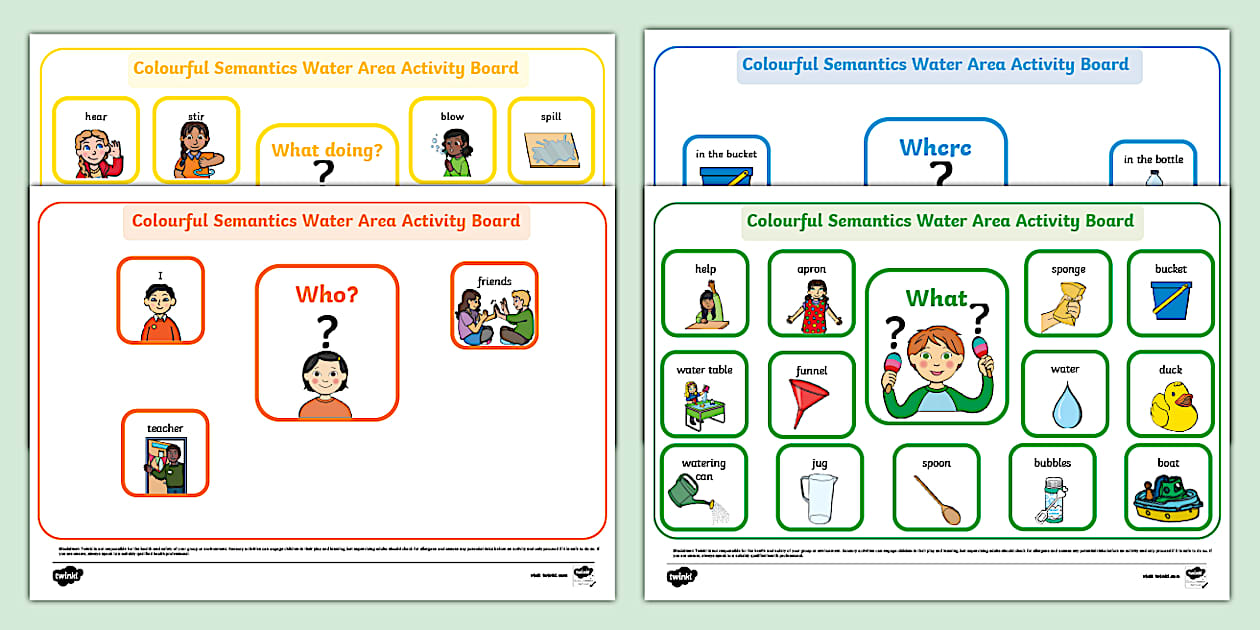
Free association helps clinicians and educators assess how quickly a child navigates their mental dictionary. Semantic webbing turns this assessment into an interactive group game.
How to set it up:
Start with a core anchor word in the center of the whiteboard (e.g., "Storm"). The first student draws a branch and writes an associated word (e.g., "Lightning"). The next student must link a new word either to the anchor word or to the previous branch, explicitly stating the semantic relationship: "I connected 'Thunder' to 'Lightning' because lightning causes the sound of thunder."
6. Context Clue Detective Scenarios
Inferring meaning from context is a cornerstone of reading comprehension. Rather than giving students standard vocabulary sheets, use synthetic "mystery" words to isolate their ability to use context without relying on prior memorization.
How to set it up:
Write short paragraphs replacing a real target word with a nonsense word:
"After hiking for eight hours under the desert sun, Marcus was completely zazzled. He dropped his heavy backpack, drank an entire bottle of cold water, and collapsed into his sleeping bag for a ten-hour nap."
Ask students to list the clues that show "zazzled" means exhausted (hiking for eight hours, collapsed, ten-hour nap). Once they successfully define the nonsense word, replace it with higher-tier target vocabulary such as fatigued, depleted, or enervated.
7. Figurative vs. Literal Sketch-Offs
Idioms and metaphors represent an advanced semantic leap. Many neurodivergent learners interpret figurative phrases literally, which can disrupt social communication and reading fluency.
How to set it up:
- Divide an unlined sheet of paper into two columns: "What it sounds like" (Literal) and "What it actually means" (Figurative).
- Give students an idiom (e.g., "Spill the beans" or "Cold feet").
- Have them draw the literal image on the left (beans falling out of a can) and the real-world meaning on the right (someone accidentally revealing a secret).
- Discuss why culture and context generate these figurative expressions.
8. Relational Analogy Puzzles
Analogies require students to isolate the exact relationship between two concepts and map that relationship onto a different pair of words. This trains inductive reasoning and higher-order semantic processing.
Structure types to practice:
- Part to Whole: Pedal : Bicycle :: Key : Keyboard
- Function/Tool: Scalpel : Surgeon :: Chisel : Sculptor
- Item to Category: Robin : Bird :: Salmon : Fish
- Antonyms/Synonyms: Expand : Contract :: Ascend : Descend
Always prompt students to form a complete bridge sentence before solving the second half: "A pedal is a part of a bicycle, just like a key is a part of a keyboard."
How to Adapt Semantic Exercises for Diverse Learners
A single semantics activity can serve varying developmental levels with minor adjustments:
- For Emerging Communicators and Early Elementary: Use tactile objects or realistic photo cards instead of written words. Focus on basic functions (things you eat vs. things you wear) and direct sensory attributes (colors, shapes, textures).
- For English Language Learners (ELLs): Highlight cognates and encourage cross-linguistic comparisons. If an ELL student knows the concept in their primary language, tie the English target word directly to that existing concept rather than treating it as an entirely new idea.
- For Advanced or Older Students: Shift focus from concrete nouns to abstract concepts (e.g., comparing "democracy" vs. "republic" on a feature analysis grid) and explore etymology, such as Greek and Latin roots.
Building Long-Term Semantic Retention
Isolated vocabulary drills rarely lead to permanent word retention. To ensure students generalize what they practice during semantic activities, integrate the target vocabulary across multiple modalities throughout the week: have them write the words, hear them used in classroom read-alouds, and identify them in independent texts.
By shifting the focus from simple dictionary lookup tasks to dynamic relationship-mapping exercises, you equip learners with the critical tools they need to unlock reading comprehension, communicate precisely, and navigate complex language with confidence.