Senses Flashcards for College Students: Study Guide
Mastering Neuroanatomy and Physiology

College-level anatomy, physiology, and psychology courses require a deep understanding of how the human body interacts with the outside world. From the intricate photoreceptors in the retina to the somatosensory cortex in the brain, the sheer volume of memorization can be overwhelming. Using senses flashcards for college students is one of the most effective ways to break down complex sensory systems into manageable, digestible pieces of information.
Whether you are studying for a mid-term in general biology or prepping for upper-level neurobiology exams, flashcards bridge the gap between passive reading and active recall. This guide explores how to design, organize, and utilize sensory system flashcards to maximize your study sessions and boost your grades.
Why Sensory Systems Are Tough to Memorize
The human sensory systems encompass much more than the traditional five senses of sight, hearing, taste, smell, and touch. College curricula dive deep into vestibular processing, proprioception, and nociception. You aren't just expected to know where an organ is located; you must understand transduction pathways, receptor potentials, cranial nerve innervation, and cortical processing.
Consider the pathway of vision. A flashcard that simply asks "What is the retina?" is far too basic for college level. Instead, successful students create cards that trace light through the cornea, pupil, lens, and fluid chambers, hitting every cellular layer of the retina until the signal reaches the optic chiasm. This level of detail requires strategic flashcard design.
Core Topics to Cover on Your Flashcards
To build a comprehensive deck, divide your flashcards into distinct anatomical and physiological categories. Here is a breakdown of the essential sensory systems you need to cover:
Vision (The Visual System)
Your visual deck should focus on optical structures, photoreceptor cells, and neural pathways. Include cards on:
- Rod vs. cone distribution, photopigments (rhodopsin), and light/dark adaptation.
- The function of horizontal, bipolar, amacrine, and ganglion cells.
- The visual pathway from the optic nerve to the lateral geniculate nucleus (LGN) and the primary visual cortex (V1).
- Common refractive errors like myopia and hyperopia and how corrective lenses alter light refraction.
Auditory and Vestibular Systems
Hearing and balance rely heavily on mechanoreception within the inner ear. Make sure your cards test:
- The transformation of sound waves through the outer, middle, and inner ear (tympanic membrane to the organ of Corti).
- How the basilar membrane performs frequency tuning (tonotopic organization).
- The role of hair cells, stereocilia, and tip links in mechanotransduction.
- The vestibular system: semicircular canals for rotational acceleration, and the utricle and saccule for linear acceleration and gravity.
Gustation and Olfaction (Chemical Senses)
Chemical senses involve direct molecular binding to receptor proteins. Focus your chemical sense cards on:
Video: Five Senses Talking Flashcards

- The five primary taste modalities (sweet, sour, salty, bitter, umami) and their respective transduction mechanisms (ion channels vs. G-protein coupled receptors).
- Cranial nerves involved in taste (VII, IX, and X).
- Olfactory receptor neurons, the cribriform plate, and the projection to the olfactory bulb and limbic system.
Somatosensation and Pain
Touch and nociception cover everything from a gentle breeze to severe trauma. Your deck should feature:
- Mechanoreceptors: Meissner's corpuscles, Merkel disks, Pacinian corpuscles, and Ruffini endings (adapting speeds and receptive fields).
- The dorsal column-medial lemniscal pathway vs. the anterolateral (spinothalamic) pathway.
- The gate control theory of pain and endogenous opioid modulation.
Best Practices for Creating and Using Your Cards
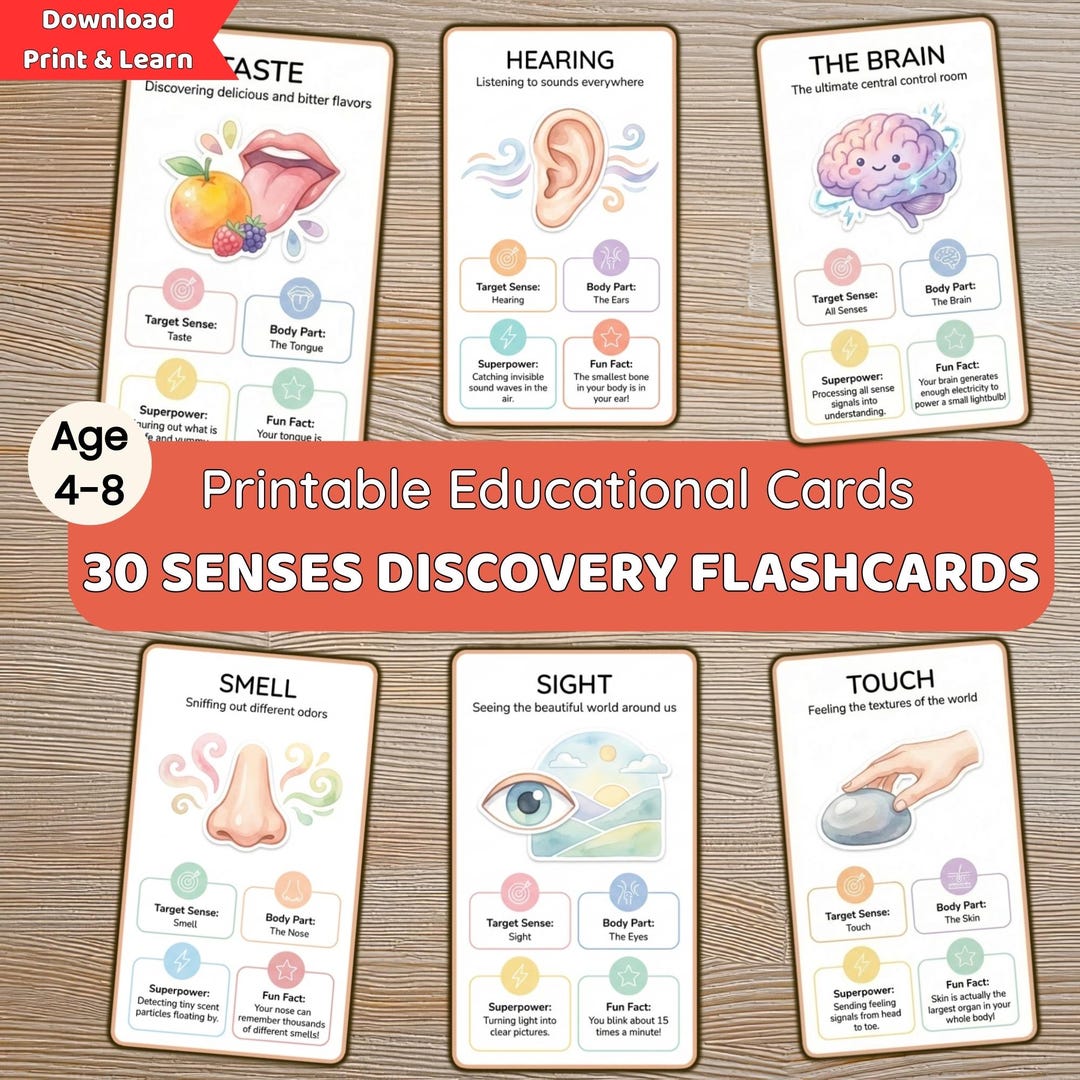
Simply downloading a pre-made deck of senses flashcards can be helpful, but building your own forces your brain to process the material firsthand. Follow these strategies to optimize your study routine:
1. Apply the Principle of Atomization
Never cram multiple facts onto a single card. If a question requires a multi-step answer, break it down. For example, instead of asking "What happens during auditory transduction?" create sequential cards: What fluid fills the scala media? What is endolymph's high concentration of? How does potassium influx affect hair cells?
2. Incorporate Diagrams and Histology
Sensory systems are visual. Text-only cards will only get you so far. Use digital flashcard platforms that allow image occlusion. Hide the labels of a histological slide of the cochlea, a cross-section of the eye, or a dermatome map, and force yourself to identify each structure.
3. Use Active Recall and Spaced Repetition
Flashcards are inherently designed for active recall, but timing is everything. Use spaced repetition software (SRS) like Anki or RemNote. These apps schedule card reviews based on how difficult you found them, ensuring you review tricky concepts like the auditory pathway right before your brain is about to forget them.
Digital vs. Physical Flashcards
Both physical index cards and digital apps have a place in a college student's toolkit, but they serve different purposes for sensory biology.
- Physical Cards: Great for sketching anatomical pathways by hand. The physical act of drawing a neural circuit reinforces memory retention better than typing on a keyboard.
- Digital Cards: Essential for handling large volumes of cards, embedding high-resolution histology images, and utilizing built-in spaced repetition algorithms without manual sorting.
Conclusion
Conquering complex biological systems doesn't have to be an uphill battle. By breaking down vision, hearing, taste, smell, and touch into focused, atomic concepts, you can transform an overwhelming amount of information into a manageable study routine. Grab your digital app or a stack of index cards, apply active recall, and watch your exam scores climb.