SI Body Paint Models: History, Art, and Legacy
When the Sports Illustrated Swimsuit Issue debuted in 1964, its purpose was straightforward: fill the quiet winter sports lull with colorful travel photography and trendy beachwear. Decades later, the editorial team took an audacious creative leap that altered the magazine's identity. The emergence of si body paint models transformed a commercial publication into an unexpected platform for trompe-l'œil fine art, blurring the boundary between traditional fashion and human sculpture.

Rather than slipping into nylon and spandex, models spent entire nights standing in studio trailers while fine-detail artists turned their bare skin into intricate, hyper-realistic suits. What started as an avant-garde experiment quickly became one of the most anticipated features of the annual issue.
The Origin and Evolution of Body Paint in SI
The concept of body painting was not invented by Sports Illustrated, but the magazine popularized it on a global scale. The seeds were planted in the late 1990s, heavily influenced by the cultural shockwave of makeup artist Joanne Gair's 1992 Vanity Fair cover featuring Demi Moore in a painted men's suit.
In 1999, Sports Illustrated editor MJ Day and the creative team invited Gair to apply her technique to their swimsuit edition. The initial shoot featured supermodel Heidi Klum wearing a meticulously painted denim vest and briefs. The public reaction was overwhelming: readers were transfixed by the realism, often squinting at the pages to decipher where the paint ended and fabric began.
Following that success, the body paint feature evolved from an occasional novelty into a core editorial staple. The themes grew increasingly elaborate, shifting from basic bikinis to wet-look lycra, tie-dye patterns, metallic accents, and complex pop-culture homages.
The Master Behind the Brush: Joanne Gair
Any discussion of body paint in the franchise is incomplete without Joanne Gair. Often nicknamed "The Queen of Body Art," the New Zealand-born artist served as the chief visionary for these spreads for more than a decade.
Gair approached the human form like a classic canvas, but with the added challenge of working on a breathing, moving surface. Her process relies on specialized techniques:
- Custom Paint Blends: Mixing water-based theatrical paints, silicone-based pigments, and liquid latex to mimic the stretch, sheen, and texture of real fabric.
- Shading and Dimension: Using fine-art contouring to paint simulated seams, stitches, zippers, and clasps that hold up under high-resolution macro photography.
- Sweat and Water Resistance: Formulating barrier sprays that prevent colors from running under intense tropical heat or occasional splashes of ocean spray.
The Grueling Reality of the Painting Process
While the final images exude effortless beach glamour, the production behind these shoots is famously grueling for both the artist and the subject.
A standard body paint application takes between 9 and 15 continuous hours. Because the paint must dry evenly and avoid creasing, the models cannot sit down, stretch, or lean back comfortably during the application. Sessions typically begin around midnight or 1:00 AM, ensuring that the elaborate artwork is completed just as the sun rises to catch the soft "golden hour" light on the beach.
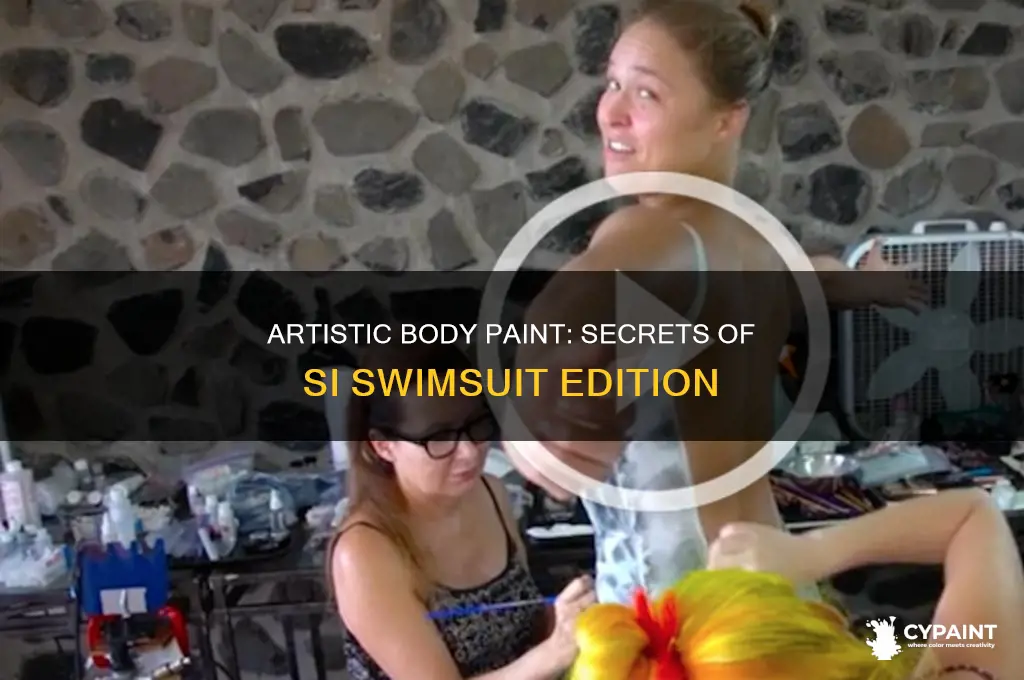
Models stand on raised platforms while a team of artists works in tandem, carefully applying base coats before hand-painting microscopic details such as elastic edges and fabric textures. Even the temperature requires precise regulation: if the trailer is too cold, the model shivers and ruins the paint lines; if it is too warm, sweat will degrade the water-resistant seal.
Once the shoot wraps, removing the suit is an entirely separate ordeal. It often takes hours of soaking in baby oil, mineral spirits, and warm showers to peel and dissolve the multiple layers of latex and pigment.
Memorable SI Body Paint Models Who Made History
Video: Emily Ratajkowski, Hannah Ferguson & More Strip Down For Body Painting | Sports Illustrated Swimsuit
Over the years, the magazine has cast high-fashion icons, mainstream celebrities, and world-class athletes for its body paint features. Certain shoots stand out as true milestones in the publication's archive.

Heidi Klum (1999)
Klum was the pioneer who validated the concept. Her painted denim ensemble proved that the feature could be stylish, tasteful, and artistically credible rather than merely sensationalist. Klum went on to participate in multiple body paint shoots, becoming the unofficial ambassador of the medium.
Marisa Miller (2008)
Marisa Miller's rock-and-roll-themed spread remains one of the most popular in the franchise's history. Wearing a hand-painted "suit" inspired by a guitar strap and vintage concert tees, Miller demonstrated how body art could channel a specific cultural aesthetic while maintaining the illusion of fabric texture.
Ronda Rousey (2016)
The inclusion of UFC champion Ronda Rousey marked a pivotal shift in the representation of athletic physiques. Rousey posed in a painted tiger-print one-piece, emphasizing functional muscle, power, and athletic conditioning over traditional runway proportions. The spread received widespread praise for celebrating female physical strength.
Caroline Wozniacki and Lindsey Vonn (2016)
Alongside Rousey, tennis star Caroline Wozniacki and Olympic skier Lindsey Vonn joined the 2016 paint roster. The spread highlighted how muscle groups in elite athletes interact with light and shade, demonstrating that painted apparel could flatter a wide spectrum of athletic builds.
Hunter McGrady (2017)
Model Hunter McGrady made history by appearing in the body paint feature as a size-16 curve model. Her feature took roughly 12 hours of detailed brushwork and was celebrated as a milestone for size inclusivity in high-profile sports media, proving that body art can empower and celebrate every figure.
Why the Concept Resonated: Artistry Over Fabric
The enduring appeal of the painted feature stems from a psychological paradox: the models are completely uncovered, yet visually fully dressed. This dynamic shifts the viewer's perception from standard glamour photography to appreciation of artistic craft.
- Illusion and Craftsmanship: Viewers are drawn to the puzzle of the image, marveling at how flat paint can mimic the weight of denim, the sheen of wet neoprene, or the fragility of lace.
- Celebration of Form: Unlike tailored swimwear, which compresses, lifts, or reshapes the body, paint follows natural contours precisely. It requires a radical comfort with vulnerability from the model.
- Collaborative Chemistry: The feature succeeds only when there is absolute trust between the model, the body painter, and the photographer. That shared endurance manifests in the confidence of the final images.
The Lasting Impact on Fashion and Media
The body paint spreads of Sports Illustrated pushed body art from fringe performance venues and festival grounds into mainstream visual culture. It inspired similar concepts across television, red carpet fashion, and high-fashion editorials.
Today, as digital editing and computer-generated imagery dominate media production, the tactile, physical reality of body painting stands out even more. Every brushstroke represents hours of human patience, skill, and creative endurance, cementing the painted series as a distinctive chapter in modern fashion photography.