Solve Work & Time Math: If 54 Persons Can Complete
Understanding Work and Time Problems
Word problems involving work, time, and the number of workers often appear in competitive exams, aptitude tests, and everyday project planning. At first glance, calculating how changing the workforce affects a completion schedule can seem confusing. However, once you understand the core mathematical relationship between workers and time, these puzzles become straightforward to solve.
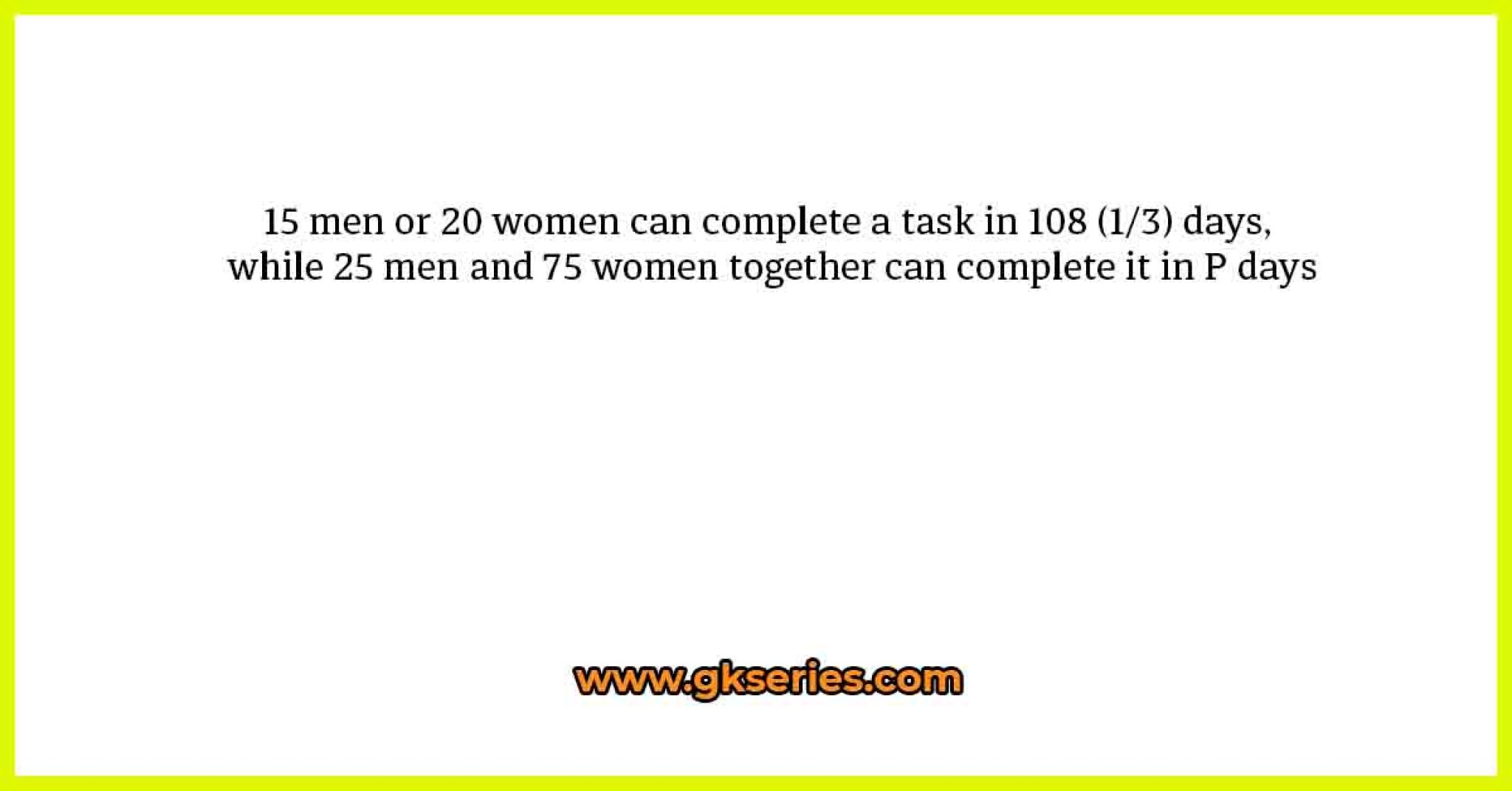
One of the most common variations of this mathematical puzzle asks: if 54 persons can complete a certain task within a specific timeframe, how long will it take a different number of workers to finish the exact same job? In this guide, we will break down the underlying formula, explore the concept of inverse proportion, and walk through practical examples to ensure you can solve these problems with confidence.
The Core Principle: Inverse Proportion
The foundation of solving any manpower-and-time equation rests on a simple logical concept: inverse proportion. As the number of workers increases, the time required to finish a fixed amount of work decreases. Conversely, if you reduce the workforce, the project takes longer to complete.
To put it mathematically, the total amount of work required is measured in "person-days" or "person-hours." This total effort remains constant regardless of how many individuals are assigned to the project. Assuming everyone works at the same average rate, the product of the number of workers and the time they take is always a fixed value.
The Standard Formula
To set up and solve these equations, we use the standard work-rate formula:
$M_1 imes D_1 = M_2 imes D_2$
Where:
- $M_1$ = Initial number of persons
- $D_1$ = Initial time (days, hours, etc.) taken by the first group
- $M_2$ = New number of persons
- $D_2$ = New time taken by the second group
Step-by-Step Example Calculation
Let us look at a practical scenario to see how this formula works in action. Suppose a construction company is hired to build a community center. Management calculates that if 54 persons can complete the construction in 30 days, how many days will it take for 36 persons to finish the same building?
Step 1: Identify the Known Variables
Before plugging numbers into the equation, list out what the problem provides:
- Initial workers ($M_1$) = 54
- Initial days ($D_1$) = 30
- New workers ($M_2$) = 36
- Unknown time ($D_2$) = ?
Step 2: Set Up the Equation
Using the inverse proportion formula, multiply the initial workforce by the initial days to find the total "person-days" required for the job. Then, equate it to the new workforce multiplied by the unknown number of days.
$54 imes 30 = 36 imes D_2$
Step 3: Solve for the Unknown Variable
First, calculate the total person-days on the left side of the equation:
$1,620 = 36 imes D_2$
Next, isolate $D_2$ by dividing 1,620 by 36:
$D_2 = rac{1,620}{36}$
$D_2 = 45$
Therefore, 36 workers will take 45 days to complete the exact same project.

Handling Variations in Work and Time Problems
Not all word problems are as simple as changing the number of workers and days. Standard aptitude tests frequently introduce additional variables, such as daily working hours or differing levels of task difficulty. Here is how you can adapt your approach for more complex scenarios.
Adding Daily Working Hours
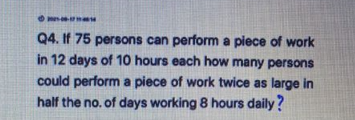
If the problem specifies how many hours each person works per day, you must include that time metric in your equation. The expanded formula becomes:
$ rac{M_1 imes D_1 imes H_1}{W_1} = rac{M_2 imes D_2 imes H_2}{W_2}$
Where:
- $H$ = Hours worked per day
- $W$ = Amount of work completed (often represented as 1 for a whole job, or fractions/multiples if the workload changes)
Example with Working Hours
Imagine a scenario where if 54 persons can complete a drainage project in 20 days working 6 hours a day, how many days will 40 persons need if they work 9 hours a day?
Set up the expanded formula:
$ rac{54 imes 20 imes 6}{1} = rac{40 imes D_2 imes 9}{1}$
Calculate the left side:
$54 imes 20 = 1,080$
$1,080 imes 6 = 6,480$ person-hours total.
Now, calculate the known variables on the right side:
$40 imes 9 = 360$
Divide the total person-hours by this new daily output:
$D_2 = rac{6,480}{360}$
$D_2 = 18$
The new crew will take 18 days to complete the project.
Common Pitfalls to Avoid
When solving work-rate math problems under time pressure, it is easy to make simple arithmetic or conceptual errors. Keep these tips in mind to protect your accuracy:
- Do not use direct proportion: A common mistake is assuming that fewer workers mean fewer days. Remember that manpower and time are inversely proportional.
- Check your units: Ensure that your time metrics match. If one group is measured in days and another in weeks, convert them to a single unit before calculating.
- Verify the workload: If the second group is tasked with building twice as much or only half as much, adjust the work variable ($W$) in your denominator accordingly.
Conclusion
Solving equations that start with scenarios like "if 54 persons can complete a task" simply requires identifying your variables and applying the inverse proportion formula. By breaking the problem down into total person-days or person-hours, you can easily scale the workforce up or down to find accurate timelines for any project.