Solving "Albert Thought of a Number Added 5"
When students first encounter the classic math riddle where albert thought of a number added 5, it often sounds like a mentalist's magic trick. A classmate or a textbook asks you to pick a secret number, perform a sequence of arithmetic operations, and reveal the final total. From that single clue, the questioner reveals your original number in seconds.
While it feels like mind reading, this puzzle is actually one of the most accessible introductions to foundational algebra. Whether you are a student working through homework, a parent helping at the kitchen table, or a puzzle lover looking to sharpen your logic, understanding how to deconstruct this problem will unlock a wide range of algebraic concepts.
Solving the Classic "Albert Thought of a Number Added 5" Problem
Because this problem appears across dozens of different math curricula and puzzle books, the exact wording and final number vary. However, the core structure remains identical. Let us examine the standard version most commonly found in middle school math assignments:
"Albert thought of a number, added 5, multiplied the result by 3, and ended up with 36. What was the original number?"
To solve this puzzle, you have two primary strategies: the algebraic method (writing an equation) and the reverse operation method (working backward). Both approaches lead to the correct answer, but they exercise slightly different mathematical thinking.
Method 1: The Algebraic Approach
Algebra allows us to translate plain English sentences into compact, solvable equations. Here is the step-by-step translation:
- Define the variable: Let $x$ represent the mystery number Albert thought of.
- Translate "added 5": The expression becomes $x + 5$.
- Translate "multiplied the result by 3": Because the entire result is multiplied, we must use parentheses: $3(x + 5)$.
- Set up the equation: The final result is 36, so our equation is $3(x + 5) = 36$.
Now, we solve for $x$ by isolating the variable:
Divide both sides by 3 to remove the multiplier outside the parentheses:
$$x + 5 = \frac{36}{3}$$
$$x + 5 = 12$$
Subtract 5 from both sides to find $x$:
$$x = 12 - 5$$
$$x = 7$$
Albert's original number was 7.
Method 2: Working Backward (Inverse Operations)
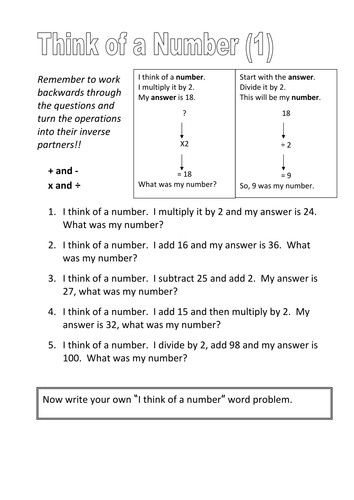
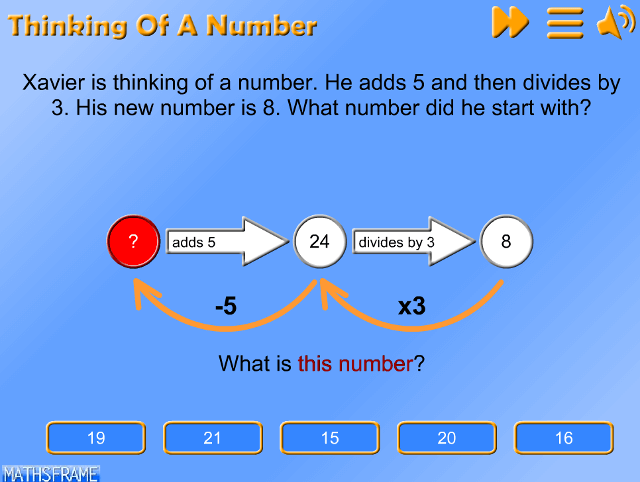
If you have not formally studied algebra yet, you can solve this exact problem using logic and inverse operations. The golden rule of working backward is simple: reverse the order of operations and invert each mathematical step.
- Forward story: Start with $x$ → Add 5 → Multiply by 3 → Get 36.
- Backward solution: Start with 36 → Divide by 3 → Subtract 5 → Find $x$.
Executing the steps in reverse:
- Take the final result: 36
- The last operation was multiplying by 3; the inverse is dividing by 3: $36 \div 3 = 12$.
- The previous operation was adding 5; the inverse is subtracting 5: $12 - 5 = 7$.
Again, you arrive smoothly at 7 without needing to write down formal variables.
Other Common Variations of the Riddle
Because teachers love to tweak this problem on quizzes and tests, you may encounter different operations applied after Albert adds 5. Here is how to handle the two most common alternative setups.

Variation A: Added 5, Doubled, Subtracted 4
"Albert thought of a number, added 5, doubled the answer, and then subtracted 4. His final answer was 26. What was his number?"
Let us write this algebraically:
$$2(x + 5) - 4 = 26$$
To solve it step-by-step:
- Add 4 to both sides: $2(x + 5) = 30$
- Divide both sides by 2: $x + 5 = 15$
- Subtract 5 from both sides: $x = 10$
Albert started with 10. Verification: $10 + 5 = 15$; $15 \times 2 = 30$; $30 - 4 = 26$.
Variation B: Added 5, Divided by 4
"Albert thought of a number, added 5, and divided the result by 4. He got 8. What was his number?"
Translating into an equation:
$$\frac{x + 5}{4} = 8$$
To solve:
- Multiply both sides by 4 to clear the denominator: $x + 5 = 32$
- Subtract 5 from both sides: $x = 27$
Albert's secret number was 27.
The Critical Trap: Watch Your Parentheses
The single most frequent mistake students make with this problem involves missing parentheses. Consider the difference between these two phrases:
- Phrase A: "Albert thought of a number, added 5, and multiplied the result by 3."
- Phrase B: "Albert thought of a number, and added 5 times 3."
In Phrase A, the words "the result" or "the sum" signal that the addition happens first, requiring grouping brackets: $3(x + 5)$. If you write $x + 5 \times 3$, standard order of operations (PEMDAS) forces multiplication first, giving you $x + 15$, which completely changes the problem and leads to an incorrect answer.
Why Educators Use "Think of a Number" Puzzles
Math educators frequently rely on these riddles because they build two vital cognitive bridges:
- Demystifying Algebra: Many beginners find algebraic letters intimidating. Framing an equation as "unwrapping a present" or "tracing your steps backward" shows that algebra is merely structured common sense.
- Understanding Equation Balance: Solving these problems demonstrates the fundamental rule of algebra: whatever operation you perform on one side of the equals sign, you must perform on the other to maintain equality.
- Reversing Functions: In higher mathematics, students study inverse functions. Reversing "add 5, multiply by 3" is the conceptual groundwork for finding the inverse of $f(x) = 3(x + 5)$.
Test Yourself: 3 Practice Challenges
Try working through these three practice puzzles using either the algebraic method or the reverse operation method before checking the answers below:
- Albert thought of a number, added 5, multiplied by 6, and got 66. What was the number?
- Albert thought of a number, added 5, divided by 3, and subtracted 2. The result was 7. What was the number?
- Albert thought of a negative number, added 5, multiplied by 4, and got -8. What was the number?
Answer Key
- Problem 1: $(66 \div 6) - 5 = 11 - 5 =$ 6.
- Problem 2: Add 2 back first ($7 + 2 = 9$), multiply by 3 ($9 \times 3 = 27$), subtract 5 ($27 - 5 =$) 22.
- Problem 3: Divide by 4 ($-8 \div 4 = -2$), subtract 5 ($-2 - 5 =$) -7.
Summary
Whenever you face a riddle starting with "Albert thought of a number, added 5," do not let the wording confuse you. Either label the unknown value as $x$ and build an equation with careful grouping, or take the final total and walk backward using opposite operations. With these two techniques, you can untangle any variation of this classic problem in seconds.