T Silver Line Exposed: What They're NOT Telling You
When visitors land at Boston Logan International Airport or scan a Massachusetts Bay Transportation Authority (MBTA) map, the bold silver line appears on equal footing with the Red, Orange, Blue, and Green lines. Marketing brochures and transit maps paint it as a seamless, high-speed pillar of the city's subway network. Yet any local commuter who has stood on Washington Street in a sleet storm or sat motionless in the Ted Williams Tunnel knows the truth. In this breakdown of the T Silver Line exposed: what they're not telling you, we pull back the glossy transit PR to examine the history, structural compromises, and operational bottlenecks that define Boston’s most misunderstood route.
The Great BRT Illusion: It Was Never a Train
The primary reality the MBTA minimizes is straightforward: the Silver Line is not a train. It is a bus system masquerading as rapid rail. Officially designated as Bus Rapid Transit (BRT), the Silver Line was conceived as a cheaper, faster-to-build alternative to heavy or light rail extensions.
True international BRT systems—such as those in Curitiba, Brazil, or Bogotá, Colombia—feature fully dedicated, physically separated lanes, off-board fare collection at every station, level boarding, and absolute traffic signal priority. The Silver Line compromises on almost every one of these standards across substantial stretches of its network:
- Mixed Traffic Interference: Routes SL4 and SL5 operate largely on surface streets alongside passenger cars, delivery trucks, and double-parked vehicles.
- Street-Level Boarding Delays: Outside of the South Boston transitway tunnel, passengers frequently board through a single door while fumbling with CharlieCards or cash, completely defeating the purpose of high-capacity transit.
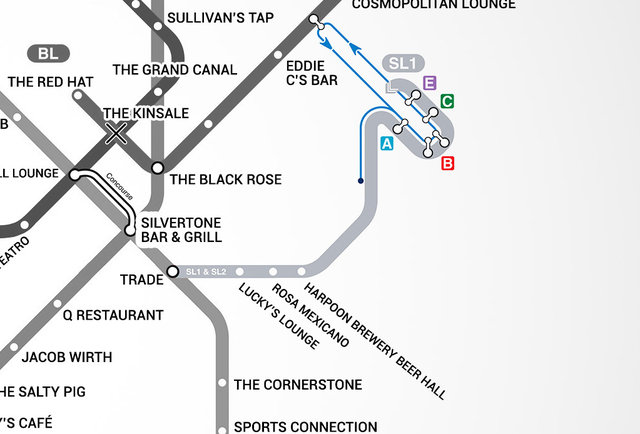
- Fragmented Identity: The Silver Line is actually split into two disjointed systems that do not physically connect: the South Boston/Airport lines (SL1, SL2, SL3) operating out of South Station, and the Washington Street lines (SL4, SL5) terminating at Downtown Crossing and South Station via surface roads.
The Broken Promise of the Washington Street Corridor
To understand the frustration surrounding the Silver Line, one must understand its origin story. Until 1987, the elevated Orange Line ran above Washington Street, connecting Roxbury and the South End directly to downtown Boston. When the state demolished the elevated structure to relocate the Orange Line into the Southwest Corridor, officials promised the historically diverse communities of Roxbury and the South End "equal or better" replacement transit.
For more than a decade, residents expected a light rail trolley extension—an actual branch of the Green Line running down Washington Street. Instead, after years of budget cuts and bureaucratic shifts, the state delivered the Silver Line Phase I (now SL4 and SL5) in 2002. Rather than modern rail, residents received elongated buses painted silver.
The decision left deep scars regarding transit equity. While wealthy neighborhoods and suburbs maintained their heavy rail connections, Roxbury and the South End were handed a bus line that immediately suffered from traffic congestion, slower run times, and overcrowded vehicles.
T Silver Line Exposed: What They're NOT Telling You About Performance
Behind the transit authority's curated performance averages lies a daily reality of systemic friction. Commuters navigating the system face chronic operational vulnerabilities that rarely make the official highlight reels.
The Ted Williams Tunnel Bottleneck
The SL1 is marketed to airport travelers as a rapid, stress-free direct link from Logan Airport to downtown Boston's South Station. What the promotional materials leave out is that once the bus leaves the dedicated South Boston underground transitway via the D Street portal, it enters general highway traffic through the Ted Williams Tunnel (I-90).
During peak weekday rush hours, summer weekend getaways, or following an accident on the highway, the Silver Line gets trapped in the exact same bumper-to-bumper gridlock as private cars, taxis, and ride-shares. On bad days, a trip from Terminal E to South Station that should take 15 minutes can balloon past 45 minutes, causing missed Amtrak connections and extreme commuter frustration.

The Curse of "Bus Bunching"
Because the surface branches lack physical barriers preventing civilian cars from blocking transit corridors, Silver Line buses suffer acutely from bus bunching. A single delivery van idling in the bus lane on Washington Street delays the lead bus by three minutes. As that lead bus picks up an accumulating crowd at every stop, it slows down further. Meanwhile, the trailing bus runs empty behind it.
The result is a familiar scene across Boston: commuters wait 20 minutes with no bus in sight, only for three Silver Line vehicles to arrive back-to-back in an inefficient convoy.
The Fleet Problem: Complex Mechanics and Transition Growing Pains
Operating a bus in an enclosed underground subway tunnel requires zero tailpipe emissions. Operating that same bus on Interstate 90 or up Washington Street requires sustained power over long distances. To solve this, the MBTA historically relied on complex dual-mode vehicles.
For years, the South Station lines relied on articulated Neoplan and New Flyer dual-mode buses that pulled electricity from overhead catenary wires while inside the tunnel, then retracted their trolley poles and switched to diesel engines upon surfacing. This transition was a persistent point of failure:
- Pole De-wiring: Trolley poles frequently slipped off the overhead wires, leaving vehicles stranded in the transitway and blocking all following buses.
- Switching Glitches: The mechanical transition between electric and internal combustion modes often stalled, forcing drivers to execute full system resets while passengers waited in dark tunnels.
While the MBTA has transitioned toward modern battery-electric buses (BEBs) and hybrid technologies to eliminate the overhead wire infrastructure, the extreme cold of New England winters presents severe challenges to battery range and heating loads. Managing fleet availability remains an ongoing operational headache behind the scenes.
How to Ride the Silver Line Like an Insider
Despite its flaws, the Silver Line is an essential component of Boston's regional transit network. Navigating it successfully requires looking past official maps and understanding how the system actually operates.
- The Airport Hack: Inbound travel on the SL1 from any Logan Airport terminal to South Station is completely free. You do not need to tap a card or buy a ticket. Furthermore, once you arrive inside the South Station underground concourse, you can transfer to the Red Line subway without paying a fare.
- Choose the Blue Line for Reliability: If you are traveling between Logan Airport and downtown Boston during peak vehicular rush hour (4:00 PM to 6:30 PM on weekdays), skip the SL1. Take the free airport shuttle bus to the Airport Station on the Blue Line instead. The Blue Line is heavy rail, completely immune to tunnel traffic jams, and provides a direct, predictable route into Government Center and State Street.
- Use Real-Time GPS Tracking: Never trust the posted static timetables for the SL4 or SL5. Because of street-level traffic, use third-party transit tracking apps that rely on real-time vehicle GPS feeds rather than scheduled arrival times.
The Verdict: Essential Transit Bound by Compromise
The MBTA Silver Line is neither the cutting-edge rapid transit system promised in transit brochures nor a total failure. It moves tens of thousands of airport workers, residents, and daily commuters across Greater Boston every day. Yet it serves as an enduring case study in what happens when municipal transit ambitions are compromised by cost-cutting measures.
Calling a bus a subway line does not make it immune to traffic. Until regional transit planners invest in absolute physical lane separation, automated signal enforcement, and true off-board fare collection along the entire footprint, the Silver Line will remain what it has always been: a high-capacity bus doing its best in a system built for trains.