Table of Elements Charges and Their Applications
In chemistry, an atom's electrical charge determines how it bonds, reacts, and functions in the physical world. Neutral atoms contain an equal number of positively charged protons and negatively charged electrons, but most elements achieve thermodynamic stability by gaining or losing electrons to attain a full valence shell. Understanding the table of elements charges and their applications allows scientists and engineers to predict molecular geometry, synthesize life-saving pharmaceuticals, design high-capacity batteries, and refine advanced structural materials.
How Elemental Charges Form: The Driving Force of the Octet Rule
Atoms interact through electrostatic forces governed by Coulomb's law and quantum mechanics. The fundamental driver of chemical charge is electron configuration. With the exception of hydrogen and helium, which follow the "duet rule," main-group elements typically pursue eight valence electrons—a stable configuration mirroring the inert noble gases. This tendency is known as the octet rule.
When an atom loses one or more electrons, it forms a positively charged ion called a cation. Conversely, when an atom captures electrons, it becomes a negatively charged ion called an anion. The magnitude of this charge corresponds directly to the number of electrons exchanged, forming predictable patterns across the periodic table.
Periodic Table Groups and Predictable Ionic Charges
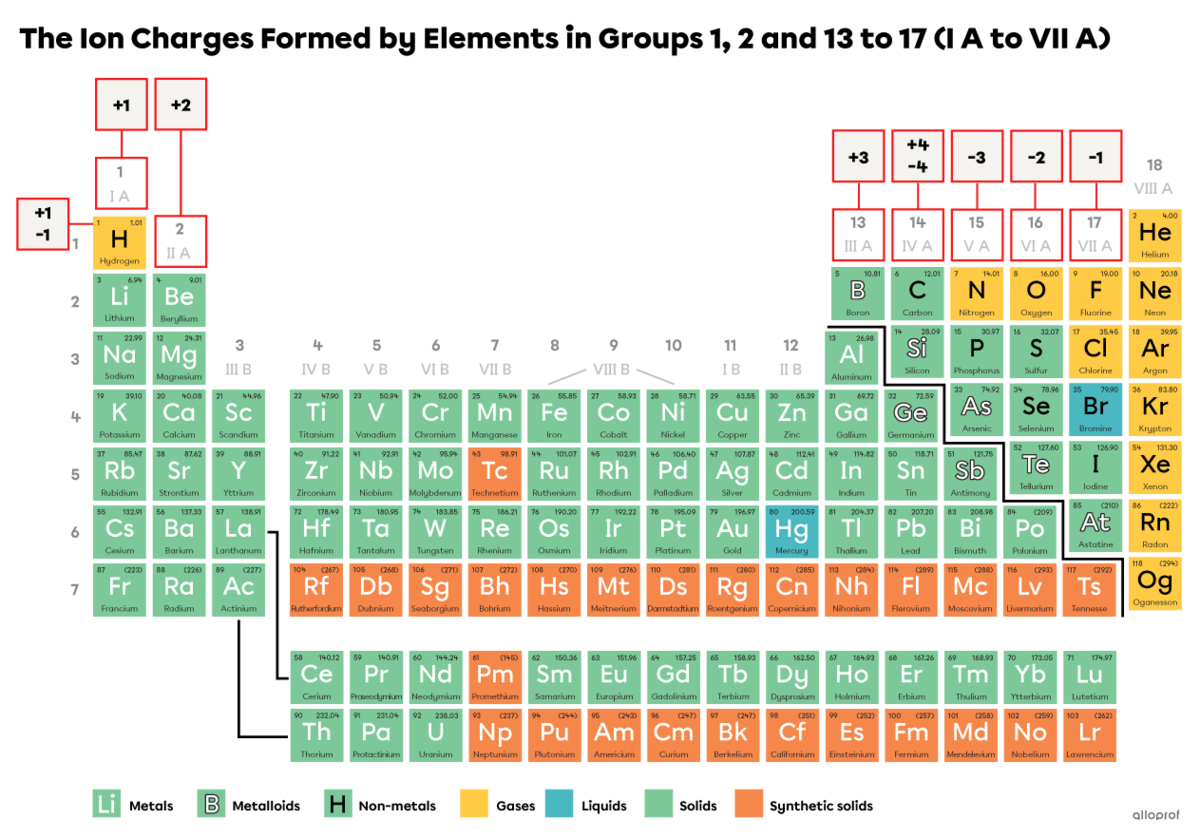
Main-group elements follow predictable charge assignments based on their column (group) in the periodic table. These charges correspond to the valence electrons found in the outermost s and p subshells.
Group 1: Alkali Metals (+1)
Alkali metals (lithium, sodium, potassium, rubidium, cesium) contain a single valence electron in their outermost s-orbital. Because shedding this electron exposes a stable, lower-energy noble gas core, these elements consistently form +1 cations (Li+, Na+, K+). They possess low first ionization energies and exhibit high chemical reactivity.
Group 2: Alkaline Earth Metals (+2)
Elements in Group 2 (beryllium, magnesium, calcium, strontium, barium) hold two valence electrons. Removing both yields a stable noble gas configuration, resulting in standard +2 cations (Mg2+, Ca2+). While less violently reactive than Group 1 elements, they readily react with halogens and oxygen.
Group 13: Boron Family (+3)
With three valence electrons (s2p1), Group 13 elements commonly lose all three to form +3 cations, most notably aluminum (Al3+). However, heavier members like thallium can also exhibit a +1 oxidation state due to the "inert pair effect," where the inner s-electrons resist participation in bonding.
Group 14: Carbon Family (±4, +2)
Group 14 elements hold four valence electrons, situated midway toward an octet. Carbon and silicon typically form covalent bonds rather than simple ionic charges, though carbon can hold formal charges ranging from -4 to +4 in organic molecules. Heavier elements like tin (Sn) and lead (Pb) routinely form +2 and +4 cations.
Group 15: Pnictogens (-3, +3, +5)
Pnictogens have five valence electrons. When forming simple binary ionic compounds with electropositive metals, nitrogen and phosphorus gain three electrons to form -3 anions (nitride, N3-; phosphide, P3-). In molecular or oxyanion environments, they often display positive formal oxidation states of +3 and +5 (such as in nitrates and phosphates).
Group 16: Chalcogens (-2)
Oxygen, sulfur, and selenium need two additional electrons to complete their valence shell. Consequently, they predominantly form -2 anions (oxide, O2-; sulfide, S2-). In covalent bonds with more electronegative elements like fluorine, sulfur can expand its octet to exhibit +4 and +6 states.
Group 17: Halogens (-1)
Halogens (fluorine, chlorine, bromine, iodine) are highly electronegative and require just one electron to complete an octet. They vigorously attract electrons to form -1 halide anions (F-, Cl-, Br-, I-). Fluorine is the most electronegative element and exclusively maintains an oxidation state of -1 in compounds.

Group 18: Noble Gases (0)
With complete valence shells (s2p6), noble gases hold a formal charge of 0 under standard conditions. They possess exceptionally high ionization energies and near-zero electron affinities, making natural ion formation energetically unfavorable.
Reference Table: Common Element Charges
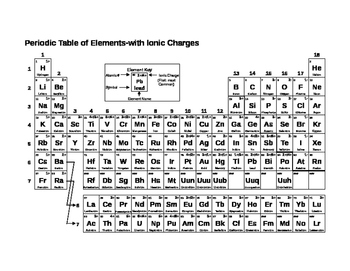
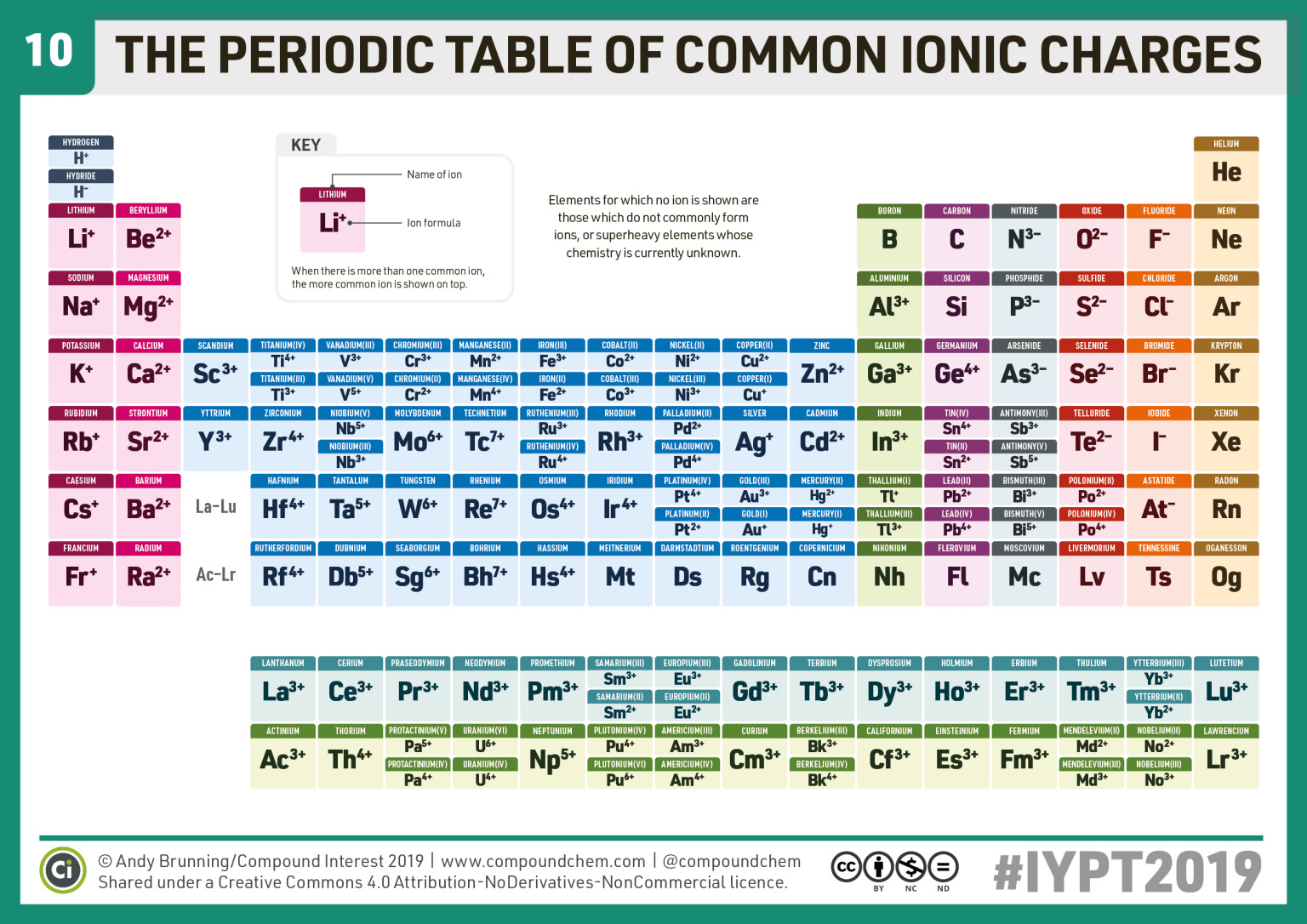
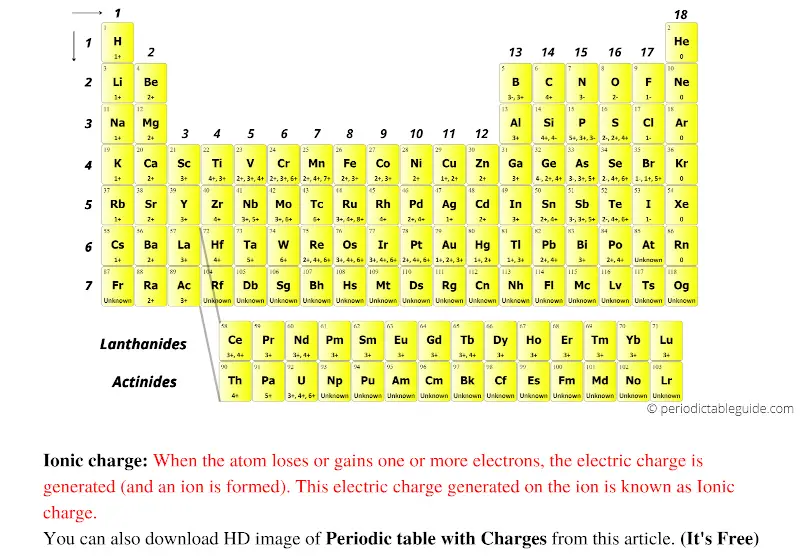
The table below provides a quick reference for common elements, their standard ionic charges, and typical electron behavior.
| Element | Symbol | Periodic Group | Common Ionic Charge | Primary Role / Ion Type |
|---|---|---|---|---|
| Hydrogen | H | Group 1 | +1, -1 | Proton donor (cation) / Hydride (anion) |
| Lithium | Li | Group 1 | +1 | Monovalent cation |
| Sodium | Na | Group 1 | +1 | Monovalent cation (electrolyte) |
| Magnesium | Mg | Group 2 | +2 | Divalent cation (cofactor) |
| Calcium | Ca | Group 2 | +2 | Divalent cation (structural/signaling) |
| Aluminum | Al | Group 13 | +3 | Trivalent cation |
| Iron | Fe | Transition (Group 8) | +2, +3 | Multivalent redox cation |
| Copper | Cu | Transition (Group 11) | +1, +2 | Multivalent redox cation |
| Zinc | Zn | Transition (Group 12) | +2 | Divalent post-transition cation |
| Oxygen | O | Group 16 | -2 | Divalent anion (oxide) |
| Chlorine | Cl | Group 17 | -1 | Monovalent anion (halide) |
The Complexity of Transition Metals: Variable Oxidation States
Unlike main-group elements, transition metals (d-block elements) utilize both their outer s-orbital electrons and their inner d-orbital electrons for chemical bonding. Because the energy difference between the (n)s and (n-1)d orbitals is minimal, transition metals can lose varying numbers of electrons, giving rise to multiple stable oxidation states.
- Iron (Fe): Readily forms Fe2+ (ferrous) and Fe3+ (ferric) ions depending on the oxidizing potential of the environment.
- Copper (Cu): Exists stably as Cu+ (cuprous) and Cu2+ (cupric).
- Manganese (Mn): Exhibits an exceptionally broad range of charges, from +2 in biological enzymes up to +7 in the powerful oxidizing agent potassium permanganate (KMnO4).
Table of Elements Charges and Their Applications in Science and Industry
Ionic charges are not abstract textbook values; they dictate how substances behave in industrial manufacturing, energy generation, biological systems, and environmental management.
1. Energy Storage and Battery Chemistry
Modern rechargeable batteries rely entirely on the controlled movement and oxidation-state changes of ions.
- Lithium-Ion Cells: Li+ ions shuttle between a graphite anode and a lithium metal oxide cathode. Because lithium is small and carries a single positive charge (+1), it intercalates easily into crystal lattices without causing severe mechanical disruption.
- Cathode Redox Centers: Transition metal ions like cobalt (Co3+/Co4+) and nickel (Ni2+/Ni3+/Ni4+) within the cathode accommodate electron transfer during charging and discharging, directly setting the cell's operating voltage.
2. Biological Homeostasis and Neurotransmission
Life depends on tight regulation of elemental charges across semi-permeable cell membranes.
- Action Potentials: The rapid exchange of Na+ (+1) and K+ (+1) across neuronal membranes via voltage-gated ion channels creates the electrical impulses that drive nerve signals and muscular contraction.
- Enzyme Activation: Divalent cations like Mg2+ and Ca2+ stabilize negatively charged molecules. For example, Mg2+ coordinates with the negative triphosphate tail of adenosine triphosphate (ATP), allowing enzymes to access and cleave high-energy phosphoanhydride bonds.
- Oxygen Transport: Hemoglobin relies on an iron ion transitioning between Fe2+ and Fe3+ states to bind and release molecular oxygen (O2) reversibly throughout the bloodstream.
3. Water Purification and Flocculation
Colloidal impurities suspended in untreated water usually carry net negative surface charges, causing them to repel each other and stay suspended. Water treatment facilities introduce multivalent coagulants containing trivalent aluminum (Al3+, commonly as alum) or iron (Fe3+).
According to the Schulze-Hardy rule, the coagulating power of an ion increases dramatically with its valence. Trivalent cations neutralize negative surface charges thousands of times more effectively than monovalent cations like Na+, allowing particles to aggregate into larger flocs that settle out rapidly.
4. Electroplating and Surface Metallurgy
Electroplating applies precise electrolytic reactions to deposit thin metal layers onto conductive substrates.
- By controlling the concentration of metal cations in solution (such as Ni2+, Cr3+, or Au+) and applying a controlled cathodic current, engineers reduce metal ions back to neutral metallic atoms (Mn+ + ne- → M0).
- This process provides uniform coatings that resist corrosion, reduce friction, and improve wear resistance on automotive components, aerospace hardware, and printed circuit boards.
Mastering Charges for Predictive Chemistry
Predicting elemental charges allows chemists to write balanced chemical formulas, predict solubility rules, and determine the thermodynamic feasibility of synthesis reactions. Whether you are balancing an oxidation-reduction reaction in a laboratory or engineering next-generation solid-state electrolytes, reference to element charges remains the foundational roadmap for modern chemical design.