Tangram Puzzles Printable PDF: Rules & Guide
Few educational tools offer the enduring appeal of the classic Chinese dissection puzzle known as the tangram. Simple in form yet boundless in complexity, working with a tangram puzzles printable pdf provides a tactile, screen-free way to hone geometric intuition, spatial reasoning, and critical thinking. Whether you are an educator designing a geometry station or a parent looking for quiet, engaging activities, printable tangrams deliver immediate hands-on value.

What Is a Tangram? The Anatomy of the Seven Tans
Originating during China’s Song Dynasty and popularized worldwide in the 19th century, a tangram begins as a single square cut into seven distinct flat polygons, individually called "tans." Despite having only seven components, these shapes can be rearranged into thousands of different silhouettes, representing animals, people, objects, and abstract geometric forms.
A standard tangram set consists of precisely:
- Two large right triangles: Congruent pieces that together make up half the total area of the original square.
- One medium right triangle: Exactly half the size of a large triangle and equal in area to two small triangles.
- Two small right triangles: Congruent pieces that serve as building blocks across multiple composite shapes.
- One square: Equal in area to the two small triangles combined.
- One parallelogram: The only piece lacking bilateral symmetry, meaning it often must be flipped over to complete certain silhouettes.
The Three Golden Rules of Tangram Puzzles
While the creative possibilities are virtually limitless, solving a traditional tangram challenge requires adherence to three fundamental rules:
- Use all seven tans: Every solution must incorporate all seven pieces. You cannot set aside an awkward triangle or the parallelogram.
- Pieces must lie flat: Tans must rest flat against the playing surface; they cannot be stood on edge or stacked.
- No overlapping: Every shape must touch at least one other shape by an edge or a corner, but no piece may overlap another.
Benefits of Using a Tangram Puzzles Printable PDF
While digital tangram apps exist, tactile manipulation provides distinct cognitive advantages that screens simply cannot replicate. Turning a piece by hand activates fine motor pathways and deepens spatial awareness.
1. Concrete Understanding of Geometric Relationships
As learners fit two small triangles together to build a square, a parallelogram, or a medium triangle, they organically discover principles of conservation of area, congruence, symmetry, and scale. These hands-on discoveries lay the groundwork for later algebraic and trigonometric concepts.
2. Spatial Rotation and Visualization
Tangrams require the solver to visualize how a shape will look once rotated or flipped. The parallelogram is particularly instructive: because it lacks reflective symmetry, solvers quickly learn the difference between rotating an object in a plane and flipping it across an axis.
3. Frustration Tolerance and Problem Solving
Attempting a challenging silhouette often leads to dead ends. Solvers must develop resilience, dismantle partial solutions, and view the empty space with fresh eyes. This iterative process mirrors the scientific method and computational thinking.
Video: Printable Tangram Puzzles with solutions

How to Prepare Your Printable Tangram Sheets
To get the most mileage out of your printed puzzle pages, spend a few minutes preparing the materials for durability and ease of use:
- Print on heavy cardstock: Standard 20 lb printer paper is too light; the pieces will shift, curl, and tear easily. Choose 65 lb to 110 lb cardstock for a sturdy feel.
- Laminate before cutting: If you plan to use the puzzles in a classroom or homeschool co-op, running the printed sheets through a thermal laminator before cutting out the tans ensures they withstand hundreds of uses.
- Use a paper cutter: Clean, precise cuts are critical. A rotary trimmer or craft knife with a metal ruler produces straight edges that fit together cleanly without awkward gaps.
- Add magnetic tape (optional): Affix small strips of adhesive magnetic tape to the back of each piece. Solvers can then assemble puzzles on cookie sheets, magnetic whiteboards, or refrigerator doors—perfect for road trips or small desks.
Progression of Challenges: From Novice to Master
When introducing tangrams, matching the challenge level to the learner's developmental stage prevents frustration. Most printable packs are structured into three distinct difficulty tiers:
Level 1: Outline with Internal Lines (Scaffolded)
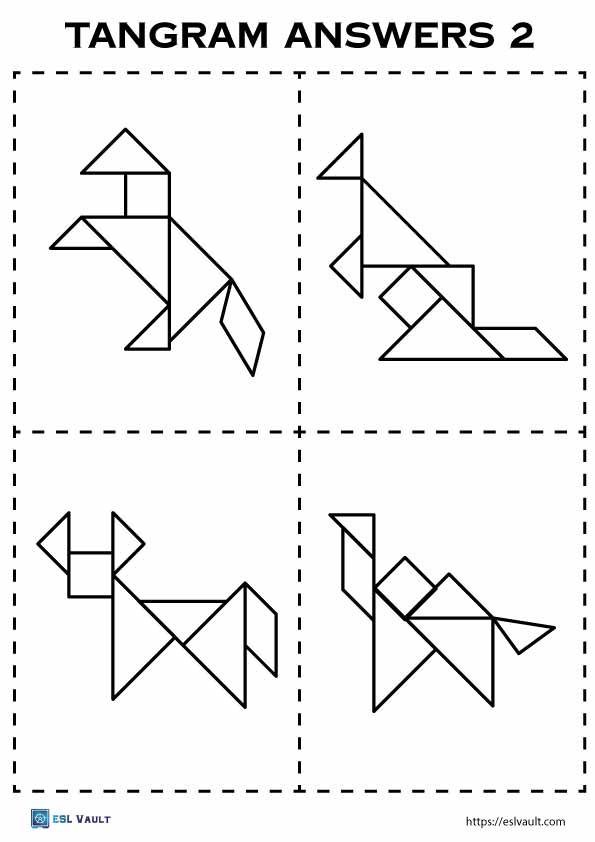
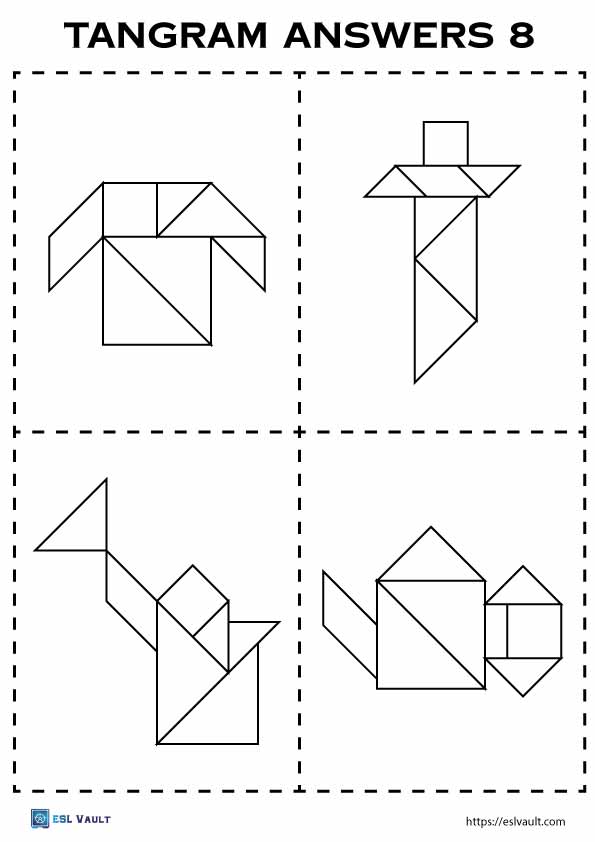
For young children or beginners, start with puzzle mats printed at a 1:1 scale where the individual shapes are drawn directly inside the target figure. Solvers simply match each physical piece to its corresponding line on the sheet. This stage builds shape recognition, spatial orientation, and fine-motor coordination.
Level 2: Pure Silhouette (Standard Challenge)
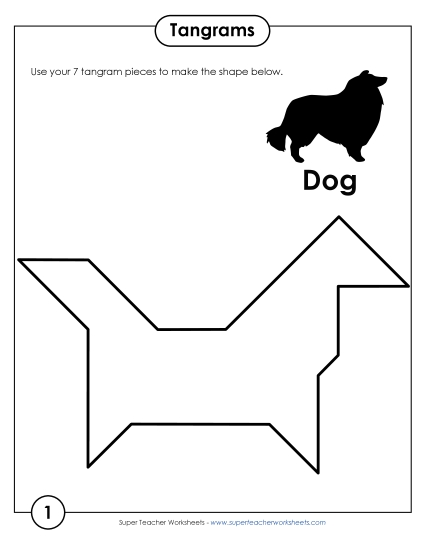
In this classic format, the puzzle card displays only a solid black silhouette without any interior seam lines. The solver must deduce where each of the seven pieces belongs based solely on outer angles and proportions. It helps to start with recognizable animals, such as a cat, swan, or running hare.
Level 3: Scaled-Down Cards and Paradoxes
Advanced puzzlers work from small reference cards (roughly 3x3 inches) rather than 1:1 mats, forcing them to mentally scale up the proportions. At this level, solvers can also explore "tangram paradoxes"—pairs of figures that appear nearly identical, yet one seems to have an extra area or missing piece despite both using all seven tans.
Creative Extensions for the Classroom and Home
Do not stop at simply matching silhouettes. You can extend the life of your printable sets with collaborative and interdisciplinary activities:
- Storytelling Silhouettes: Have children arrange their tans into an animal or character, trace the exterior outline, and write a creative short story about that figure.
- Tangram Speed Runs: Print two identical sets and see who can construct a specific figure (such as the standard square or a sailboat) the fastest.
- Perimeter and Area Investigations: Have older math students calculate the perimeter of various figures constructed from the same set of tans. While the area remains constant across every 7-piece design, the perimeters vary dramatically.
Final Thoughts
Printable tangrams combine historical elegance with timeless educational value. By taking a few moments to print, cut, and present these versatile shapes, you provide learners of any age with an open-ended puzzle system that sharpens the mind, encourages perseverance, and makes abstract geometry beautifully concrete.