Teeth Printable Templates Make Creating Dental Diagrams Easy
Whether you are a practicing clinician mapping out a complex restorative case, a dental assistant documenting findings, or a student memorizing tooth morphology, clear visuals are essential. While electronic health record (EHR) systems dominate modern operatories, teeth printable templates make creating dental diagrams easy, accessible, and fast when digital tools feel too rigid or cumbersome. A well-designed printable sheet provides an instant, tactile canvas to sketch pathologies, plan aesthetic enhancements, and communicate procedures transparently with patients.
Why Teeth Printable Templates Make Creating Dental Diagrams Easy
Dental anatomy is inherently three-dimensional and complex. Trying to explain an interproximal lesion or an upcoming endodontic procedure using purely verbal descriptions often leaves patients confused and anxious. Printable templates eliminate this friction by bridging the gap between clinical jargon and visual comprehension.
Here is why paper-based dental templates remain an indispensable asset across clinics and classrooms:
- Zero Learning Curve: Unlike electronic charting software that requires multiple clicks, dropdown menus, and specific hardware, a printed template requires only a pen or colored pencil. You can draw exactly what you see in seconds.
- Enhanced Patient Comprehension: Handing a patient a physical diagram where their specific issue is circled or highlighted in color dramatically improves treatment plan acceptance. They can hold it, ask targeted questions, and take it home to discuss with family.
- Tactile Study Aid: For dental and dental hygiene students, physically shading tooth surfaces, roots, and pulp chambers reinforces spatial anatomy far more effectively than passive screen reading.
- Clinical Redundancy: During unexpected practice management software downtime or internet outages, pre-printed odontograms ensure that diagnostic note-taking and charting continue without disrupting patient flow.
Standard Diagram Styles You Can Print
Different clinical and educational scenarios demand different diagram layouts. Selecting the right printable format ensures your annotations remain legible and relevant.
1. Universal Full-Mouth Odontograms
The standard adult dentition template features all 32 permanent teeth, typically displayed in both anatomical and geometric projections. Geometric layouts represent each tooth as five intersecting shapes (facial/buccal, lingual, mesial, distal, and occlusal/incisal). These are ideal for quick charting of restorations, sealants, and carious lesions using standardized dental shorthand.
2. Pediatric (Deciduous) Dentition Charts
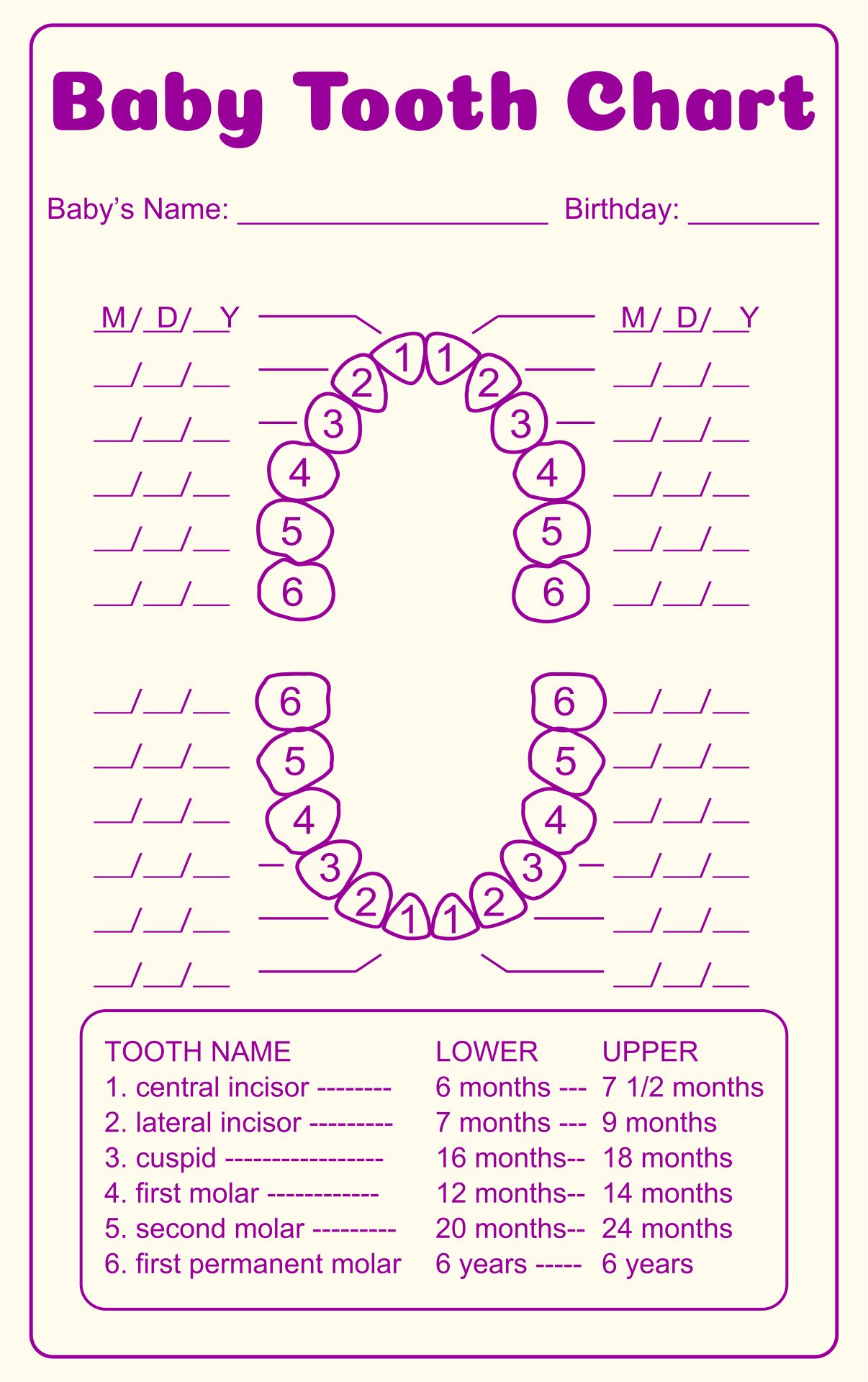
Primary dentition templates showcase the 20 baby teeth (letters A through T in the Universal Numbering System). Pediatric templates are particularly useful for tracking tooth eruption schedules, identifying early childhood caries, and monitoring space maintenance when teeth exfoliate prematurely.
3. Periodontal Charting Sheets
Periodontal diagrams prioritize the gingival margin, bone levels, and root structures. These templates include dedicated grids above and below each tooth to record probing depths (six sites per tooth), clinical attachment loss, bleeding on probing (BOP), furcation involvement, and tooth mobility.
4. Aesthetic and Smile Design Grids
Focused exclusively on the maxillary anterior teeth (canine to canine or premolar to premolar), these templates include midline guides, incisal edge curves, and proportional height-to-width ratios. Cosmetic dentists and ceramists use them to design veneers, composite bonding, and gingivectomy contours.
Video: Using dental charting template
How to Use Standard Charting Conventions on Paper
To maximize the clarity of your printed diagrams, adhering to universal dental charting conventions is critical. This ensures that any team member, specialist, or referring provider can interpret your drawings accurately.
- Red Means Action Required: Use red ink or pencil to denote active conditions that require treatment. This includes active caries, defective margins, fractured cusps, or pending extractions. A red outline on an occlusal surface immediately signals decay to the restorative team.
- Blue/Green Means Existing Work: Blue or black ink is typically reserved for stable, existing restorations. Solid blue shading indicates an existing amalgam restoration, while an outline in blue represents a composite restoration. Existing full-coverage crowns are typically cross-hatched in blue.
- Black 'X' for Missing Teeth: Draw a clean, single diagonal slash through teeth scheduled for extraction, and a complete 'X' through teeth that are congenitally missing or previously extracted.
- Arrow Vectors for Movement: If a tooth has drifted mesially, tilted lingually, or supra-erupted, draw an arrow originating from the crown pointing in the direction of the displacement. This is especially useful in orthodontic evaluations and implant space assessments.
Practical Workflows for Dental Teams and Educators
Chairside Consultations
Keep a clear acrylic caddy stocked with clean, single-sided templates in every operatory. When presenting a treatment plan that involves multiple options—such as a bridge versus an implant—grab a fresh sheet and sketch both scenarios side-by-side. Write the estimated appointment counts and key advantages directly beneath each diagram. Giving the patient this personalized sketch builds tremendous trust and transparency.
Educational Quizzing and Skill Building
Instructors can print blank anatomical templates without tooth numbers to test students on the Universal, Palmer, or FDI Two-Digit numbering systems. Students can also be assigned clinical case vignettes and tasked with charting complex restorative and endodontic histories directly onto the paper sheets during practical examinations.
Lamination for Operatory Efficiency
If you want to cut down on paper waste, run heavy cardstock templates through a thermal laminator. Mount a laminated sheet on the operatory wall or keep it on the bracket table. Using fine-tip dry-erase or wet-erase markers, assistants can quickly jot down pocket depths or surgical landmarks during an exam, transfer the data into the digital record later, and wipe the chart clean with an approved surface disinfectant between patients.
Digital Integration: The Hybrid Approach
Using printable templates does not mean abandoning your digital infrastructure. Many clinicians download high-resolution PDF templates onto tablets using stylus-driven note-taking apps. This approach provides the fluid, natural feel of freehand sketching with the organizational perks of digital storage.
Once you sketch a case on your tablet or annotate a physical sheet, you can instantly scan or photograph the diagram and upload it directly into the patient's digital chart under their document attachments. You gain the unmatched speed of pen-and-paper charting combined with the security and compliance of an electronic record.
Final Thoughts
Clear communication is the foundation of successful dentistry. Whether your goal is educating a nervous patient, mastering dental anatomy, or streamlining interdisciplinary treatment planning between periodontists and lab technicians, printable templates offer a reliable, zero-latency solution. By keeping a selection of quality templates ready to print, you equip your practice with a simple visual tool that elevates patient care and clinical organization.