Terminating Decimal Definition: Guide & Examples
When you begin studying fractions, real numbers, and division, understanding the terminating decimal definition is one of the most fundamental concepts you will encounter. In mathematics, decimals generally fall into two broad categories: those that continue forever and those that come to an exact end. Knowing how to identify, convert, and calculate terminating decimals is an essential pre-algebra skill that simplifies work with fractions, percentages, and scientific measurements.

What Is the Terminating Decimal Definition in Mathematics?
In standard arithmetic, a terminating decimal is defined as a decimal number that contains a finite number of digits after the decimal point. The word “terminate” simply means “to end.” Therefore, a terminating decimal is any decimal number whose fractional part ends rather than repeating endlessly or continuing indefinitely without a pattern.
From an algebraic perspective, every terminating decimal represents a rational number. When you divide the numerator of a fraction by its denominator, the division process terminates whenever the remainder reaches zero. For instance, dividing $1$ by $4$ produces $0.25$ with a remainder of zero, making $0.25$ a terminating decimal.
Clear Examples of Terminating Decimals
Terminating decimals appear everywhere in daily life, especially when dealing with currency, weights, and measurements. Here are several common examples showing how different fractions resolve into finite decimal values:
- 0.5: Equivalent to the fraction 1/2. It has exactly one decimal digit.
- 0.75: Equivalent to 3/4. It ends after two decimal digits.
- 0.125: Equivalent to 1/8. It ends neatly after three decimal digits.
- 3.625: Equivalent to the mixed number 3 5/8. It stops after three decimal digits.
- -0.4: Equivalent to -2/5. Negative decimals can also be terminating decimals.
Whole numbers (integers) can also be viewed as terminating decimals. For example, the integer $7$ can be written as $7.0$, which has a finite number of digits.
Terminating vs. Repeating Decimals: What Is the Difference?
To fully grasp what a terminating decimal is, it helps to compare it to other types of decimal values. Decimals represent real numbers and are classified primarily by how their fractional parts behave:
1. Terminating Decimals
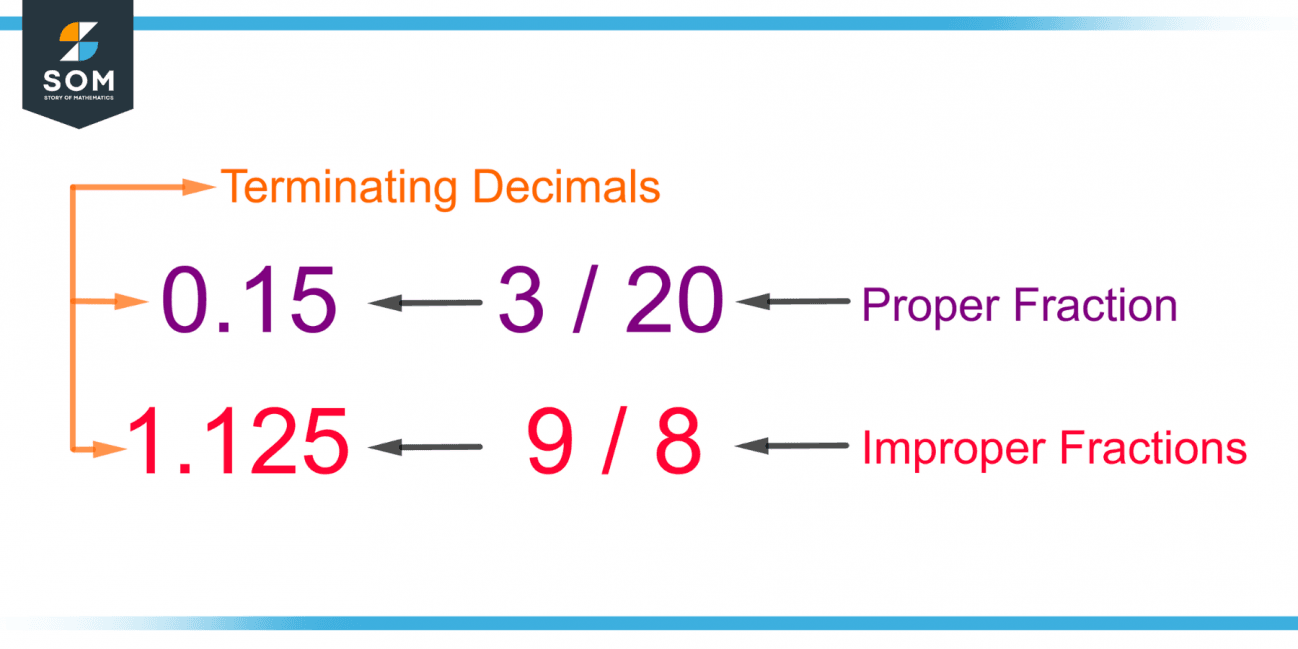
These have a fixed stopping point because the division produces a remainder of zero. For example, 1/5 yields 0.2. The decimal does not continue.
2. Repeating (Recurring) Decimals
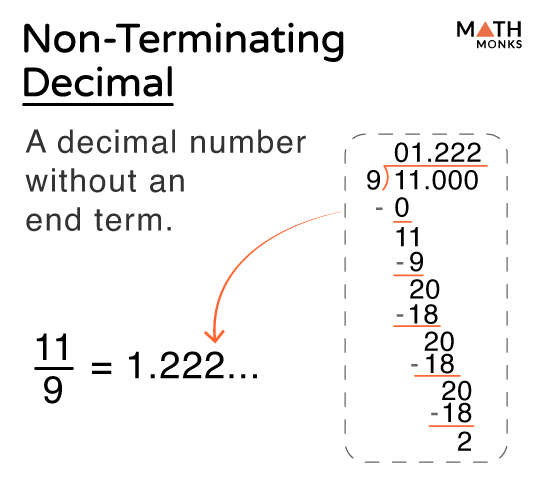
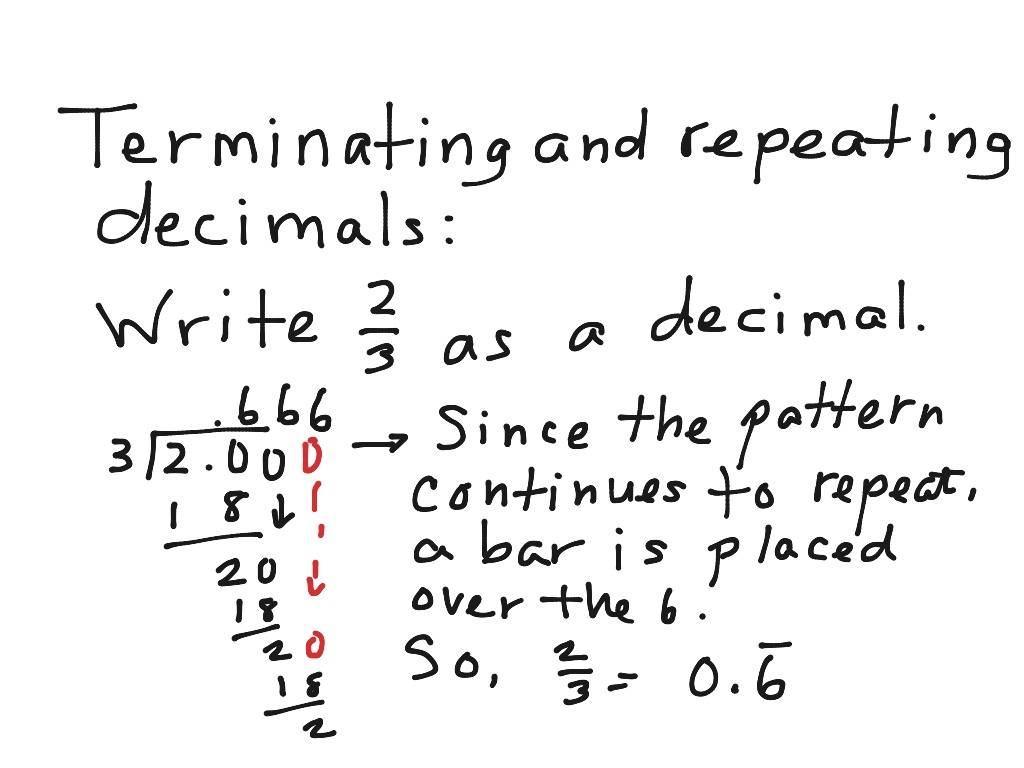
A repeating decimal is a rational number whose digits repeat indefinitely in a cycle. When you divide 1 by 3, you get 0.3333..., written mathematically as 0.3 with a bar (vinculum) over the 3. Because the remainder is never zero, the sequence of digits never terminates.
3. Non-Terminating, Non-Repeating Decimals
These are irrational numbers. Their decimal expansions go on forever without ever repeating a predictable pattern. Famously, the mathematical constant $\pi$ (approximately 3.14159...) and the square root of 2 (approximately 1.41421...) are non-terminating and non-repeating. Unlike terminating decimals, these numbers cannot be expressed as a ratio of two integers.
The Shortcut Rule: Identify a Terminating Decimal Without Dividing
You do not need to perform long division to find out whether a fraction will become a terminating decimal. There is a simple, reliable algebraic rule based on the prime factors of the denominator.
The Base-10 Factorization Rule

Because our standard number system is base 10, and the prime factors of 10 are 2 and 5, a fraction will convert into a terminating decimal if and only if the denominator's prime factors consist solely of 2s, 5s, or both.
Follow these three steps to test any fraction:
- Simplify the fraction: Reduce the fraction to its lowest terms by canceling out any common factors between the numerator and the denominator.
- Find prime factors of the denominator: Break down the bottom number into its prime factors.
- Inspect the factors: If the only prime factors present are 2, 5, or both (in the form $2^m \times 5^n$), the decimal will terminate. If any other prime factor appears (such as 3, 7, 11, or 13), the decimal will repeat.
Testing the Rule with Examples
Let's evaluate several fractions using this test:
- Example A: 7/20
The fraction is already in simplest terms. The prime factorization of 20 is $2 \times 2 \times 5$ ($2^2 \times 5^1$). Because the only prime factors are 2 and 5, 7/20 is guaranteed to terminate ($7/20 = 0.35$). - Example B: 5/12
The fraction is in simplest terms. The prime factorization of 12 is $2 \times 2 \times 3$ ($2^2 \times 3^1$). Because the factor 3 is present, 5/12 is a repeating decimal ($0.41666...$). - Example C: 9/30
Be careful! Always simplify first. Reducing 9/30 by dividing both terms by 3 gives 3/10. The denominator 10 factors into $2 \times 5$. Therefore, 9/30 terminates ($0.3$). Had you checked 30 without simplifying, the factor of 3 might have misled you.
How to Convert Between Terminating Decimals and Fractions
Because terminating decimals are rational numbers, converting back and forth between decimals and fractions is straightforward.
Converting a Terminating Decimal to a Fraction
- Count the decimal places: Determine how many digits sit to the right of the decimal point.
- Create the denominator: Write the decimal digits as an integer over a power of 10 ($10, 100, 1000$, etc.) with the same number of zeros as decimal places.
- Simplify: Reduce the resulting fraction to its simplest form.
For example, to convert 0.375 to a fraction:
- There are three decimal places, so the denominator is $10^3 = 1000$.
- Write the fraction as 375/1000.
- Divide numerator and denominator by their greatest common divisor (125) to arrive at 3/8.
Converting a Fraction to a Terminating Decimal
When you know a fraction terminates, you have two primary methods to convert it:
- Method 1: Long Division. Divide the top number by the bottom number. Add a decimal point and zeros to the dividend until the remainder reaches zero.
- Method 2: Equivalent Base-10 Denominator. Multiply both numerator and denominator by whatever factor turns the denominator into a power of 10. For instance, with 3/20, multiply both parts by 5 to get 15/100, which is immediately recognizable as 0.15.
Frequently Asked Questions
Are all terminating decimals rational numbers?
Yes. By definition, any terminating decimal can be written as a fraction where both numerator and denominator are integers (specifically, an integer over a power of 10). Because this matches the exact definition of a rational number, all terminating decimals are rational.
Can an irrational number ever be a terminating decimal?
No. Irrational numbers cannot be represented as fractions of integers, and their decimal expansions run infinitely without repeating. Therefore, an irrational number can never terminate.
What is the difference between a finite decimal and a terminating decimal?
“Finite decimal” and “terminating decimal” are synonyms. Both terms describe a decimal number with a countable, limited number of digits after the decimal point.