Tesla Net Worth Explosion: $200B to $350B in 2024
Few financial stories in recent history match the volatility and sheer scale of Tesla’s market performance in 2024. Early in the year, financial analysts sounded alarms as electric vehicle adoption showed signs of cooling, margins compressed under aggressive price cuts, and competitive pressures intensified across Asia and Europe. Yet, within months, sentiment reversed dramatically. From $200B to $350B in 2024—Tesla’s net worth explosion explained reveals not just a story of stock price recovery, but a fundamental realignment of how Wall Street values Tesla: no longer merely as an automotive manufacturer, but as an artificial intelligence, robotics, and energy infrastructure powerhouse.

Whether tracking the company’s enterprise valuation swings or CEO Elon Musk’s personal net worth—which relies heavily on his 13% direct stake and long-term performance options in Tesla—the leap from the $200 billion baseline to peak highs above $350 billion marked one of the fastest wealth creations in corporate history. Below, we break down the operational catalysts, market factors, and technological shifts that powered this massive turnaround.
From $200B to $350B in 2024—Tesla’s Net Worth Explosion Explained
To understand the magnitude of this rebound, it is essential to revisit the low point of early 2024. By April, Tesla stock had dropped more than 40% year-to-date, trading near $140 per share. Wall Street was fixated on negative growth prints, shrinking gross margins, and lower deliveries. Elon Musk's net worth hovered near $180B–$200B, far below its previous peaks.
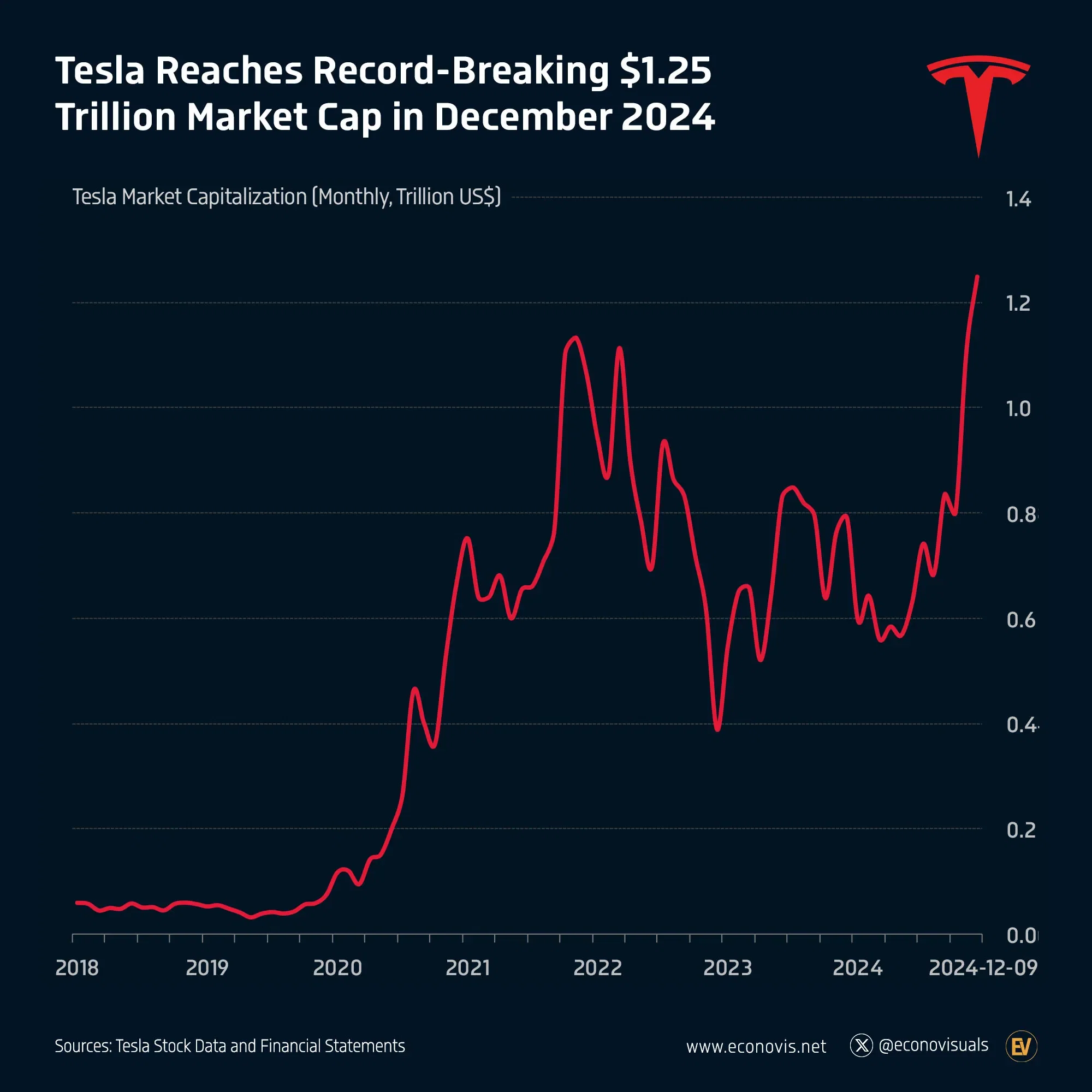
By late autumn 2024, the narrative flipped entirely. Tesla shares broke past $350, lifting the company's market capitalization back over the $1 trillion milestone and elevating Musk’s personal fortune beyond $350 billion. This expansion was not an accidental speculative bubble; it was triggered by a sequence of high-impact strategic pivots and hard operational milestones.
1. The Tesla Energy Renaissance
While the financial press routinely focuses on vehicle production numbers, Tesla Energy emerged as the quiet heavyweight of 2024. For years, stationary energy storage was viewed as a minor side venture. In 2024, it became a primary driver of top-line growth and margin expansion.
- Megapack Deployment: Deployments of the utility-scale Megapack surged past 15 GWh across multiple quarters, representing over 100% year-over-year growth.
- Higher Margins than Autos: Energy storage segment gross margins regularly eclipsed 25%, insulating Tesla from the price competition affecting the automotive segment.
- Lathrop Megafactory Ramp: With the 40 GWh Lathrop facility reaching sustained output and a second Megapack factory breaking ground in Shanghai, institutional investors began assigning a standalone valuation of over $100 billion to Tesla's energy business alone.
2. The End-to-End AI Pivot: FSD V12 and Robotaxi
A central reason for Tesla's valuation explosion was the transition of its Full Self-Driving (FSD) architecture to version 12. Prior iterations relied on hundreds of thousands of lines of explicit C++ code governing vehicle decisions. FSD V12 replaced that heuristic architecture with end-to-end neural networks trained directly on video data.
This technical breakthrough transformed market perception in three ways:
- Validation of the AI Thesis: By demonstrating rapid, non-linear improvements in driving interventions, Tesla proved to institutional investors that its massive investment in compute clusters (Dojo and thousands of NVIDIA H100/H200 GPUs) was generating tangible product advantages.
- The Cybercab Event: In October 2024, Tesla unveiled its dedicated autonomous vehicle, the Cybercab, alongside the 20-passenger Robovan and updated prototypes of the humanoid robot, Optimus. While commercial rollout timelines remain subject to regulatory approval, the event cemented Tesla’s identity as an applied robotics firm.
- High-Margin Software Potential: Recurring revenue from FSD licensing, subscriptions, and future fleet management provided the basis for analysts to assign software-level price-to-earnings (P/E) multiples to the stock once again.
3. Automotive Cost Compression and Delivery Rebound
A resurgence in investor confidence required the core automotive business to stabilize. In the third quarter of 2024, Tesla delivered concrete proof that vehicle margins had reached an inflection point:
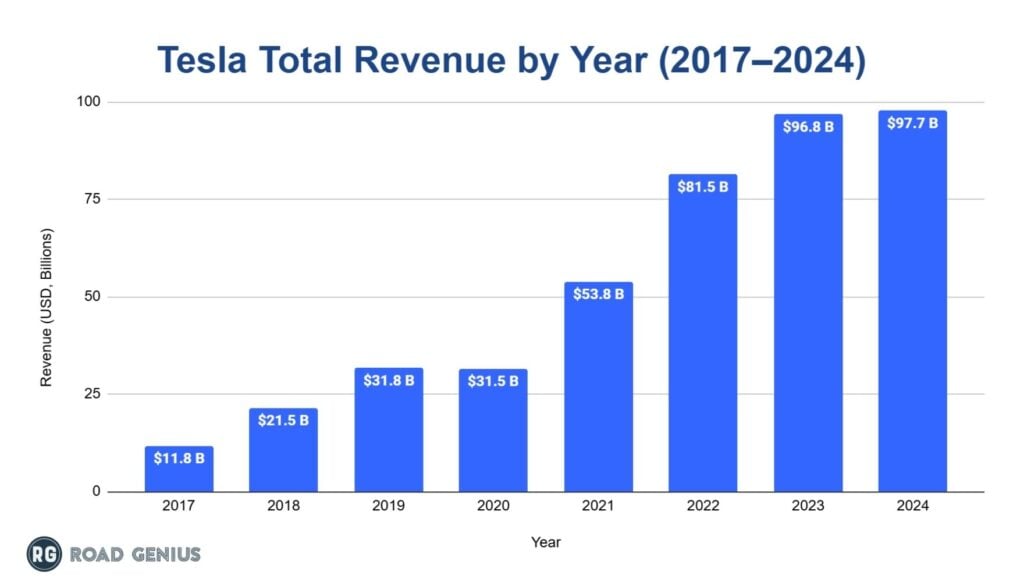
- Cost of Goods Sold (COGS): Tesla managed to drive its per-vehicle cost of goods sold down to approximately $35,100—its lowest level in company history.
- Cybertruck Profitability: Despite early skepticism, the Cybertruck became the third-best-selling all-electric vehicle in the United States and achieved positive gross margin status ahead of analyst projections.
- Delivery Growth: Strong demand in China, backed by government scrappage incentives and zero-percent financing options, restored positive delivery growth in Q3 and Q4.
4. Macro Sentiment and Political Tailwinds
Financial fundamentals rarely move in a vacuum. Broader macroeconomic conditions played an undeniable role in lifting Tesla’s enterprise valuation:
Interest Rate Easing
Automobile purchases rely heavily on financing. As central banks initiated benchmark interest rate cuts in late 2024, consumer financing costs moderated, relieving pressure on monthly payment calculations and reducing the need for further dealer incentives or price cuts.
Regulatory Optimism
Following the 2024 U.S. presidential election, market expectations shifted heavily in favor of deregulation. Investors rapidly priced in the likelihood of a streamlined federal framework for fully autonomous vehicles. Currently, autonomous testing and commercial deployment in the U.S. are fragmented across a patchwork of state-level rules. A unified federal standard would dramatically accelerate Tesla’s timeline for launching commercial autonomous ride-hailing services without human safety drivers.
Can Tesla Sustain Its Valuation Momentum?
With Tesla's market capitalization back above $1 trillion and key executives' net worth crossing historic milestones, the central question for investors is whether the company can defend its valuation multiples going forward. Tesla trades at a steep premium compared to legacy automakers, reflecting its potential in robotics and autonomous services.
Sustaining this trajectory will require execution on several key fronts:
- Unsupervised FSD Approvals: Moving from supervised FSD to fully autonomous commercial operation in key markets like Texas and California.
- Sub-$30,000 Next-Gen Vehicle: Bringing the lower-cost consumer model to market to protect market share against low-cost international competitors.
- Optimus Scaling: Transitioning humanoid robotic units from internal factory tasks to pilot commercial sales.
Final Thoughts
Tesla’s jump from a bruised $200 billion baseline back toward peak multi-hundred-billion territory in 2024 serves as a textbook lesson in market psychology and strategic execution. By pairing disciplined manufacturing cost controls with breakthrough progress in AI compute and utility storage, Tesla quieted short-sellers and redefined its investment thesis for the remainder of the decade.


.jpg)


