Texas Divorce Papers and Process: A Beginner's Overview
Filing to end a marriage can feel overwhelming, especially when faced with unfamiliar court jargon and state-specific legal requirements. Understanding the Texas divorce papers and process: a beginner's overview can demystify the journey, helping you protect your rights, make informed decisions, and move forward with confidence.

Whether you plan to represent yourself (known as filing pro se) or hire a family law attorney, this guide breaks down the essential paperwork, Texas legal criteria, and the step-by-step timeline required to finalize a divorce in the Lone Star State.
Texas Residency Requirements: Before You File
Before you can submit a single document to the court, you must verify that you meet the state's jurisdictional rules under Section 6.301 of the Texas Family Code. To file for divorce in Texas:
- Either you or your spouse must have lived in Texas for at least six consecutive months immediately before filing.
- Either you or your spouse must have lived in the county where the divorce is filed for at least 90 days immediately prior to filing.
If you fail to meet these residency benchmarks, the court cannot hear your case, and your filing will be dismissed.
Core Texas Divorce Papers You Need to Know
A Texas divorce relies on a standardized set of court documents. While every couple's situation differs—particularly when children or significant assets are involved—most cases involve the following core pleadings:
1. The Original Petition for Divorce
The Original Petition is the formal document that initiates the divorce case. Filed by the "Petitioner" against the "Respondent" (the other spouse), it outlines basic demographic details, residency qualifications, grounds for divorce, and general requests regarding property division and child custody.
Texas permits both fault and no-fault divorces. The vast majority of petitioners select the no-fault ground of "insupportability," meaning the marriage has become unworkable due to conflict or discord with no reasonable expectation of reconciliation.
2. The Citation and Service Forms (or Waiver)
Under Texas law, the Respondent is entitled to formal notice of the lawsuit. This is handled in one of two ways:
Video: What is the Divorce Process in Texas? - Start to Finish | Dallas Divorce Lawyer

- Waiver of Service Only: In uncontested divorces, the Respondent signs a notarized waiver acknowledging receipt of the petition and waiving the need for formal service by a sheriff or process server.
- Citation and Process Service: In contested divorces, a process server or county constable formally delivers the citation and petition to the Respondent. The server then files a Return of Service with the court.
3. Forms Involving Minor Children (SAPCR)
If you and your spouse share minor children, your divorce must include a Suit Affecting the Parent-Child Relationship (SAPCR). Key child-related forms include:
- Parenting Plan: Details conservatorship (legal custody), possession schedules (visitation), and geographic residence restrictions.
- Child Support and Medical Support Worksheets: Documents showing calculations based on Texas statutory child support guidelines.
- Information on Suit Affecting the Family Relationship (Austin Form / VS-165): A vital statistics record submitted to the state.
4. The Final Decree of Divorce
The Final Decree of Divorce is the binding court order that officially dissolves the marriage. It contains all final terms, including the division of community property and debts, spousal maintenance (if applicable), and all child-related orders. The judge signs this document at the end of the process.
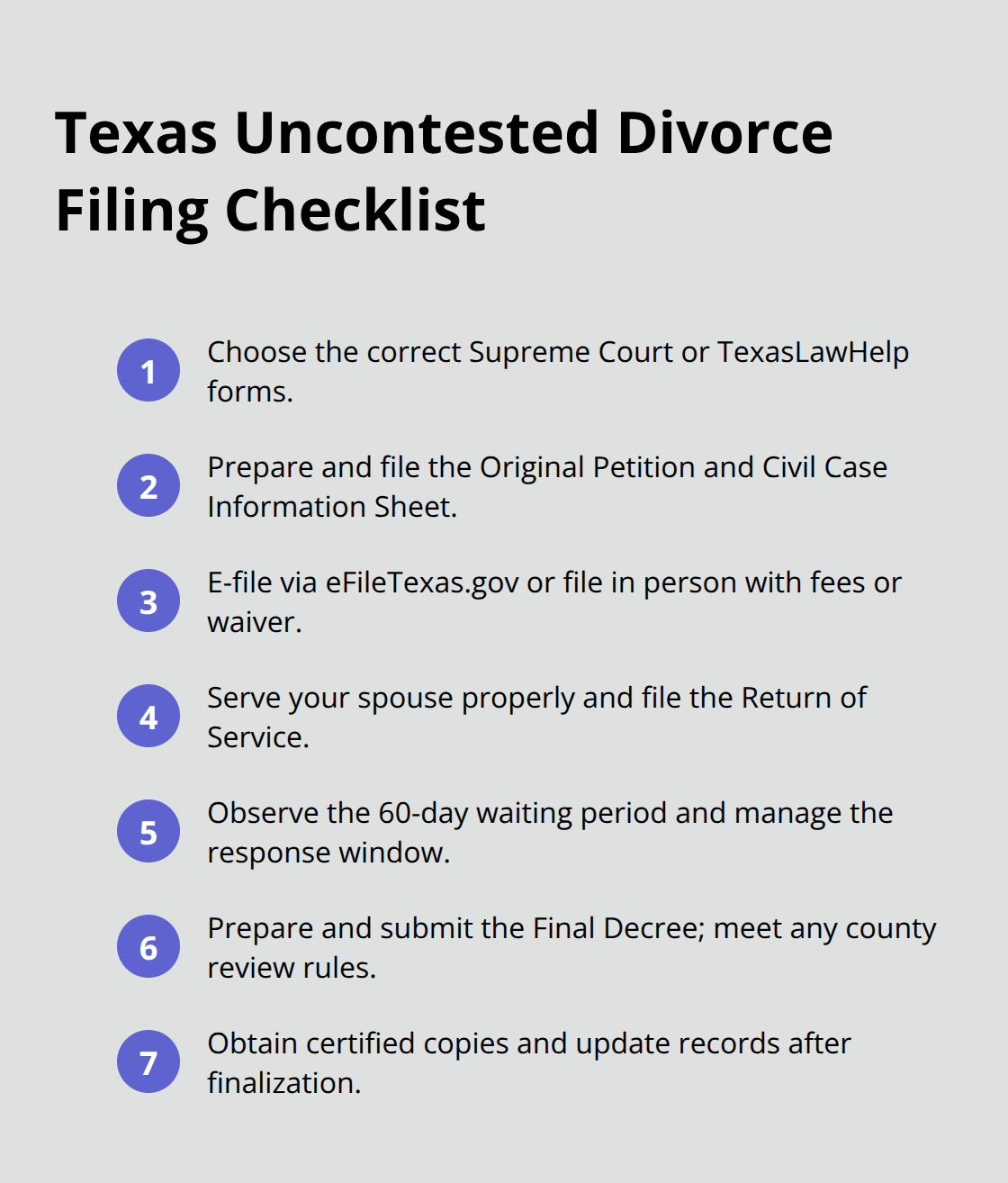
Texas Divorce Papers and Process: A Beginner's Overview of the Timeline
Once you understand the basic paperwork, the next step is navigating the chronological roadmap from filing to final judgment.
-
Drafting and Filing the Petition:
The Petitioner completes the Original Petition for Divorce and files it with the District Clerk's office in their county (most Texas courts require electronic filing through eFileTexas). At this stage, the clerk assigns a cause number and district court. -
Serving the Other Spouse:
The Respondent must be notified. Once served, a Texas respondent has until 10:00 AM on the Monday following the expiration of 20 days to file an official Answer. If they fail to answer, the Petitioner may eventually seek a default judgment. -
The 60-Day Mandatory Waiting Period:
Texas law mandates a minimum 60-day "cooling-off" period from the date the petition is filed before the judge can sign a Final Decree. Very few exceptions apply, mainly cases involving domestic violence protective orders. -
Issuing Temporary Orders (If Needed):
If spouses cannot agree on who stays in the home, temporary child support, or bill payments while the divorce is pending, either party can request a hearing for Temporary Orders. These establish ground rules until the case concludes. -
Discovery and Negotiation:
Both parties exchange financial records, property inventories, and debt schedules. Texas is a community property state, meaning assets acquired during the marriage are presumed to be owned equally unless proved otherwise by clear and convincing evidence. Many courts require mediation before allowing a case to go to trial. -
The Prove-Up Hearing and Final Decree:
In uncontested cases, once the 60 days have passed and agreements are signed, the Petitioner attends a short, informal court appearance called a "prove-up" (many courts now handle this via simple affidavit or brief virtual hearing). The judge verifies statutory compliance, signs the Final Decree, and the divorce is officially finalized.
Uncontested vs. Contested Divorces in Texas
The path your case takes depends largely on whether you and your spouse agree on all terms:
- Uncontested Divorce: You agree on property division, debt allocation, custody, and support. These divorces are faster, significantly less expensive, and can often be completed shortly after the 60-day waiting period ends.
- Contested Divorce: Disputes exist over property, finances, or child custody. These cases require formal discovery, temporary hearings, mediation, and possibly a bench or jury trial. Contested cases often take six months to over a year to resolve.
Common Pitfalls to Avoid
Even in straightforward cases, mistakes with paperwork can delay your final decree or create legal headaches down the road:
- Overlooking Retirement Assets: Simply stating you keep your 401(k) in the decree is not enough. Dividing employer-sponsored retirement plans requires a separate order called a Qualified Domestic Relations Order (QDRO).
- Improper Real Estate Transfers: Agreeing that one spouse keeps the marital home requires a Special Warranty Deed and Deed of Trust to Secure Assumption to properly release title interests and address mortgage liabilities.
- Rushing the 60-Day Window: Courts cannot legally grant the divorce on day 59. Calendar your dates carefully starting from the day after filing.
Moving Forward with Your Texas Divorce
Navigating the legal dissolution of a marriage takes patience and careful organization. By familiarizing yourself with the core Texas divorce papers and the mandatory legal steps, you ensure that your proceedings run smoothly and your rights remain safeguarded. If your marital estate includes complex assets, disputed child custody, or contentious disagreements, consulting an experienced Texas family law attorney can provide the personalized guidance needed to protect your future.