The Age of Moses’s Gold: Pillars of Belief
When modern readers picture the Exodus, their minds typically conjure cinematic vistas: the parting of the Red Sea, thunder cracking over Mount Sinai, and Moses descending the craggy slopes clutching stone tablets. Yet the theological birth of monotheism was not accomplished through rhetoric and miracles alone. To truly understand the tangible dawn of biblical worship, one must step into the age of Moses’s gold—discover how a jeweler’s hands shaped the pillars of belief! Long before permanent temples crowned Jerusalem, faith required a physical home in the wilderness, and that home was forged by hammer, crucible, and chisel.

While Moses served as the visionary lawgiver, the daunting task of translating ethereal heavenly blueprints into gold, silver, and acacia wood fell to an artisan. His name was Bezalel. Far from a mere foot soldier of antiquity, this master craftsman used the sophisticated metallurgical techniques of late Bronze Age Egypt to erect the sacred framework of a new civilization.
The Metalsmith Behind the Prophet: Who Was Bezalel?
Biblical narrative introduces Bezalel, son of Uri, with a singular theological distinction. In the book of Exodus, he is the very first human recorded as being filled with the “Spirit of God” (Ruach Elohim). Intriguingly, this divine endowment was granted neither to a priest nor a king, but to an artisan. The text specifies that he possessed wisdom, artistic insight, and practical knowledge in cutting stones, carving wood, and working with gold, silver, and bronze.
Bezalel was not working in an artistic vacuum. Generations of Hebrew residence in Egypt had placed them at the crossroads of the ancient world’s most advanced metallurgical hub. New Kingdom Egypt had perfected gold-working to an unprecedented zenith, as evidenced by the treasures recovered from the tomb of Tutankhamun and the royal workshops of Thebes and Memphis. Bezalel and his cohort were trained in these exact royal traditions, acquiring sophisticated skills in lost-wax casting, repoussé, granulation, and sheet gilding.
Desert Metallurgy: Where Did the Gold Come From?
A longstanding historical question asks how nomadic pastoralists in the arid Sinai peninsula could have commanded hundreds of pounds of precious metal. The biblical record notes that upon leaving Egypt, the departing Israelites requested and received vessels of silver and gold from their Egyptian neighbors—essentially back pay for generations of uncompensated labor.
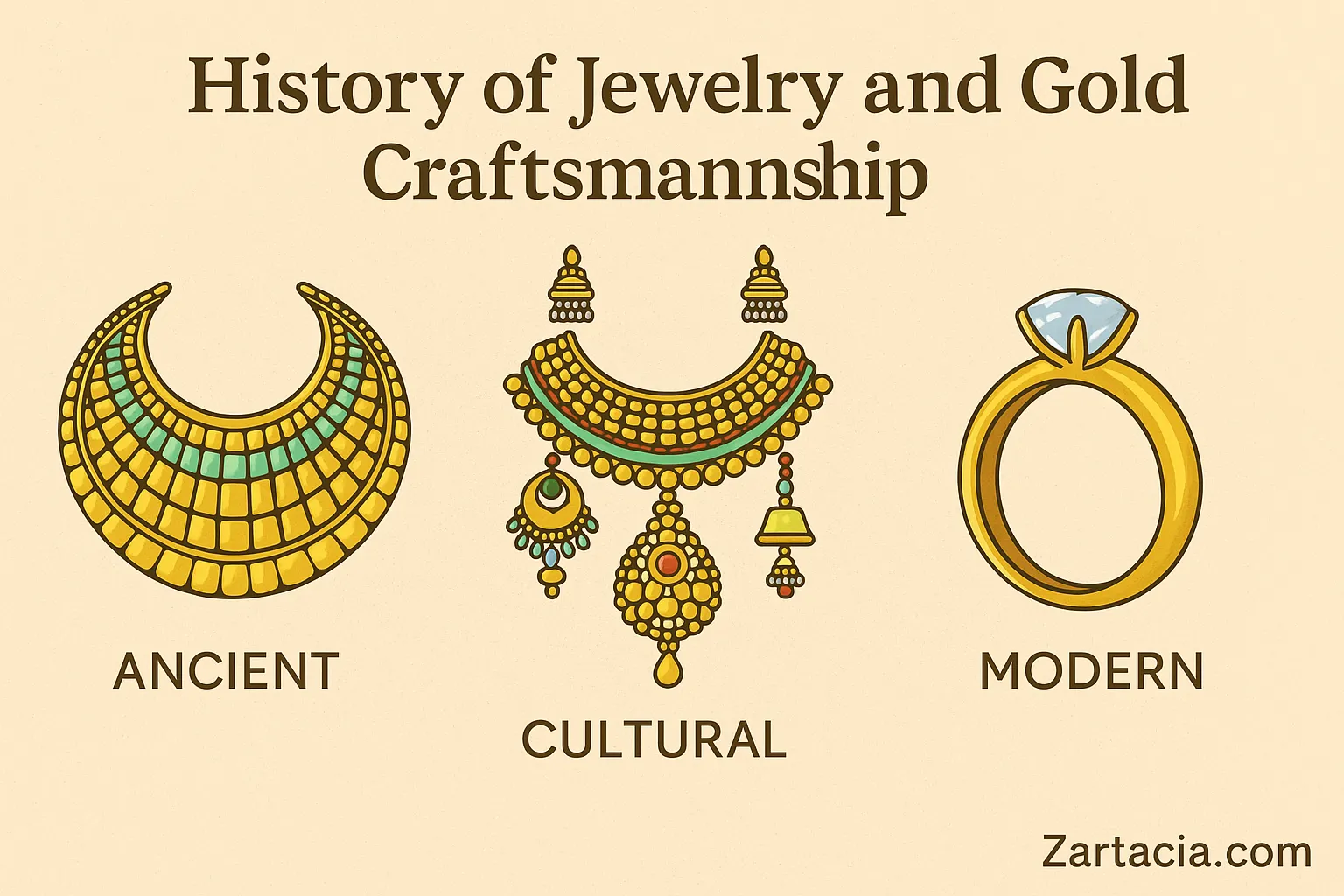
This cache of metal took the form of common Egyptian jewelry: heavy electrum torcs, gold signet rings, hoop earrings, and beaten amulets. In the wilderness, these disparate personal ornaments were melted down and purified. However, the metal carried a dual potential. In Moses’s absence, hasty metallurgy gave birth to the Golden Calf—a crude, cast idol mimicking the Egyptian bull cults of Apis and Hathor. Moses’s subsequent commission of the Tabernacle served as a deliberate theological counter-offensive: taking that same Egyptian gold and redeeming it through disciplined, architectural craftsmanship.
The Age of Moses’s Gold—Discover How a Jeweler’s Hands Shaped The Pillars of Belief!
In the construction of the Tabernacle (the Mishkan), gold was not treated merely as decoration; it was an architectural medium that established theological boundaries. The structure progressed in holiness from bronze in the outer courtyard, to silver in the foundational sockets, and finally to pure gold within the inner sanctum.

The Gilded Acacia Pillars
The structural skeleton of the desert sanctuary relied on upright pillars made of desert acacia (shittim) wood. Acacia was dense, insect-resistant, and plentiful in the wadis of Sinai, but its fibrous nature made it rough. Bezalel’s team covered these immense pillars in micro-thin sheets of hammered gold leaf. These golden pillars served vital structural and symbolic roles:
- Supporting the Veil: Four central gilded pillars suspended the Parochet, the heavy woven curtain that separated the Holy Place from the Holy of Holies.
- Reflecting Sacred Fire: Inside the windowless sanctuary, the gleaming gold surfaces multiplied the light of the sacred oil lamps, creating an otherworldly, radiant environment.
- Bridging Heaven and Earth: The core of resilient desert wood clad in incorruptible gold symbolized the meeting of mortal frailty and divine eternity.
The Masterpiece: The Hammered Golden Menorah
Perhaps no single artifact demonstrated Bezalel’s genius more than the golden lampstand (Menorah). Ancient texts state that this seven-branched candelabrum was not cast from molten metal assembled in pieces; rather, it was beaten out of a single talent (roughly 75 pounds) of pure, solid gold. Through the technique known today as repoussé and chasing, the artisan repeatedly heated, hammered, and cooled the metal, raising decorative almond blossoms, calyxes, and petals from a solitary golden mass.
The Mercy Seat and the Cherubim
Similarly, the lid of the Ark of the Covenant—the kapporet—was fashioned from a single solid block of gold. The two winged cherubim facing each other with outspread wings were hammered directly out of the base, requiring flawless spatial awareness. A single fracture in the gold would ruin the entire piece, demanding an artisan operating at the absolute peak of ancient metallurgical mastery.
Theological Alchemy: Transforming the "Flesh of the Gods"
In Egyptian cosmology, gold was considered the literal flesh of the gods, particularly the sun god Ra. Pharaonic jewelry and burial masks were designed to render the deceased divine and immortal. When Bezalel melted down Egyptian gold, he performed an act of radical theological subversion.
Under his hands, gold was stripped of its pagan identity:
- From Idols to Vessels: Gold was no longer shaped into the face of a god to be worshiped. Instead, it was shaped into tables, lampstands, hooks, and clasps to serve an invisible Deity who could not be depicted.
- Sacred Textile Integration: The artisans hammered gold ingots into wafer-thin foils, cut them into fine threads, and wove them directly into the blue, purple, and scarlet linen of the High Priest’s garments (Exodus 39:3). Gold became pliable, dynamic, and woven into human service.
- The Empty Throne: Atop the solid gold Mercy Seat, there sat no physical likeness of God. The most expensive gold in the entire camp framed an empty space—the throne of the unrepresented Creator.
The Enduring Legacy of Sacred Craftsmanship
The tabernacle of the wilderness eventually gave way to Solomon’s stone temple, but the architectural and