The Complete NCE Study Guide to Pass on Your First Try
Preparing for the National Counselor Examination (NCE) can feel overwhelming given the sheer volume of graduate-level material it covers. Whether you are aiming for National Certified Counselor (NCC) certification or seeking state licensure as an LPC or LMHC, having a structured nce study guide is critical. With proper planning, targeted content review, and realistic practice questions, you can approach exam day with complete confidence.

Understanding the NCE Format and Scoring
The NCE is a computer-based examination developed and administered by the National Board for Certified Counselors (NBCC). Understanding how the test is built is the first step toward conquering it:
- Total Questions: 225 multiple-choice questions.
- Scored vs. Unscored: 160 questions are scored; 65 questions are field-test items that do not count toward your final score. You will not know which questions are experimental, so treat every item as scored.
- Testing Time: 3 hours and 45 minutes (225 minutes), which gives you exactly one minute per question.
- Passing Score: The passing score fluctuates slightly between forms depending on equated difficulty, typically falling between 58% and 65% (usually around 90–105 correct answers out of 160).
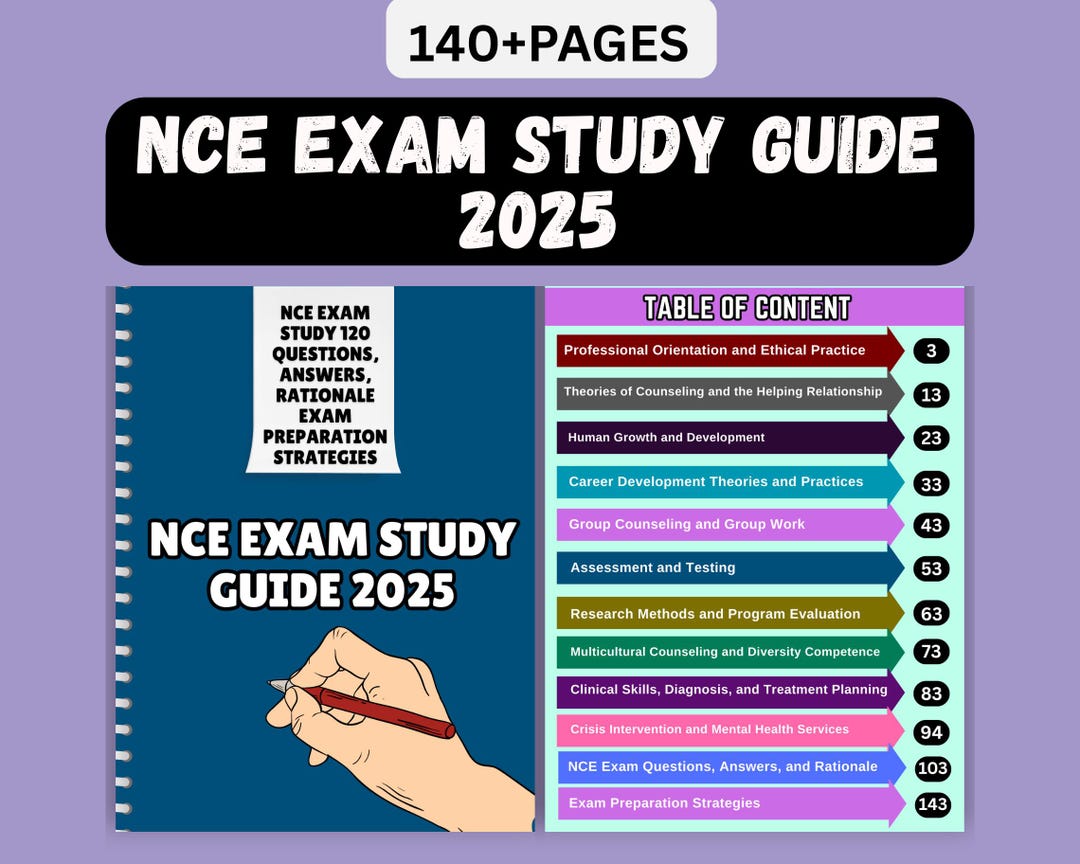
The exam draws from eight core Council for Accreditation of Counseling and Related Educational Programs (CACREP) curriculum areas, cross-referenced against six fundamental Work Behavior domains, including Clinical Focus, Intake and Assessment, and Ethical Practice.
High-Yield CACREP Domains to Master
1. Human Growth and Development
This section tests developmental trajectories across the lifespan. Pay close attention to stage theories, biological milestones, and psychological crises.
- Erik Erikson: Know all eight psychosocial stages, their age ranges, and the resulting virtues or crises (e.g., Industry vs. Inferiority in school-aged children).
- Jean Piaget: Master the sensorimotor, preoperational, concrete operational, and formal operational stages, along with concepts like assimilation, accommodation, and conservation.
- Lawrence Kohlberg: Distinguish between Preconventional, Conventional, and Postconventional moral development.
- Attachment Theory: John Bowlby and Mary Ainsworth’s attachment styles (secure, anxious-ambivalent, avoidant, disorganized).
2. Counseling Theories and Helping Relationships
The NCE heavily emphasizes theoretical foundations and their clinical application. You must be able to recognize interventions based on clinical vignettes.
- Cognitive Behavioral Therapy (CBT & REBT): Aaron Beck’s cognitive distortions (catastrophizing, black-and-white thinking) and Albert Ellis’s ABCDE model.
- Psychodynamic & Psychoanalytic: Defense mechanisms (projection, reaction formation, sublimation, displacement), transference, and countertransference.
- Humanistic & Existential: Carl Rogers’s core conditions (unconditional positive regard, empathy, genuineness/congruence) and Viktor Frankl’s search for meaning.
- Family Systems: Murray Bowen (triangulation, differentiation of self, genograms) and Salvador Minuchin (structural family therapy, boundaries, enmeshment).
3. Professional Practice and Ethics
Ethics questions test your real-time decision-making using the American Counseling Association (ACA) Code of Ethics. These questions usually ask what you should do first or what is most ethical.
- Confidentiality and Exceptions: Clear and imminent danger to self or others, mandated reporting of child or elder abuse, and court orders signed by a judge (versus subpoenas from an attorney).
- Dual Relationships: Boundaries, sexual relationships (a mandatory five-year waiting period post-termination under ACA guidelines), and accepting small cultural gifts.
- Informed Consent: Required elements at the start of counseling and as an ongoing process throughout treatment.
4. Group Work, Career, and Assessment
- Group Dynamics: Irvin Yalom’s curative factors, stages of group development (forming, storming, norming, performing, adjourning), and group leadership styles (authoritarian, democratic, laissez-faire).
- Career Theories: John Holland’s RIASEC model, Donald Super’s life-span life-space approach, and Linda Gottfredson’s theory of circumscription and compromise.
- Appraisal & Research: Mean, median, mode; standard deviation; bell curve percentiles; validity (construct, criterion, content) versus reliability (test-retest, split-half); and Type I versus Type II errors.
Building an Effective NCE Study Guide Schedule

A structured 8-week study plan balances deep content review with deliberate test simulation. Avoid cramming; sustained spaced repetition produces far higher retention on conceptual questions.
- Weeks 1–2: Human Growth, Development, and Ethics
Establish baseline knowledge. Take a 50-question diagnostic exam to identify blind spots. Focus heavily on developmental theorists and the ACA Code of Ethics. - Weeks 3–4: Counseling Theories and Helping Techniques
Map out every major counseling modality. Create comparison matrices comparing the role of the counselor, goals of therapy, and signature techniques across psychoanalytic, CBT, Adlerian, Gestalt, and narrative approaches. - Weeks 5–6: Group Work, Career Development, and Cultural Diversity
Review group stages and leadership interventions. Dive into career development models and multicultural counseling competencies, focusing on microaggressions, cultural identity models, and systemic barriers. - Week 7: Research, Assessment, and Psychometrics
Master standard scores (z-scores, T-scores), statistical significance, and psychometric instruments (MMPI, BDI, WAIS). Demystify experimental design and internal versus external validity. - Week 8: Full-Length Practice Exams and Final Review
Sit for at least two full-length, timed 225-question practice tests. Review rationales for every question you answered incorrectly or flagged as a guess. Rest your brain completely the day before the exam.
Top Recommended Study Resources
Rather than buying dozens of books, concentrate on two or three reputable resources:
- Dr. Howard Rosenthal’s Encyclopedia of Counseling (The "Purple Book"): Considered the gold standard for NCE review. It uses an engaging Q&A format with thorough, memorable rationales.
- Pocket Prep (Behavioral Health App): Ideal for daily mobile study. Use it during commutes or breaks to practice 20–30 questions per day with quick rationale checks.
- Dr. Andrew Helwig’s Study Guide for the NCE: A comprehensive, linear outline format that covers CACREP standards systematically.
- Official NBCC Practice Exams: The most accurate gauge of question syntax, tone, and difficulty level.
Critical Test-Taking Strategies for Exam Day
Knowledge alone is not enough; test mechanics often make the difference between passing and failing.
1. Read the Stem with Precision
Watch out for polarizing modifiers like EXCEPT, FIRST, BEST, LEAST, and ALWAYS. Highlight or mentally repeat these words. Many questions test the logical sequence of an intervention—what you should do first is rarely the ultimate solution, but rather an immediate safety, rapport, or assessment step.
2. Follow the Rule of Immediacy and Safety
If a question involves physical safety, child abuse, or acute suicidality, direct action and safety planning always trump theoretical exploration. Never analyze a client's childhood trauma when they are in active crisis.
3. Manage Your Clock
With 225 minutes for 225 questions, you cannot spend three minutes agonizing over an ambiguous question. Choose your best educated guess, flag it, and move on. If you keep pace at 60 questions per hour, you will have 15 to 20 minutes remaining at the end to review flagged items.
With disciplined preparation, an organized schedule, and consistent practice with high-quality questions, the NCE is a hurdle you can clear on your very first attempt.