The Fascinating Story of Hawk Andre Dawson
When baseball fans discuss the titans of the 1980s diamond, names like Rickey Henderson, George Brett, and Cal Ripken Jr. instantly roll off the tongue. Yet, one of the most complete, feared, and fiercely respected players of that era often gets lost in modern historical debates. It is time to dive into The Fascinating Story of Hawk Andre Dawson, a narrative defined by relentless perseverance, extraordinary talent, and an unwavering love for the game that ultimately reshaped how we view athletic longevity.

Andre Dawson was not just a star; he was a warrior who played through chronic knee pain on brutal artificial turf surfaces, leaving everything he had between the white lines. Despite winning an MVP award, earning eight Gold Gloves, and being inducted into the National Baseball Hall of Fame, his cultural footprint today feels surprisingly muted. Let's explore why his story is so compelling and why sports fans should be talking about him a whole lot more.
From South Florida to the Montreal Expos
Long before he was earning the nickname "Hawk" for his sharp focus and predatory outfield defense, Andre Dawson was forging his athletic identity in Miami, Florida. Drafted by the Montreal Expos in the 11th round of the 1975 amateur draft, Dawson wasn't viewed as an immediate generational prodigy. Teams worried about his knees, which would unfortunately become a recurring theme in his career.
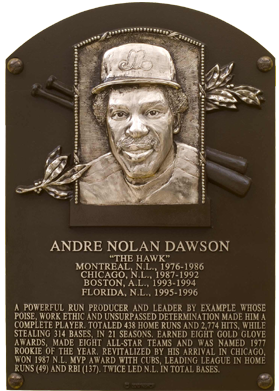
However, the Expos quickly realized they had captured lightning in a bottle. Standing at 6 feet 2 inches with a powerful frame, Dawson reached the majors in 1976 and immediately made his presence felt. By 1977, he won the National League Rookie of the Year award, batting .282 with 19 home runs and flashing the brilliant defense that would soon become his trademark.
The Montreal Years: Excellence on Turf
During his time in Montreal, Dawson developed into one of the premier outfielders in the National League. He could beat opponents in every imaginable way:
- Power: Routinely launching 20 to 30 home runs a season.
- Speed: Stealing over 30 bases in multiple seasons before injuries mounted.
- Defense: Tracking down fly balls in the cavernous, unforgiving expanses of Olympic Stadium.
Tragically, the concrete-hard artificial turf at Olympic Stadium took a devastating toll on Dawson’s knees. By the mid-1980s, he required intense pre-game taping regimens and sheer willpower just to step onto the field. His joints were aching, his legs were battered, but his competitive fire never flickered.
The Unprecedented 1987 Blank-Check MVP Season
Perhaps the most fascinating chapter of Dawson’s career occurred during the winter of 1986–1987. Facing declining mobility due to his knee injuries and a collapsing free-agent market—partially fueled by the infamous MLB collusion scandals—Dawson found himself without a lucrative contract. Desperate to play for a team that played on natural grass to save his career, Dawson and his agent took a bold gamble.
They went to the Chicago Cubs with a blank contract. Dawson essentially told the Cubs front office to write in whatever salary they felt was fair. The Cubs signed him for a modest base salary of $500,000, with incentives attached.

What followed was one of the most magical individual seasons in baseball history. Playing under the friendly confines of Wrigley Field's natural grass, Dawson put together an unforgettable campaign:
- Smashed a career-high 49 home runs.
- Drove in 137 runs, leading the National League in both categories.
- Carried the last-place Cubs with his heroic daily performances.
In a twist that highlights just how incredible his season was, Dawson won the National League MVP award despite the Cubs finishing with a dismal 76-85 record. It remains a rare testament to individual brilliance completely transcending team success.
The Hall of Fame Battle and Legacy
When Dawson’s career wrapped up in 1996 after stints with the Boston Red Sox and a final return to Florida, his statistics were staggering: 438 home runs, 314 stolen bases, 2,774 hits, and eight Gold Glove awards. He is one of only eight players in MLB history to record at least 400 home runs and 300 stolen bases.
Yet, his path to Cooperstown was surprisingly bumpy. It took voters until 2010—his ninth year on the ballot—to finally elect him. Many baseball historians argue that modern metrics and appreciation for two-way, gritty outfielders arrived too late for a player whose quiet, unassuming demeanor kept him out of major media headlines.
Why We Aren't Talking About Him Enough Today
In the era of hyper-analytics, exit velocities, and social media highlight reels, players like Andre Dawson sometimes slip through the cracks. He didn't play in a massive media market like New York or Los Angeles for the prime of his career, and he wasn't known for controversy or self-promotion. He simply showed up, wrapped his knees in ice and tape, played stellar defense, and hit towering home runs.
Furthermore, because his career was defined by playing through intense physical agony, younger generations might overlook the sheer athleticism he possessed before his knees deteriorated in Montreal. He wasn't just a slugger; early in his career, he was a blazing-fast center fielder who covered an astonishing amount of grass.
Conclusion
The story of Andre "Hawk" Dawson is a masterclass in resilience, humility, and raw athletic brilliance. From his rookie days in Canada to handing the Chicago Cubs a blank contract, and finally earning his rightful place in the Hall of Fame, Dawson’s journey embodies the soul of baseball. By keeping his memory alive and celebrating his legendary achievements, we honor a rare breed of competitor who gave every ounce of his body to the game he loved.