The MCS-90 Insurance Rule Explained Simply
Understanding the MCS-90 Endorsement

If you operate a commercial trucking business in the United States, navigating federal insurance regulations is a core part of staying compliant. Among the most critical yet misunderstood documents in the industry is the MCS-90 form. Understanding the MCS-90 insurance rule explained simply can save motor carriers from costly misunderstandings, legal liabilities, and regulatory penalties.
Many truckers and small fleet owners mistakenly believe the MCS-90 is a standard liability insurance policy. In reality, it is something very different: a financial guarantee or surety. Created by the Federal Motor Carrier Safety Administration (FMCSA), this endorsement ensures that the public is protected if a commercial vehicle causes bodily injury or property damage, even if the underlying insurance policy has coverage gaps.
What Is the MCS-90 Form and Why Does It Exist?
The MCS-90 is officially titled the "Endorsement for Motor Carrier Policies of Insurance for Public Liability Under Sections 29 and 30 of the Motor Carrier Act of 1980." Congress passed the Motor Carrier Act to deregulate the trucking industry while simultaneously ensuring that fly-by-night operators could not avoid financial responsibility for highway accidents.
Before a motor carrier can legally cross state lines (interstate commerce) and obtain operating authority from the FMCSA, they must prove they can cover catastrophic accidents. The MCS-90 acts as a safety net. It guarantees that injured members of the public will receive compensation up to the federally mandated limits, regardless of whether the trucking company's specific insurance policy covers a particular truck, driver, or route at the exact time of the crash.
How the MCS-90 Works: Surety vs. Traditional Insurance
To truly grasp this regulation, you must understand the distinction between a standard commercial auto insurance policy and the MCS-90 endorsement.
- Standard Insurance Policy: This is a contract between you (the insured) and the insurance company. If you get into an accident, the insurer pays the injured third party on your behalf, provided the incident fits within the policy terms, deductibles, and exclusions.
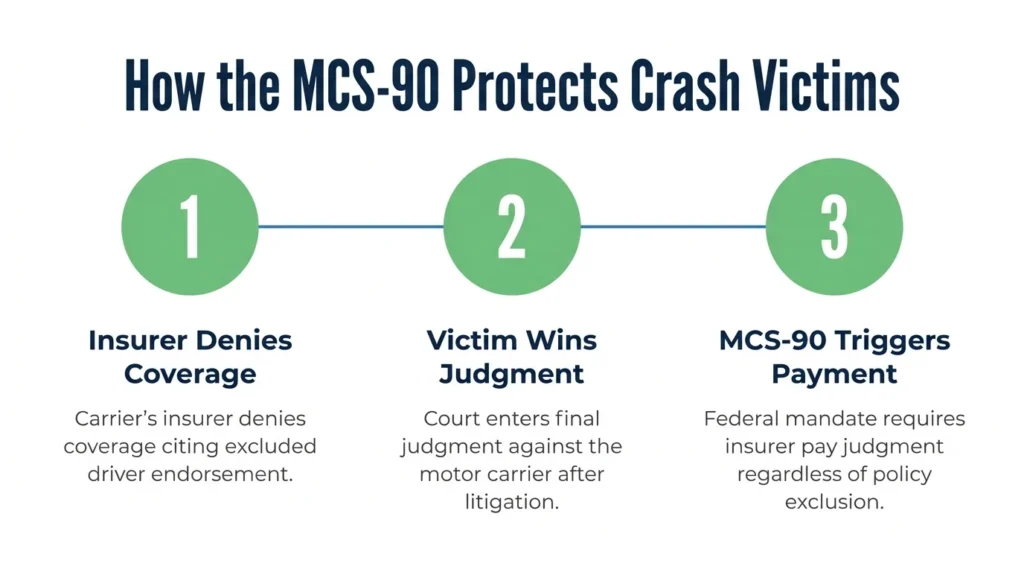
- The MCS-90 Endorsement: This acts more like a surety bond. If your insurance company denies a claim because of a technicality—such as an unauthorized driver, an unlisted vehicle, or a policy cancellation notice that wasn't processed in time—the MCS-90 forces the insurer to pay the injured public anyway.
However, there is a major catch for motor carriers. If an insurer is forced to pay a claim solely because of the MCS-90 endorsement (even though the underlying policy excluded it), the insurance company has the legal right to sue you for reimbursement. In practice, the MCS-90 protects the public first, but it ultimately leaves the financial burden on the motor carrier if the accident is excluded from their base policy.
Who Needs an MCS-90 Endorsement?
Not every commercial vehicle on the road requires this federal filing. The mandate generally applies to for-hire and private motor carriers operating commercial motor vehicles (CMVs) in interstate commerce. Specifically, you need it if you transport:
- Non-hazardous property in vehicles with a Gross Vehicle Weight Rating (GVWR) of 10,001 pounds or more.
- Hazardous materials, substances, or wastes in quantities that require placarding, regardless of vehicle weight.
If you operate purely intrastate (within a single state and never crossing state lines), federal FMCSA rules do not apply, though your home state likely has its own distinct financial responsibility requirements.
Required Coverage Limits Under the Rule

The federal government sets minimum financial responsibility limits based on the type of cargo you haul. These limits dictate the minimum coverage your insurance policy and MCS-90 form must reflect:
- $750,000: For most for-hire and private carriers transporting general freight in vehicles over 10,000 pounds GVWR.
- $1,000,000: For carriers hauling oil, certain hazardous waste, and large quantities of oil-related products.
- $5,000,000: For carriers transporting extremely hazardous substances, explosives, radioactive materials, or interstate passenger transport in large buses.
Meeting these limits is a mandatory prerequisite for activating your FMCSA operating authority (MC number).
Common Misconceptions About the MCS-90
Because legal terminology in the insurance industry can be dense, several dangerous myths persist among truck drivers and business owners.
Myth 1: "The MCS-90 is free insurance coverage."
As detailed earlier, the MCS-90 is not free money. If your insurance company pays out a settlement because of the endorsement, they will aggressively seek to recover every penny from your business assets.
Myth 2: "Once filed, I never have to worry about it again."
The endorsement stays attached to your policy until it is officially canceled or replaced. If your insurance lapses or you switch providers, your broker must file a new endorsement (often accompanied by form BMC-91 or BMC-91X) to avoid a revocation of your operating authority.
Myth 3: "It covers my damaged truck."
The MCS-90 exclusively covers public liability—meaning injuries and property damage sustained by *other* people in an accident. It does not provide physical damage coverage for your own tractor-trailer.
Summary for Motor Carriers
The MCS-90 rule exists to ensure highway safety and public accountability. For motor carriers, treating compliance as an afterthought is a dangerous gamble. Always work with an experienced commercial trucking insurance broker to ensure your base policy, operating routes, and drivers match your federal filings, minimizing the risk of out-of-pocket lawsuits down the road.


.png?width=1200&name=Schedule of Limits-Public Liability_MCS-90(2).png)