The Radio Invention Timeline: History of Wireless Tech
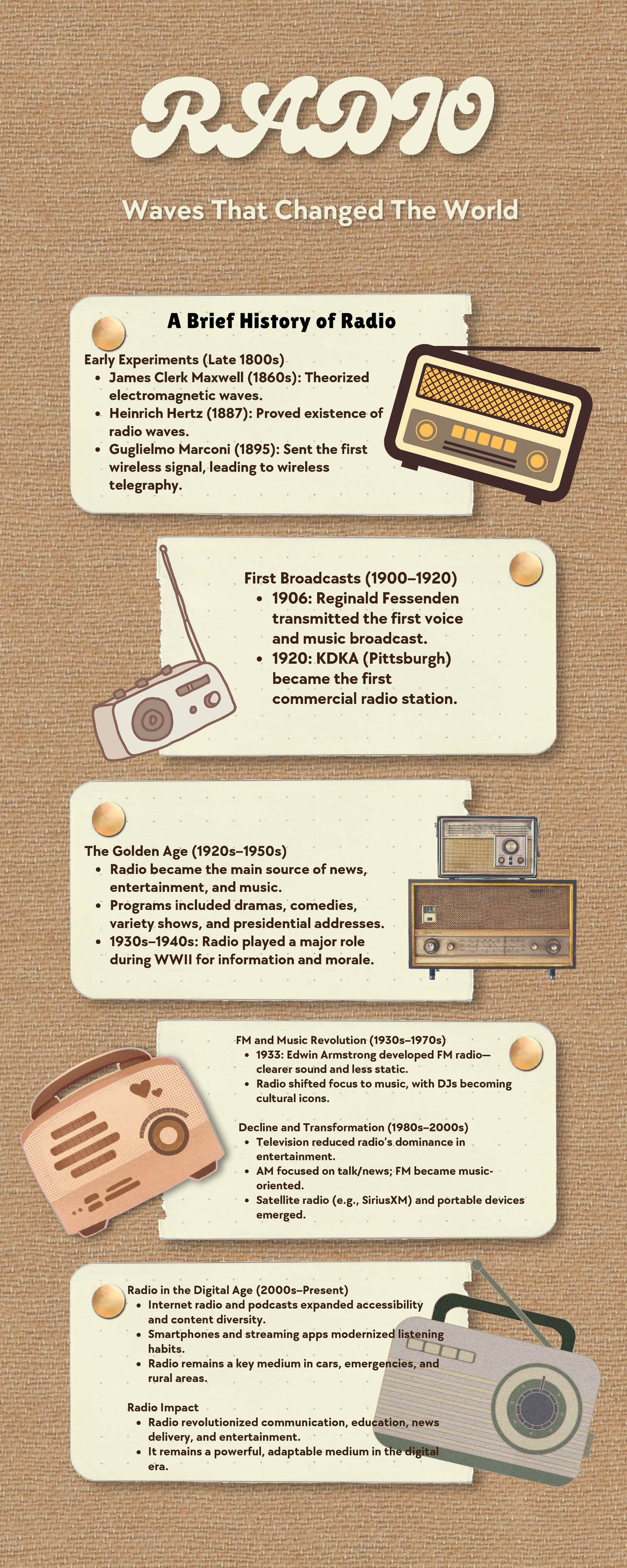
The evolution of wireless communication is one of humanity's most fascinating technological journeys. Tracing the radio invention timeline reveals that radio was not created by a single inventor overnight. Instead, it was built upon decades of scientific experiments, fierce patent rivalries, and brilliant theoretical breakthroughs by physicists across the globe.

Laying the Theoretical Foundation (1860s–1880s)
Before anyone could transmit an audio signal through the air, scientists had to prove that invisible electromagnetic waves actually existed.
James Clerk Maxwell's Equations (1864)
Scottish physicist James Clerk Maxwell published a foundational theory of electromagnetic radiation. He mathematically demonstrated that electrical and magnetic fields travel through space as waves at the speed of light. This mathematical framework became the bedrock for all future radio technology.
Heinrich Hertz Proves the Waves (1887)
German physicist Heinrich Hertz built an apparatus to generate and detect electromagnetic waves in a laboratory setting. Using an induction coil and a spark gap, Hertz successfully proved Maxwell's theories correct. For his efforts, the unit of frequency is measured in Hertz (Hz) today, marking a massive milestone in early wireless experimentation.
From Telegraph to Wireless: The Pioneers Emerge (1890s)
Once the existence of radio waves was established, inventors quickly raced to find practical applications, shifting the focus from mere physics to communication.
Edouard Branly and the Coherer (1890)
French physicist Edouard Branly developed the coherer, a device that could detect radio waves. The coherer changed its electrical resistance when exposed to electromagnetic signals, making it possible to build much more sensitive receivers.
Oliver Lodge Improves Reception (1894)
British physicist Sir Oliver Lodge refined Branly's coherer and demonstrated the transmission of telegraphic signals over short distances using Morse code. His public lectures on Hertzian waves heavily influenced other inventors of the era.
Guglielmo Marconi and Commercialization (1895–1897)

Italian inventor Guglielmo Marconi combined existing components—such as the Ruhmkorff coil, spark-gap transmitter, and Branly coherer—into a functional, long-range wireless telegraph system. By 1897, Marconi had formed the Wireless Telegraph and Signal Company, securing patents and aggressively commercializing the technology for maritime and military use.
The Battle for Patents and Voice Transmission (1900–1920s)
As Marconi dominated early wireless telegraphy, other inventors focused on transmitting the human voice rather than simple dots and dashes.
- 1901: Marconi successfully transmits the first transatlantic radio signal from Cornwall, England, to Newfoundland, Canada.
- 1906: Reginald Fessenden uses an Alexanderson alternator to transmit the first-ever audio broadcast, featuring music and a human voice, to ships at sea on Christmas Eve.
- 1906: Lee de Forest invents the Audion tube (triode), a revolutionary vacuum tube that could amplify weak electrical signals, paving the way for reliable radio receivers and audio amplification.
- 1914–1918: World War I accelerates radio development. Governments take control of radio patents to improve battlefield communications, leading to rapid hardware miniaturization and reliability.
The Golden Age of Commercial Broadcasting (1920s–1950s)
The transition from point-to-point communication to mass broadcasting revolutionized entertainment, politics, and culture.
The First Commercial Stations (1920)
Station KDKA in Pittsburgh, Pennsylvania, went on the air in November 1920, broadcasting the U.S. presidential election results. This is widely considered the birth of scheduled commercial radio broadcasting.
The Rise of Networks and Regulation (1926–1934)
The National Broadcasting Company (NBC) formed the first major commercial radio network in 1926, soon followed by CBS. To manage crowded airwaves, the U.S. government established the Federal Radio Commission in 1927, which later became the Federal Communications Commission (FCC) in 1934.
FM Radio Breakthrough (1933)
Edwin Armstrong patented Frequency Modulation (FM) radio, which drastically reduced static and interference compared to Amplitude Modulation (AM). Despite bitter legal battles with corporate entities like RCA, FM eventually became the standard for high-fidelity music broadcasting.
The Transistor Revolution and Modern Era (1950s–Present)
The invention of the transistor at Bell Labs in 1947 transformed radio architecture. Bulky vacuum tubes were replaced by tiny, efficient semiconductor devices.
- 1954: Texas Instruments and Regency introduce the first commercial pocket transistor radio, making portable music and news accessible everywhere.
- 1960s–1970s: The introduction of satellite radio concepts and stereo FM broadcasting improves audio quality and coverage range.
- 1990s–Present: Analog radio transitions toward digital formats (DAB, HD Radio) and internet-connected streaming platforms, ensuring that the legacy of early wireless pioneers endures in the modern digital age.