Third Grade Math Worksheets: Key Skills Guide
Third grade represents a monumental pivot in elementary education. Students transition from the foundational additive thinking of early childhood into multiplicative reasoning, abstract representations, and multi-step logic. Finding and utilizing high-quality third grade math worksheets can bridge the gap between classroom instruction and independent mastery, giving eight- and nine-year-olds the focused practice they need to build lasting confidence.

However, not all worksheets are created equal. Effective practice requires more than endless rows of repetitive equations. To genuinely support learning, printables must balance conceptual models, procedural fluency, and real-world problem-solving. Here is a comprehensive look at the core mathematical standards of third grade and how targeted worksheets can reinforce them.
Core Domains for Third Grade Math Worksheets
Third-grade curricula align heavily around several critical pillars outlined by educational standards. When curating or assigning practice sheets, ensure they target these essential domains.
1. Multiplication and Division Foundations
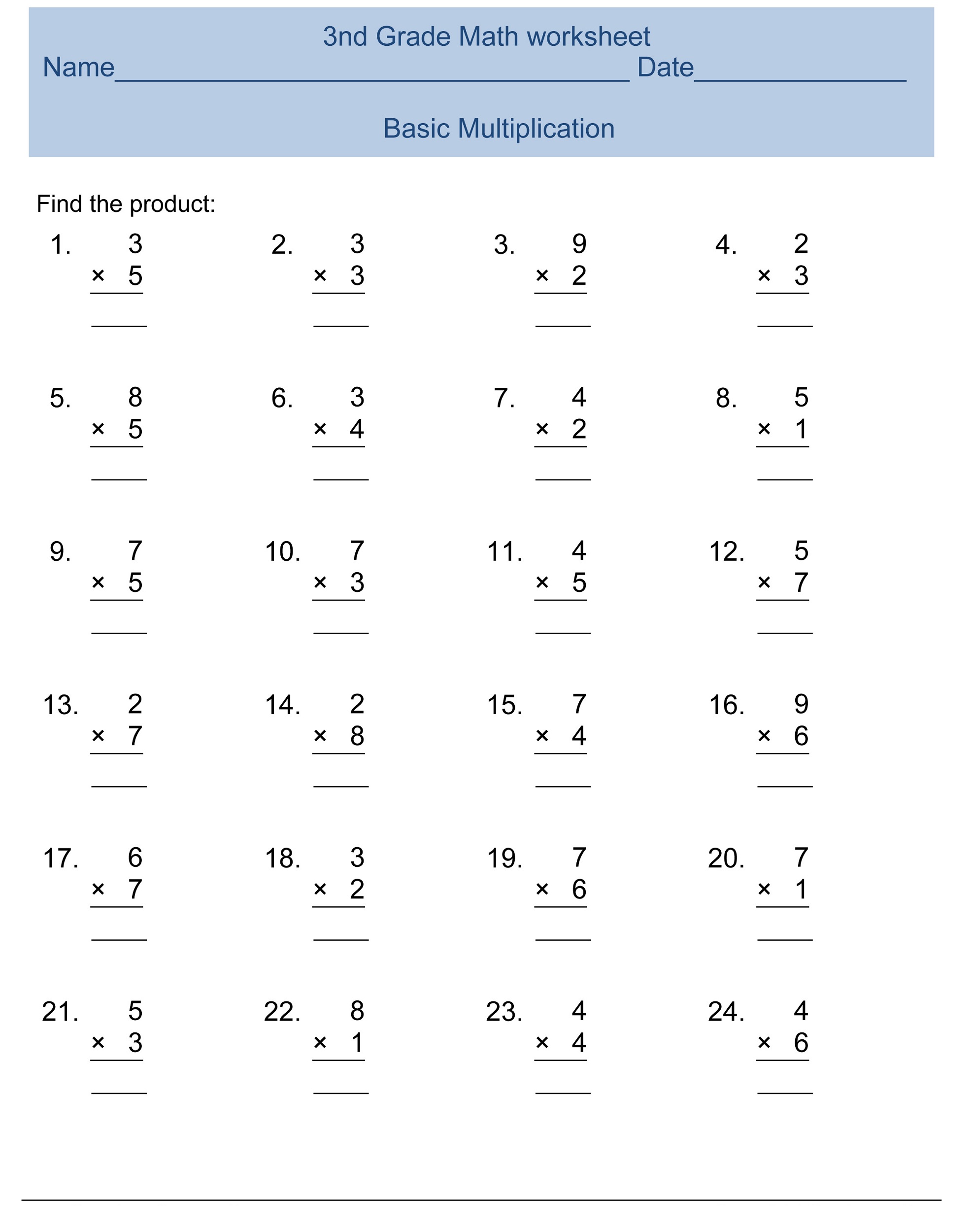
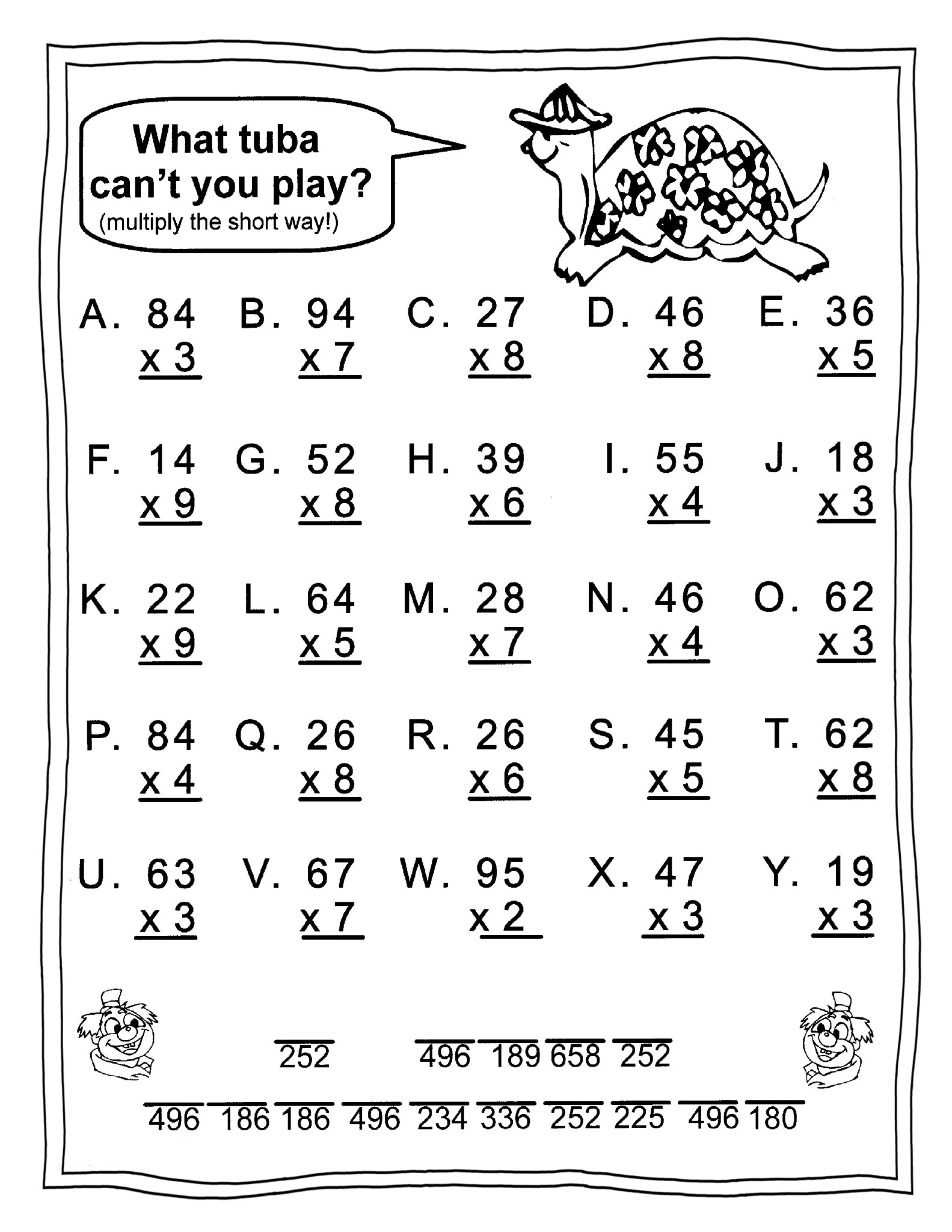
Third grade is the year students are expected to achieve fluency with single-digit multiplication and division facts up to $10 \times 10$ (and often up to $12 \times 12$). Effective worksheets should not start with rote memorization drills immediately. Instead, look for resources that emphasize:
- Array and Area Models: Grids showing rows and columns (e.g., 4 rows of 6 dots) that visually illustrate the meaning of multiplication.
- Equal Groups and Repeated Addition: Demonstrating that $3 \times 4$ is equivalent to $4 + 4 + 4$.
- Fact Families: Pairing inverse relationships, showing how knowing $6 \times 7 = 42$ directly solves $42 \div 6 = 7$.
- Properties of Operations: Breaking down tricky facts using the Distributive Property, such as rewriting $7 \times 8$ as $(5 \times 8) + (2 \times 8) = 40 + 16 = 56$.
2. Introduction to Fractions
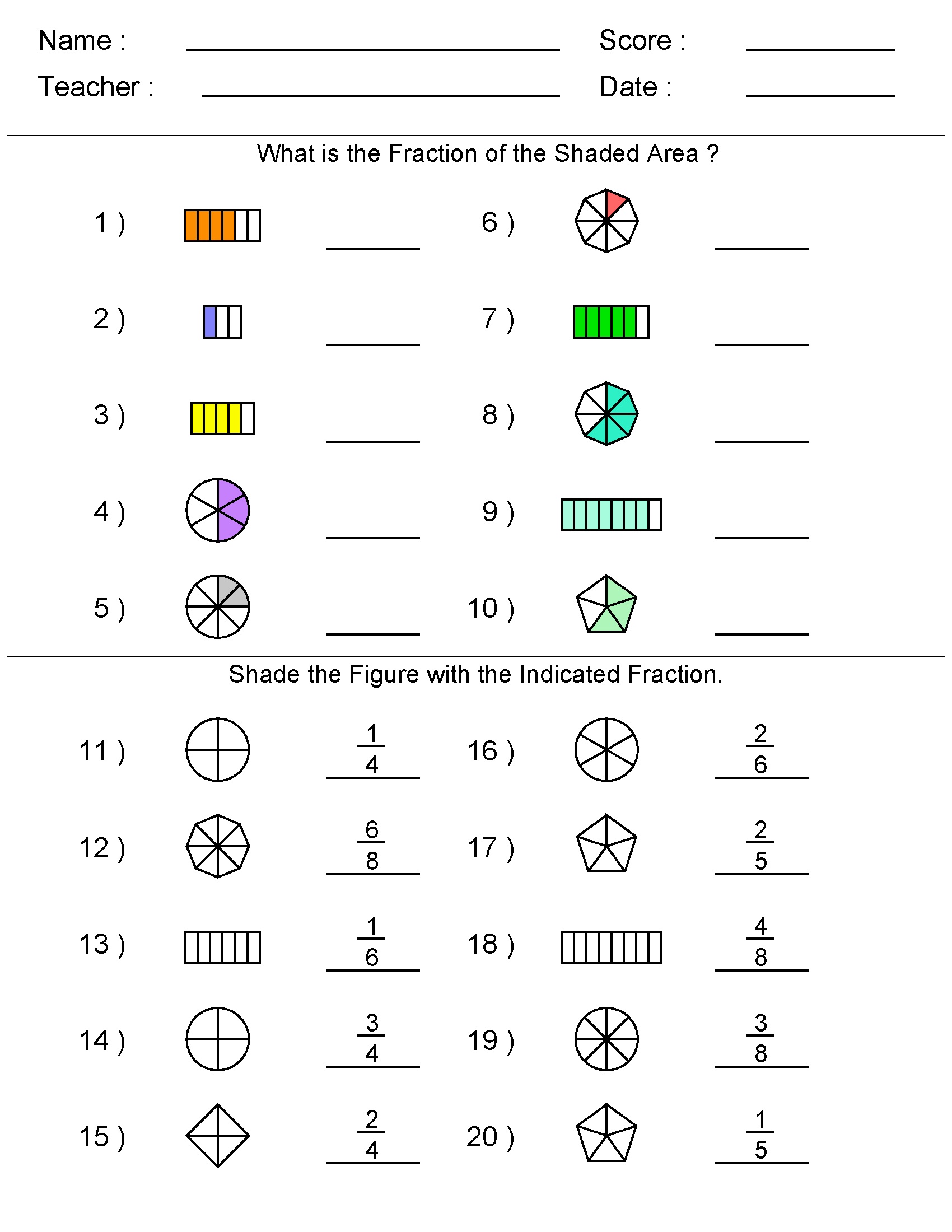
Fractions are notoriously challenging for third graders because numbers no longer behave strictly as whole counting units. High-yield fraction worksheets introduce these concepts visually:
- Unit Fractions: Identifying parts of a whole where the numerator is 1 (such as $\frac{1}{2}$, $\frac{1}{3}$, $\frac{1}{4}$, $\frac{1}{6}$, and $\frac{1}{8}$).
- Number Line Models: Placing fractions on a number line between 0 and 1, helping students see fractions as distinct numerical quantities rather than two disconnected numbers stacked together.
- Equivalent Fractions: Visual comparisons using fraction strips or shaded bars to show that $\frac{2}{4}$ covers the exact same area as $\frac{1}{2}$.
3. Multi-Digit Addition and Subtraction
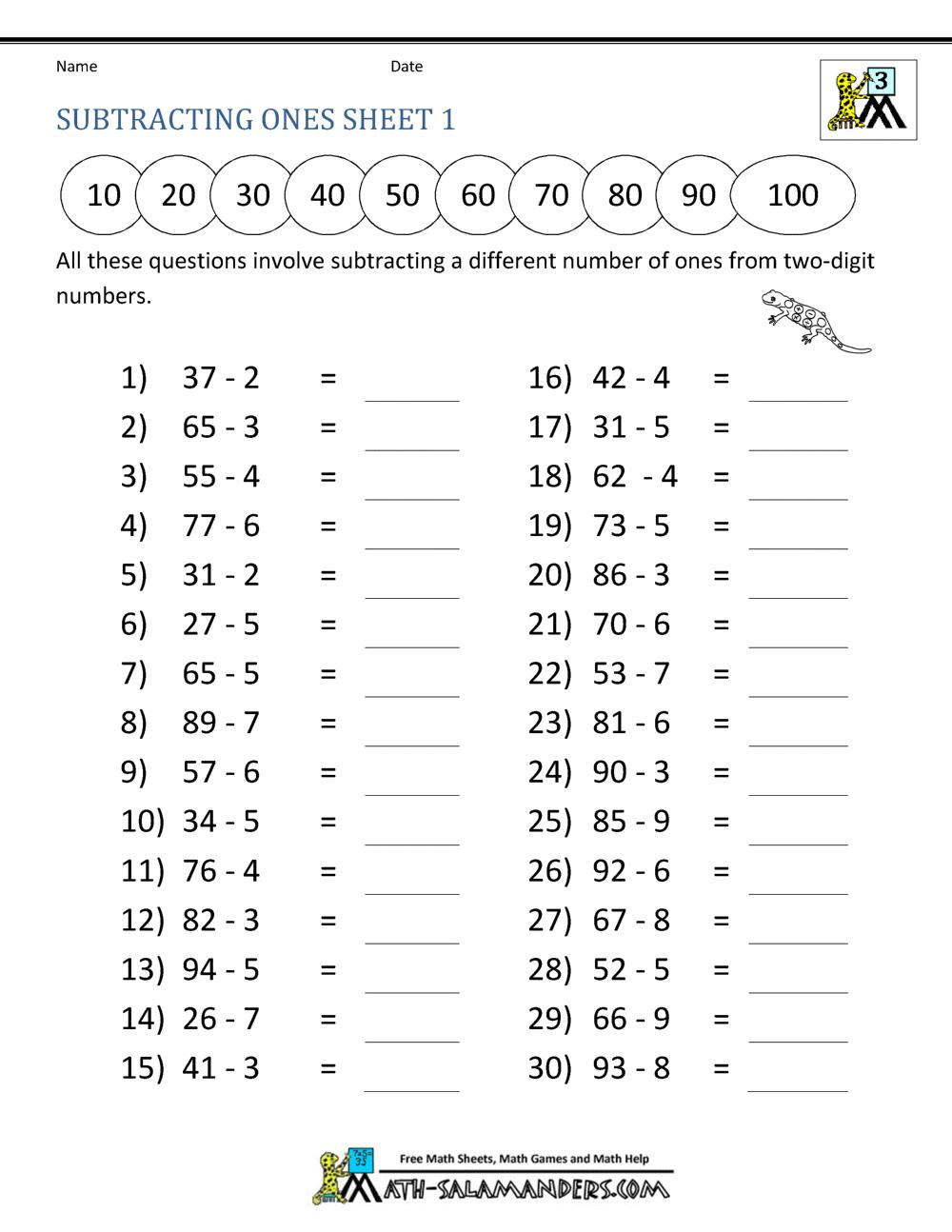
While addition and subtraction are introduced in earlier grades, third grade solidifies fluently adding and subtracting within 1,000 using standard algorithms and place value strategies. Quality worksheets should incorporate regrouping across zeros (e.g., $500 - 247$), which is a common stumbling block for students at this age.
Video: 3 digit addition worksheet #trending #education #maths #addition #worksheet #3digit

4. Measurement, Area, and Perimeter
Geometry and measurement become much more quantitative in grade three. Practice materials should clearly differentiate between linear distance and two-dimensional space:
- Perimeter: Finding the distance around a 2D shape by summing side lengths, including solving for an unknown side.
- Area: Tiling surfaces with square units to illustrate that area equals length times width.
- Telling Time: Reading analog clocks to the nearest minute and solving elapsed time word problems.
- Liquid Volume and Mass: Estimating and calculating grams, kilograms, and liters.
5. Multi-Step Word Problems
Third graders must learn to read a scenario, extract the mathematical question, determine which operations to apply, and carry out the steps sequentially. Look for worksheets featuring "tape diagrams" or bar models that prompt students to represent the problem visually before writing out equations.
Evaluating Quality: What Makes an Effective Worksheet?
Flooding a child with cluttered printables often causes anxiety rather than building skill. When selecting practice materials, evaluate them against these criteria:
- Generous White Space: Children in third grade still have emerging fine-motor handwriting skills. Worksheets must provide ample room to draw models, show regrouping, and write scratch calculations.
- Scaffolded Progression: A well-designed page begins with accessible, guided problems (often with visual supports) before advancing toward independent calculation and non-routine application.
- Contextual Relevance: Word problems should reflect everyday situations kids understand, such as sharing snacks, counting trading cards, or tracking minutes on a playground.
- Answer Keys with Work Shown: For parents and tutors, having step-by-step solutions simplifies rapid feedback and makes diagnosing errors straightforward.
Best Practices for Implementing Practice at Home or School
Even the best worksheets will fail if used purely as busywork. Integrate these strategies to make worksheet sessions engaging and productive:
- Cap Sessions at 10 to 15 Minutes: Focused, high-intensity practice yields far better retention than a grueling 45-minute slog. Assigning 5 to 10 thoughtfully designed problems per evening is plenty for deliberate practice.
- Pair with Physical Manipulatives: If a student struggles with an abstract concept on paper, immediately step back to hands-on tools. Use base-ten blocks for multi-digit subtraction, colored counters for division arrays, or paper strips folded into equal sections for fractions.
- Conduct Regular Error Audits: Treat mistakes as diagnostic tools. Did the student misread the operation sign? Did they forget to regroup? Or is there a fundamental misunderstanding of the concept? Address the root pattern rather than simply assigning more pages.
- Emphasize the "Why": Regularly ask the child: "How did you know to divide here?" or "Can you prove your answer using a drawing?" Verbalizing mathematical reasoning develops metacognition and solidifies memory far faster than silent repetition.
Fostering Long-Term Confidence
Third grade sets the trajectory for upper-elementary mathematics. By selecting intentional, well-structured practice sheets that prioritize conceptual visual models alongside procedural fluency, you provide young learners with a stable launchpad for fourth-grade fractions, decimals, and advanced operations.