Top 10 Biggest Rat in the World: Giant Species Ranked
When most people think of a large rat, they picture a Norway rat scurrying through an alleyway or subway tunnel. While an urban rat can certainly give anyone a fright, wild rodents across remote islands and dense rainforests grow significantly larger. From tree-dwelling arboreal giants to gentle fruit-eaters living in volcanic craters, discovering the top 10 biggest rat in the world reveals just how diverse and supersized these rodents can become.

To qualify as a true rat, an animal must belong to the superfamily Muroidea, primarily within the family Muridae (or closely affiliated sister families like Nesomyidae). This excludes non-rat rodents like the capybara, beaver, coypu (nutria), and cane rat. Here is the definitive countdown of the world's largest true rat species, ranked from tenth place up to the undisputed heavyweight champion.
The Top 10 Biggest Rat in the World: Ranked by Size
The following rankings evaluate species primarily by average adult mass and total length (head, body, and tail combined).
10. Brown Rat (Rattus norvegicus)
Average Weight: 300 to 500 grams (0.66 to 1.1 lbs)
Total Length: Up to 40 cm (16 inches)
Also known as the Norway rat or sewer rat, this ubiquitous creature holds the tenth spot. Native to northern China and Mongolia, brown rats have colonized every continent except Antarctica. While urban legends claim city sewer rats can grow to the size of domestic cats, verified wild specimens rarely exceed 500 grams. Even so, their dense muscular build, exceptional intelligence, and adaptability make them the largest common urban rodent species on Earth.
9. Mountain Giant Sunda Rat (Sundamys infraluteus)
Average Weight: 500 to 800 grams (1.1 to 1.8 lbs)
Total Length: 50 to 65 cm (20 to 25.5 inches)
Native to the high-elevation cloud forests of Borneo and Sumatra, the Mountain Giant Sunda rat is a terrestrial omnivore adapted to rugged mountainous terrain. Covered in coarse, dark brown fur, this elusive rodent feeds on fallen fruit, roots, insects, and soft fungi along the damp rainforest floor. Because human settlements rarely overlap with its high-altitude habitat, it faces fewer ecological threats than lowland species.
8. Vangunu Giant Rat (Uromys vika)
Average Weight: 700 grams to 1 kilogram (1.5 to 2.2 lbs)
Total Length: 45 to 50 cm (18 to 20 inches)
Discovered scientifically in 2017 on the island of Vangunu in the Solomon Islands, this rare canopy-dwelling rodent was long known to local indigenous communities. The Vangunu giant rat is famed for its immense jaw strength, which allows it to crack open tough-shelled nuts and coconuts. Critically endangered due to commercial logging, live specimens are exceptionally difficult to document in the wild.
7. Goliath White-Toothed Giant Rat (Hyomys goliath)
Average Weight: 900 grams to 1.1 kilograms (2.0 to 2.4 lbs)
Total Length: Up to 60 cm (24 inches)
Endemic to the central mountain ranges of New Guinea, the Goliath white-toothed rat inhabits primary montane rainforests between 1,400 and 2,800 meters above sea level. It features a robust skull, prominent white incisors, and rough, bristly gray hair. Despite its ferocious name, this giant rat is predominantly herbivorous, relying on bamboo shoots, roots, and fibrous alpine vegetation.
6. Flores Giant Rat (Papagomys armandvillei)
Average Weight: 1.0 to 1.3 kilograms (2.2 to 2.9 lbs)
Total Length: Up to 75 cm (29.5 inches)
Living exclusively on the Indonesian island of Flores, this prehistoric-looking rodent measures more than double the size of an ordinary brown rat. Covered in dense blackish-brown hair with small, rounded ears, the Flores giant rat spends its days sheltering in subterranean burrows and emerges at night to forage for leaves, seeds, and insects. It represents a living example of island gigantism.
Video: Worlds biggest Rat!
5. Emin's Pouched Rat (Cricetomys emini)
Average Weight: 1.0 to 1.4 kilograms (2.2 to 3.1 lbs)
Total Length: 65 to 80 cm (25.5 to 31.5 inches)

Hailing from the dense equatorial rainforest belt of Central and West Africa, Emin's pouched rat is a sleek, arboreal cousin of the Gambian pouched rat. It is distinguished by a crisp white belly, dark mask around the eyes, and a half-white tail tip. Its cheek pouches can expand substantially, allowing it to collect hundreds of seeds and nuts in a single foraging run to cache inside deep tree hollows.
4. Giant Bushy-Tailed Cloud Rat (Crateromys schadenbergi)
Average Weight: 1.3 to 1.5 kilograms (2.9 to 3.3 lbs)
Total Length: 75 to 85 cm (29.5 to 33.5 inches)
Endemic to the Cordillera Central mountain range of Luzon in the Philippines, this stunning animal looks more like a tree-dwelling squirrel or small red panda than a typical rat. Covered in thick, woolly, multi-colored fur and boasting a bushy tail, it lives in high canopy layers. Its specialized diet consists almost entirely of young pine needles, oak buds, and high-altitude bark.
3. Gambian Pouched Rat (Cricetomys gambianus)
Average Weight: 1.4 to 2.0 kilograms (3.1 to 4.4 lbs)
Total Length: Up to 90 cm (35.4 inches)
The Gambian pouched rat is one of the most famous giant rodents on the planet. Found across sub-Saharan Africa, it possesses exceptional olfactory senses. Non-profit humanitarian groups have famously trained these intelligent animals—known as "HeroRATs"—to safely detect unexploded landmines and screen human sputum samples for tuberculosis. In captivity and well-fed conditions, exceptionally large males can weigh over 2.5 kilograms.
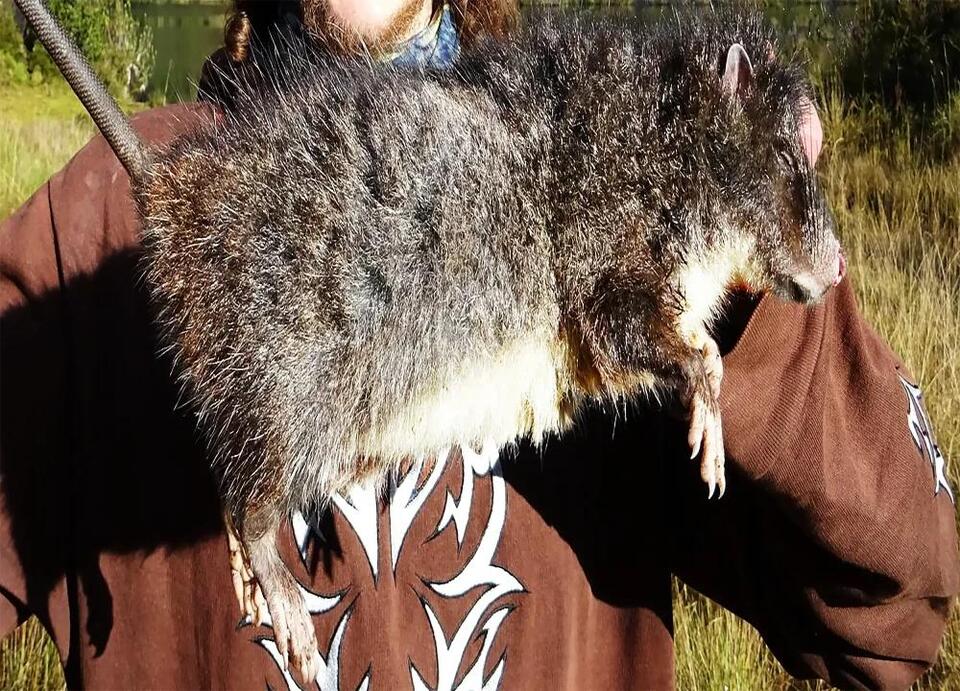
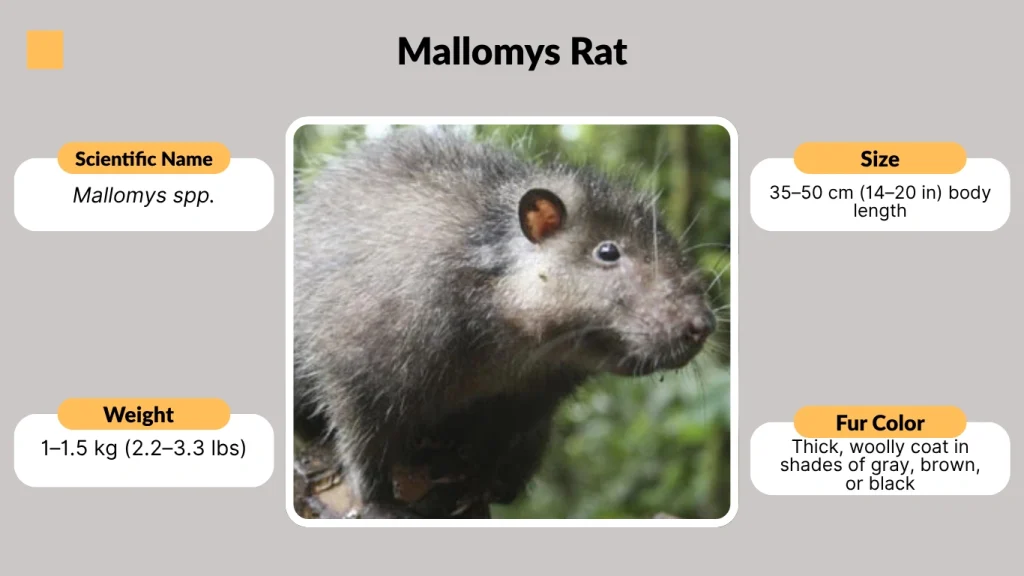
2. Mount Bosavi Woolly Rat (Mallomys sp. nov.)
Average Weight: 1.6 to 2.0 kilograms (3.5 to 4.4 lbs)
Total Length: Up to 82 cm (32 inches)
Discovered in 2009 by a BBC natural history filming crew inside the extinct volcanic crater of Mount Bosavi in Papua New Guinea, this unnamed species of Mallomys is one of the newest large mammals known to science. Possessing a thick silver-brown coat that shields it from damp crater air, the Bosavi woolly rat displayed virtually zero fear of humans upon discovery, highlighting the pristine isolation of its crater home.
1. Northern Luzon Giant Cloud Rat (Phloeomys pallidus)
Average Weight: 1.9 to 2.6 kilograms (4.2 to 5.7 lbs)
Total Length: 75 to 88 cm (29.5 to 34.6 inches)
The undisputed king of the true rats is the Northern Luzon giant cloud rat, native to the northern sections of Luzon island in the Philippines. Tipping the scales at well over 2.5 kilograms—heavier than many domestic cats—this peaceful, tree-dwelling vegetarian has dense, soft fur patterned with white, gray, and black. It spends its life climbing through forest canopies using strong claws and muscular limbs, feeding on fruit, leaves, and tender shoots.
Comparison of the World's Largest Rats
- Heaviest Species: Northern Luzon Giant Cloud Rat (up to 2.6 kg)
- Longest Total Length: Gambian Pouched Rat (up to 90 cm including tail)
- Most Endangered: Vangunu Giant Rat and Giant Bushy-Tailed Cloud Rat
- Most Common / Widespread: Brown Rat (found worldwide)
Why Do Tropical Islands Produce Giant Rats?
You may have noticed that most species among the top 10 biggest rat in the world reside on islands like Luzon, Flores, New Guinea, and Borneo. This distribution is driven by an evolutionary phenomenon known as island gigantism (or the Foster rule).
When small ancestral rodents reached predator-scarce islands, several evolutionary pressures took over:
- Absence of Carnivores: Without large mammalian predators like big cats or canines, rodents do not need to stay tiny to hide in narrow rock cracks or crevices.
- Vacant Ecological Niches: In the absence of medium-sized herbivores (such as small deer, goats, or primates), rodents evolved larger frames and stronger dental anatomy to process fibrous leaves and hard-shelled nuts.
- Thermal Efficiency: Larger body masses retain heat more efficiently in damp, high-altitude cloud forests.
Are Giant Rats Dangerous to Humans?
Despite their imposing dimensions, none of the wild giant rat species are aggressive predators. The largest species, including the cloud rats and woolly rats, are strict herbivores that move at a relaxed pace through forest foliage. African pouched rats are gentle, highly trainable social animals when conditioned from a young age.
The only species on this list with a reputation for biting or spreading zoonotic disease is the brown rat, whose proximity to human waste and urban settlements can cause public health risks. The true giant rats of the world, by contrast, remain fragile keystones of disappearing island ecosystems that need our conservation efforts.