Understanding Feminist Psychology: Core Tenets & Myths
Introduction to Feminist Psychology

Feminist psychology emerged as a critical response to the traditional, male-dominated history of psychological research and clinical practice. For decades, psychological theories were built primarily on male subjects and generalized to the entire population, often pathologizing normal female experiences or ignoring the profound impact of social structures on mental health. Feminist psychology sought to correct these biases by centering women's experiences, examining power dynamics, and integrating social context into psychological healing.
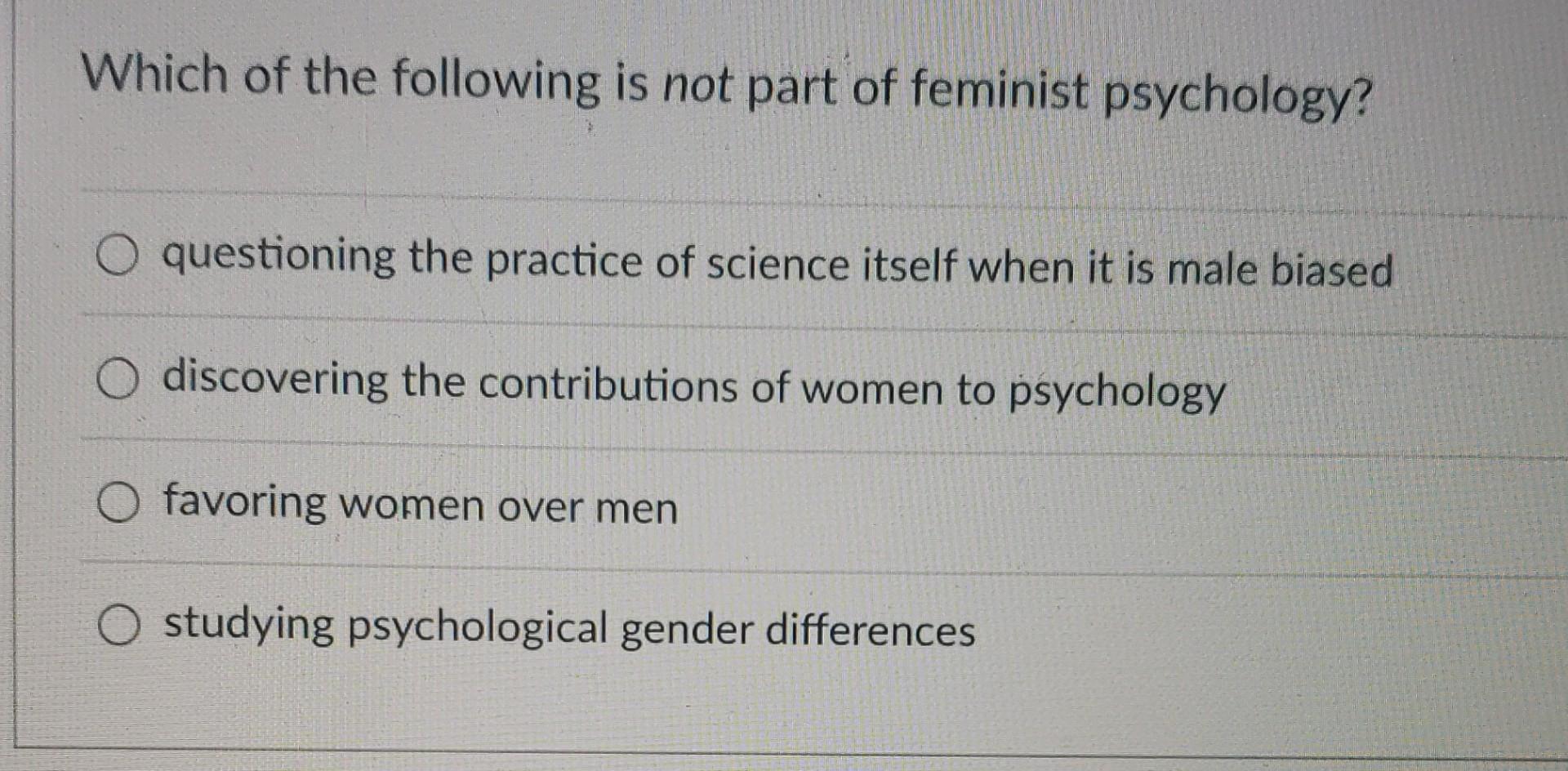
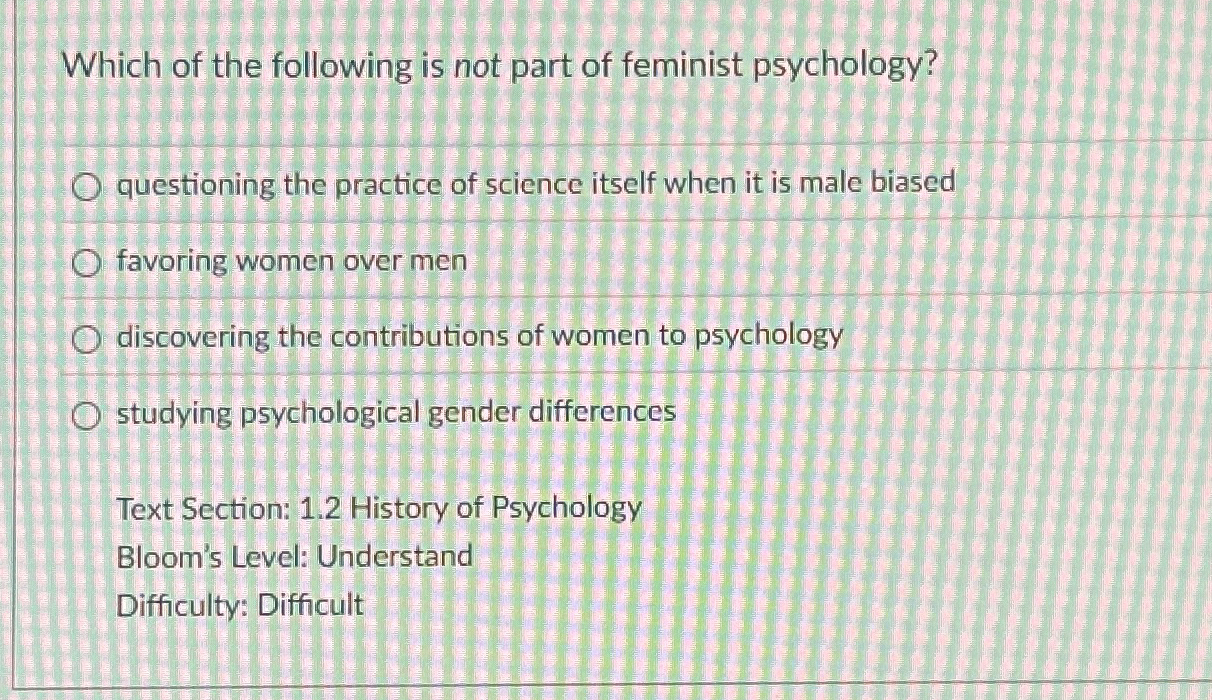
However, when studying this specialized field for exams or personal enrichment, students and professionals often encounter multiple-choice questions asking, “which of the following is not part of feminist psychology?” To answer that question accurately, we must first understand what actually defines the core tenets of this movement, and conversely, what concepts flatly contradict its foundational philosophy.
Core Principles of Feminist Psychology
Before identifying what falls outside the scope of feminist psychology, it is essential to review the pillars that hold the discipline together. Feminist psychology is not a monolith, but it shares several non-negotiable commitments:
- The Personal is Political: Individual struggles with anxiety, depression, or self-esteem are rarely isolated internal failures. Instead, they are frequently tied to broader systemic issues, such as sexism, poverty, discrimination, and domestic inequality.
- Egalitarian Therapeutic Relationships: Unlike traditional psychoanalysis or hierarchical medical models where the therapist holds absolute authority, feminist therapists strive for an egalitarian relationship. The client is viewed as the expert on their own life.
- Valuing Women's Experiences: Traditional psychology often devalued traits associated with femininity (such as emotionality or relational focus) while rewarding male-coded traits (such as independence and stoicism). Feminist psychology validates and revalues these female experiences.
- Intersectionality: Modern feminist psychology recognizes that gender does not exist in a vacuum. Race, class, sexual orientation, ability, and age intersect to shape an individual's unique experience of oppression and privilege.
Concepts That Are NOT Part of Feminist Psychology
When tests or discussions ask which of the following is not part of feminist psychology, the correct answer usually points to traditional, reductionist, or biased psychological frameworks. Here are the primary concepts that directly conflict with feminist psychological theory:
Biological Essentialism and Reductionism
A core stance of feminist psychology is the rejection of biological essentialism—the belief that psychological differences between men and women are entirely hardwired, fixed, and unchangeable. If a multiple-choice option suggests that women are naturally passive, nurturing, or mathematically inferior due to simple biological destiny, that option is not part of feminist psychology. The field emphasizes social constructionism, arguing that gender roles are largely learned through culture, socialization, and systemic reinforcement.
Blaming the Victim
Traditional clinical approaches sometimes pathologized women for reacting normally to abnormal situations—such as blaming a woman for depression caused by an unequal division of domestic labor or systemic workplace harassment. Feminist psychology explicitly rejects victim-blaming. It shifts the burden of pathology away from the individual's internal psyche and examines how external environments and societal oppressions contribute to psychological distress.
Hierarchical Therapist-Client Dynamics
Any theory that positions the therapist as an all-knowing authority figure who dictates reality to a passive, submissive client is fundamentally opposed to feminist therapy. Feminist psychology champions collaboration, empowerment, and mutual respect, discarding the rigid hierarchy found in older psychiatric models.
Ignoring Intersectionality in Favor of Universal Womanhood
Early waves of feminist thought sometimes made the mistake of assuming all women shared the exact same experiences, usually centering the perspectives of white, middle-class, cisgender women. While older, uncritical universalism is sometimes mistakenly conflated with the field, modern feminist psychology explicitly rejects the erasure of race, class, and sexuality. Any framework that treats "women" as a monolith without acknowledging intersecting identities is fundamentally flawed within this discipline.
How Feminist Psychology Differs From Traditional Models
To further solidify what does and does not belong in this framework, it helps to compare traditional approaches with feminist theory side-by-side.
- Traditional Model: Focuses heavily on internal pathology, views the client through a standardized, male-normative lens, and maintains strict clinical detachment.
- Feminist Model: Focuses on contextual factors, validates emotional responses to societal oppression, encourages social action, and embraces transparency and egalitarianism in therapy.
By understanding these distinct boundaries, navigating academic questions about the discipline becomes straightforward. Whenever you see a prompt asking which of the following is not part of feminist psychology, look for answers that promote biological determinism, uphold rigid hierarchies, or blame individuals for systemic inequalities.
Conclusion
Feminist psychology revolutionized the mental health landscape by forcing the scientific community to look beyond the individual and examine the societal structures shaping human behavior. By rejecting biological reductionism, victim-blaming, and rigid therapeutic hierarchies, the field continues to offer empowering, inclusive frameworks for healing. Recognizing these boundaries ensures that both students and practitioners can apply feminist principles accurately and ethically in research and clinical settings.