Understanding the Augmented Column in Modern Databases
Modern database management systems require flexible, high-performance architectures to handle complex data workloads. As applications scale, developers often face a common dilemma: how to query derived or calculated data efficiently without constantly executing expensive runtime operations. This challenge is where the concept of an augmented column becomes invaluable. By adding calculated, enriched, or derived data directly into the database schema, developers can streamline queries and dramatically improve application response times.

What Is an Augmented Column?
An augmented column—frequently referred to in various database management systems as a computed, generated, or virtual column—is a database table column whose values are derived programmatically from other columns within the same row, or through predefined functions and expressions. Instead of requiring the application layer to calculate values on the fly or forcing the database to run heavy aggregations during every SELECT statement, an augmented column stores or computes this data automatically.
Depending on the database engine, these columns generally fall into two categories:
- Virtual (Computed) Columns: The values are not physically stored on disk. Instead, the database calculates them dynamically whenever a query requests them. This saves storage space at the cost of slight CPU overhead during retrieval.
- Stored (Persisted) Columns: The database computes the value once when the row is inserted or updated, and then writes that value to disk. This consumes storage space but allows the database to index the column, resulting in blazing-fast read performance.
Benefits of Using Augmented Columns
Implementing augmented columns in your data models offers several distinct technical and architectural advantages. Whether you are working with PostgreSQL, MySQL, SQL Server, or modern cloud databases, leveraging these fields transforms how data is processed.
1. Improved Query Performance
When you persist an augmented column, you can apply standard database indexes to it. For example, if you frequently query users by their full name, but your table separates first_name and last_name, you can create a stored augmented column called full_name and index it. Queries filtering by full name will execute via an index scan rather than a full table scan.
2. Data Consistency and Integrity
When calculations happen in the application layer, different microservices or client apps might implement the math slightly differently, leading to data drift. By defining the logic directly in the database schema via an augmented column, you ensure that the derived data is calculated uniformly across all reads and writes, protecting business logic integrity.
3. Simplified Application Code
Moving complex string manipulations, mathematical formulas, or date parsing into the database schema simplifies your SQL queries and ORM mappings. Your application code no longer needs to stitch together multiple fields or perform repetitive transformations before presenting data to the user interface.
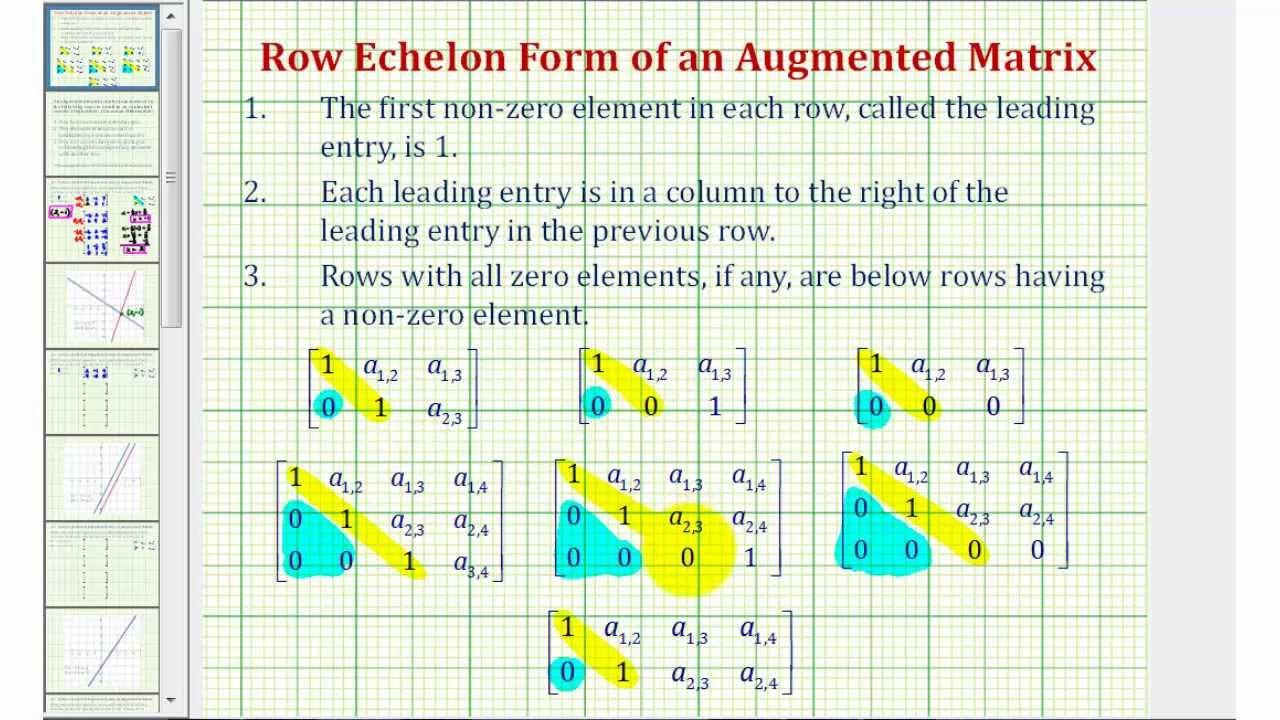
Video: What is an Augmented Matrix? | Linear Algebra, Matrix Theory, Augmented Matrices
Common Use Cases and Examples
Database administrators and software engineers deploy augmented columns across a wide variety of scenarios. Here are three practical examples of how they solve everyday engineering problems:
- Financial Calculations: Multiplying
unit_pricebyquantity_orderedto create a persistedtotal_line_costcolumn, ensuring pricing metrics are always instantly accessible for reporting. - Geospatial Data: Combining latitude and longitude coordinates into a spatial geometry type automatically upon row insertion.
- Text Search and Normalization: Generating a lowercase or trimmed version of a user-submitted email address to enforce case-insensitive uniqueness constraints efficiently.
Best Practices for Implementation
While augmented columns provide powerful optimization capabilities, improper usage can lead to unexpected performance bottlenecks or storage bloat. Keep these guidelines in mind when designing your schema:
Choose Between Virtual and Stored Wisely
If the derived value is accessed infrequently, use a virtual column to save disk space and avoid unnecessary write overhead. If the value is read constantly, heavily filtered, or sorted, use a stored column and apply an appropriate index.
Avoid Non-Deterministic Functions
Most database engines restrict the types of functions you can use inside an augmented column definition. Functions that rely on the current time (like NOW() or CURRENT_TIMESTAMP) or external states are often non-deterministic and can break the determinism required for stored columns or indexing.
Monitor Write Performance Impact
Persisted augmented columns add CPU overhead during INSERT and UPDATE operations because the database must evaluate the expression for every modified row. Always benchmark your write-heavy workflows before deploying complex computed columns to production environments.
Conclusion
The augmented column is a versatile tool in modern database design, bridging the gap between raw normalized data and application-ready insights. By carefully choosing between virtual and persisted implementations, developers can strike the ideal balance between storage efficiency and query speed. Whether you are optimizing a legacy relational database or designing a high-throughput microservices backend, mastering computed fields will elevate the performance and maintainability of your data architecture.


